Thinking about Ovation of the Seas and wondering what you actually need to know before you book? Here is the short version: she is one of Royal Caribbean’s Quantum-Class ships, a mid-size megaship that has been freshly amplified, and her signature program is Alaska. She sails one-way between Vancouver and Seward with a day of scenic glacier cruising, and her secret weapon is glass. Where most cruise ships push you out onto cold, windy open decks to see the scenery, Ovation wraps huge glass-walled indoor spaces around you so you can watch fjords and glaciers slide past in comfort. This guide walks through what makes her different, where she goes, when to sail, what to book before you leave home, and who she suits best.
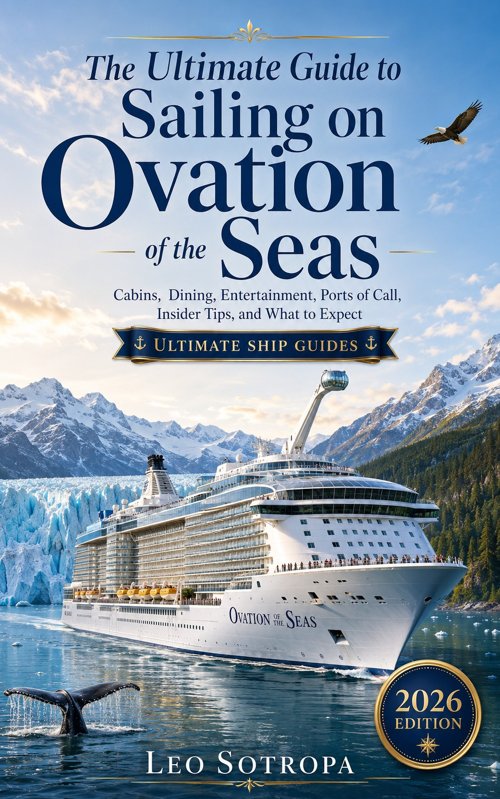
Everything in this article and far more, deck by deck, in The Ultimate Guide to Sailing on Ovation of the Seas.
Get the book →Ovation of the Seas at a glance
Ovation of the Seas is a Quantum-Class ship: around 168,000 gross tons, roughly 16 guest decks, and about 4,180 guests at double occupancy, rising to nearly 4,900 when every berth is full. That makes her a mid-size megaship by today’s standards. She is big enough to carry a genuinely deep list of things to do, yet she never feels like the sprawling city-at-sea that the very largest ships have become. You can learn her layout in a day or two and get around without a map by the second morning.
The detail that matters most for the way she is used is the glass. A large share of her public spaces sit behind floor-to-ceiling windows, and several of the best rooms on board are enclosed and climate-controlled. That design choice is the reason she is such a natural fit for Alaska, where the scenery is spectacular but the weather is often cool, damp, or breezy. On Ovation you can sit warm and dry with a coffee and still have a front-row view of a glacier. Keep in mind she also sails other regions and home ports in other seasons, so always confirm your specific voyage in the Royal Caribbean app rather than assuming every Ovation sailing is an Alaska one.
What makes a Quantum-Class ship different
Quantum-Class ships were built to solve a specific problem: how do you keep guests entertained and comfortable when the destination is cold or the sea is rough? The answer was a cluster of signature venues and thrills that you will not find laid out the same way on other Royal Caribbean classes. Here is what sets Ovation apart.
North Star
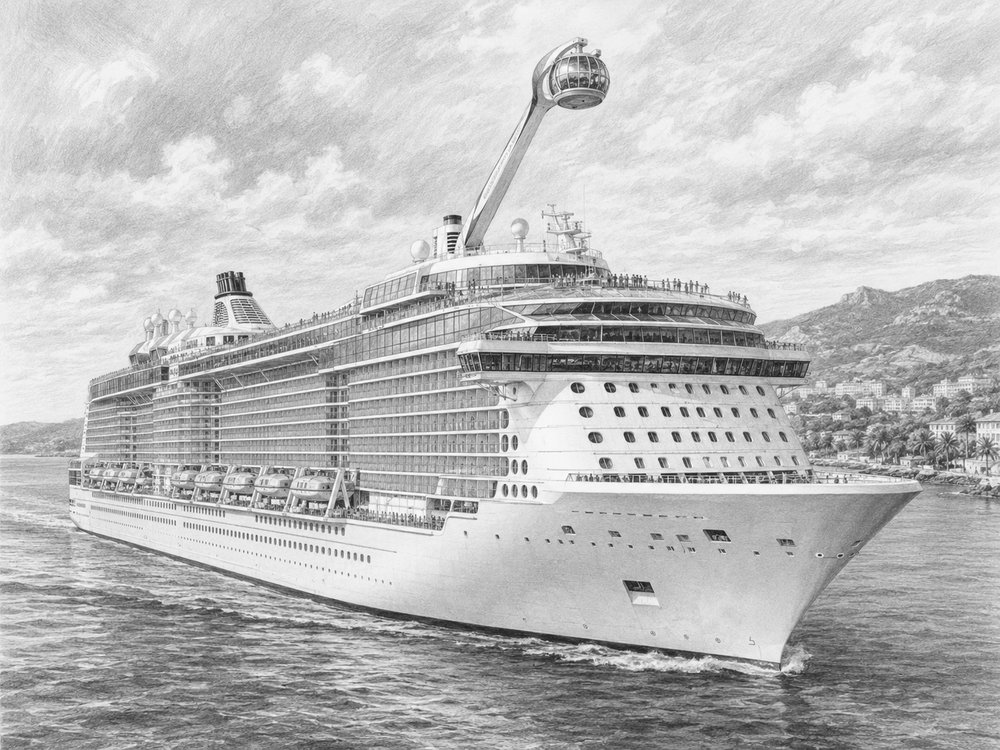
North Star is the headline attraction and the single best reason to sail this ship in Alaska. It is a jewel-shaped glass observation capsule mounted on a long mechanical arm that lifts you about 300 feet above the sea. From up there you get a slow, sweeping 360-degree view over the ship, the coastline, the fjords, and the glaciers. On a glacier-cruising day it is genuinely extraordinary. Because there are only so many rides available and demand is high on scenic days, reserve North Star early rather than hoping to walk up.
RipCord by iFly and FlowRider
RipCord by iFly is a skydiving simulator built around a vertical wind tunnel, so you get the sensation of freefall without leaving the ship. FlowRider is a surf simulator where you can bodyboard or stand-up surf against a wall of fast-moving water. Both are the kind of activity you would never expect to try on an Alaska cruise, which is exactly why they are fun to have on a cool-weather sailing when the outdoor pool is not calling your name.
SeaPlex
SeaPlex is billed as the largest indoor active space at sea, and on an Alaska sailing it earns that reputation. Across the day it rotates through bumper cars, roller skating, basketball, and an arcade. When the weather outside turns gray, SeaPlex is where families and restless teens end up, and it keeps everyone moving without anyone needing a coat.
Two70 and the glass-roofed pool
Two70 is a multi-story venue at the back of the ship with a wall of glass that floods the room with daylight and coastline views. By night it transforms: the same space runs immersive Vistarama projection and Roboscreen shows, where robotic arms move video screens around the stage. It is a lounge, a viewing room, and a theater rolled into one. Elsewhere, the indoor pool sits under a glass roof and the adults-only Solarium sits under a glass dome, so you can swim or relax in warmth while Alaska drifts past outside the windows. Round out the list with the Royal Esplanade indoor promenade, the Music Hall, the Bionic Bar with its robot bartenders, a rock wall, the Vitality Spa, and Adventure Ocean for kids, and you have a ship that is built to be enjoyed from the inside out.
If any single one of these venues is the reason you are drawn to the ship, it is worth reading more about how to make the most of it. Our deeper look at the North Star experience in Alaska covers timing and reservations in detail.

Where Ovation sails in Alaska
Ovation’s Alaska sailings are open-jaw, which is the important thing to understand before you book flights. Instead of returning to the port she left from, she runs one-way between Vancouver, Canada and Seward, the port that serves Anchorage, Alaska. You can sail either direction: northbound from Vancouver up to Seward, or southbound from Seward down to Vancouver. Both cover the same water, so pick the direction that fits your travel plans and any land add-ons.
A typical itinerary calls at a mix of the classic Inside Passage and Gulf of Alaska ports. Expect stops that usually include Juneau, Skagway, Sitka, Icy Strait Point at Hoonah, and Ketchikan, plus a day of scenic glacier cruising, watched from deck or from North Star, at a spot such as Hubbard Glacier or Dawes Glacier in Endicott Arm. Ports do vary by sailing, so treat this as the general shape rather than a guarantee and confirm your exact itinerary in the app. For a fuller walk-through of the route and what each stop offers, see our guide to the Vancouver to Seward voyage.
Because the cruise is one-way, your flights need to bookend two different cities. Fly into one end and out of the other. If you sail northbound, you will likely arrive in Vancouver and depart from Anchorage; southbound flips that. Vancouver rewards an extra day or two with Stanley Park, Granville Island, Gastown, and the Capilano Suspension Bridge. On the Alaska end, Seward is the gateway to Kenai Fjords National Park and the overland route toward Anchorage and Denali, which is why so many travelers pair the cruise with a few days on land.
What the ports offer
Each stop has its own character. Juneau is the base for the Mendenhall Glacier, whale watching, and the Mount Roberts Tramway. Skagway is gold-rush country, home to the White Pass and Yukon Route railway and Klondike history. Sitka carries a strong Russian heritage at St. Michael’s Cathedral, along with the totems of Sitka National Historical Park, the Alaska Raptor Center, and abundant wildlife. Icy Strait Point at Hoonah is known for whale watching, one of the world’s longest ziplines, and Tlingit culture. Ketchikan brings historic Creek Street, the totem poles of Totem Bight, the Misty Fjords, and salmon in every form. On the glacier day, the ship simply holds position while the ice calves into the water in front of you.
When to sail Alaska
Alaska’s cruise window runs across the warmer months, and the character of the trip shifts as the season moves. Early in the season the landscape is still fresh and green, waterfalls run hard from snowmelt, and prices tend to sit at their friendliest. The middle stretch brings the longest daylight and the most settled, mildest weather, which is why it is the most popular and usually the most expensive time to go. Later in the season the crowds thin, wildlife activity such as bears feeding ahead of winter can be strong, and fares often ease again, though you trade some of that for cooler, wetter days and shorter light.
There is no single right answer. If you want the warmest, driest odds and the fullest days of light, aim for the peak of summer and book early. If value matters more and you do not mind a jacket, the shoulder edges of the season can be a smart trade. Whatever window you choose, remember that Alaska weather is changeable at any time, so pack layers and a waterproof shell regardless of when you go. Check current sailing dates in the Royal Caribbean app, since the schedule is set fresh each season.
What to book before you sail
This is the part travelers most often get wrong, and it costs them. On an Alaska sailing, both the ship’s marquee thrills and the shore excursions sell out well ahead of time. The whole point of an amplified Quantum ship is the experiences, so plan them like reservations, not impulses.
- North Star: reserve as early as you can, especially for the glacier-cruising day when demand peaks. This is the one thing you do not want to miss.
- RipCord by iFly and FlowRider: these take timed slots, and the popular hours fill quickly.
- Specialty dining: if you know you want Wonderland or Chops Grille on a particular night, book it before you board.
- Shore excursions: whale watching in Juneau or Icy Strait Point, the White Pass railway in Skagway, and the Mendenhall Glacier trips are perennial sellouts. Booking early protects the tour and often the better times.
You can manage most of this in advance through the app, and it is worth doing before your sailing rather than in the boarding-day scramble. For a broader set of planning habits that make the trip smoother, our Ovation of the Seas tips go deeper on timing and booking strategy.
Dining on board
Your fare already covers a solid range of restaurants. The Main Dining Room handles sit-down dinners with a rotating menu, the Windjammer buffet covers casual breakfast, lunch, and dinner, Café Promenade is the spot for grab-and-go snacks and coffee, and Sorrento’s serves pizza. You can eat well on Ovation without ever spending a dollar beyond your fare.
The specialty restaurants cost extra and are worth budgeting for if food is part of the fun. Wonderland leans into imaginative, playful dishes and presentation; Jamie’s Italian brings rustic Italian plates; Chops Grille is the steakhouse; Izumi covers Japanese and sushi; the Chef’s Table is a multi-course wine-paired evening; and Johnny Rockets serves classic American diner fare. You do not need to book all of them. Pick one or two nights that matter to you and let the included venues cover the rest.
Thrills in brief
On the activity side, Ovation packs a lot into a mid-size hull. North Star lifts you above the sea for the views. RipCord by iFly gives you indoor skydiving and FlowRider gives you surfing. SeaPlex rotates through bumper cars, roller skating, basketball, and an arcade. There is a rock wall to climb, the Bionic Bar where robots mix your drink, Two70 for shows, the Music Hall for live music, and the Vitality Spa when you want to slow down. Families get Adventure Ocean for kids. The through-line is that almost all of it works in cold weather, which is not something you can say about most ships. That indoor depth is exactly what makes her hold up on a rainy sea day, and it is a theme we cover further in our look at what to expect on Ovation of the Seas.
Cabins in brief
Ovation’s cabin lineup runs from clever interiors up to two-deck suites. The value pick is the Virtual Balcony interior, an inside cabin fitted with a floor-to-ceiling screen that shows a real-time view of the ocean outside, so you get light and a sense of place without paying for a window. Above that sit Ocean View rooms with a real window, Balcony cabins that all face outward with a private veranda, Studio cabins designed and priced for solo travelers, and suites climbing up to the enormous two-deck Royal Loft Suite.
Here is the key Alaska decision: a real balcony pays off more here than almost anywhere else. Glaciers, waterfalls, and wildlife appear on their own schedule, and having your own outdoor space means you can step out in a robe with a coffee the moment something happens, without racing to a crowded public deck. The best all-round choice for scenery, space, and the steadiest ride is a midship balcony on the mid-decks. If budget is the priority, the Virtual Balcony interior is the smart value play.
A few rooms are worth avoiding, though you should always confirm against the current deck plan. Cabins directly under the pool deck or SeaPlex can be noisy; rooms near Two70 or the Music Hall catch the nightlife; forward high-deck rooms move the most, which matters if anyone in your party is prone to motion; and some lower-deck balconies have their views blocked by lifeboats. For a room-by-room breakdown, see our guide to the best cabins on Ovation of the Seas.
What’s included and budgeting
Your cruise fare covers your cabin, the included restaurants listed above, most onboard entertainment and activities, and access to the pools, the Solarium, and the fitness center. That baseline is generous, and a careful traveler can have a full trip without spending much beyond it.
The extras are where a budget grows. Specialty dining, shore excursions, spa treatments, and the paid North Star and RipCord sessions all cost more. Your SeaPass card acts as your cashless account for everything on board, daily gratuities are added automatically, and Wi-Fi is a paid plan rather than a free perk. Alcoholic drinks and premium coffees are extra unless you buy a package. None of this has a fixed price you can plan around from year to year, so the honest advice is to decide which experiences matter to you, budget for those, and confirm the current costs in the Royal Caribbean app before you sail. If it is your first Royal Caribbean cruise, learning how the SeaPass and app tie the whole system together will save you time on boarding day.
Who Ovation of the Seas is for
Ovation suits travelers who want Alaska’s scenery without giving up comfort or things to do. She is a strong fit for families, thanks to SeaPlex, Adventure Ocean, and the thrills that keep kids and teens busy on a cool-weather sailing. She works for couples who want a balcony, a quiet Solarium, and a good specialty dinner. She fits multi-generational groups who need everyone entertained under one roof, and she rewards anyone who cares more about the destination than about a sun-drenched pool deck, because her indoor spaces are built to keep the coastline in view no matter the weather.
She is less ideal if your dream is a hot, tropical, sea-and-sunshine vacation, since her signature program points north to cooler water. But for the Inside Passage and the Gulf of Alaska, the combination of North Star, glass-walled venues, and a manageable mid-size layout makes her one of the most sensible ships you can pick.
Plan your ports of call
Make the most of every day ashore with our in-depth port guides for the stops on this ship’s itineraries:
Get the complete Ovation of the Seas playbook
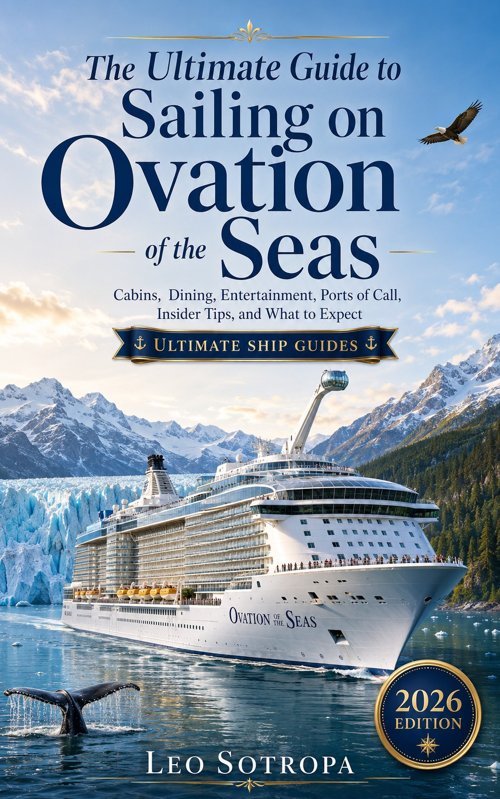
Want every North Star reservation, cabin pick, port plan, and money-saving move in one place? “The Ultimate Guide to Sailing on Ovation of the Seas” walks you through it step by step. It is part of the Ultimate Ship Guides series by Leo Sotropa, with clear action steps in every chapter so you board knowing exactly what to do.
Frequently asked questions
Where does Ovation of the Seas cruise?
Her signature program is Alaska, sailing one-way between Vancouver, Canada and Seward, Alaska, with ports that usually include Juneau, Skagway, Sitka, Icy Strait Point, and Ketchikan plus a day of glacier cruising. She also sails other regions in other seasons, so confirm your specific voyage in the Royal Caribbean app.
What is the North Star on Ovation of the Seas?
North Star is a glass observation capsule on a mechanical arm that lifts you about 300 feet above the sea for a 360-degree view. It is the standout way to take in glaciers and fjords, and because slots are limited you should reserve it early, particularly for the glacier-cruising day.
Why is Ovation of the Seas good for Alaska?
She has an unusually large amount of glass-walled indoor space, including a glass-roofed pool, a glass-domed Solarium, and Two70’s wall of windows. That lets you enjoy the scenery in warmth and comfort even when the weather outside is cold or wet, which is common in Alaska.
Do I need a balcony cabin for an Alaska cruise?
You do not strictly need one, but a real balcony pays off more in Alaska than in most destinations because glaciers and wildlife appear unpredictably and you can step outside instantly. A midship balcony on the mid-decks is the best all-round choice; the Virtual Balcony interior is the best value alternative.
What should I book before I sail?
Reserve North Star first, then any RipCord by iFly or FlowRider slots, specialty dining nights, and your shore excursions. Alaska excursions and the ship’s marquee thrills sell out early, so book them in advance through the Royal Caribbean app rather than waiting until you are on board.
What’s included in the cruise fare?
Your fare covers your cabin, the Main Dining Room, the Windjammer buffet, Café Promenade, Sorrento’s, most entertainment, and the pools and fitness center. Extras include specialty dining, shore excursions, spa treatments, paid thrill sessions, drinks, and Wi-Fi. Daily gratuities are added and your SeaPass card runs your onboard account.
Since the cruise is one-way, how do I plan flights?
Ovation’s Alaska sailings are open-jaw, so you fly into one city and out of the other rather than returning to your start. Sail northbound and you typically begin in Vancouver and end near Anchorage; southbound reverses that. Many travelers add a few land days at either end for Denali or Vancouver.
Ready for the whole ship in one place? It is all in The Ultimate Guide to Sailing on Ovation of the Seas.
Get the book →
Meet Leo: The Heartbeat Behind ‘A Country A Month’
Journeying through the pages of A Country A Month, you might often feel the rhythm of a storyteller’s heartbeat, pulsating through each line, each image, and each adventure shared. That heartbeat belongs to none other than our remarkable website editor, Leo.
With a lens in one hand and a pen in the other, Leo seamlessly marries his passions for photography and writing. His eye captures moments that words can barely describe, yet his eloquence brings those images to life, transcending borders and connecting us all through shared stories. An avid traveler, every country he’s visited has added another chapter to his expansive tale, and through our platform, he generously shares these chapters with us.