New to cruising and new to Alaska? Booking Ovation of the Seas is one of the easiest ways to do both at once, because she was built for exactly this kind of cool-weather, big-scenery voyage. She carries roughly 4,180 guests, keeps much of her best space behind glass, and sails a one-way route between Vancouver and Seward past glaciers, whales and fjords. This first time Alaska cruise guide walks you through what a beginner needs — how to choose your cabin, how the one-way routing changes your flights, when to sail, what to pack, and the reservations to make before you step aboard.
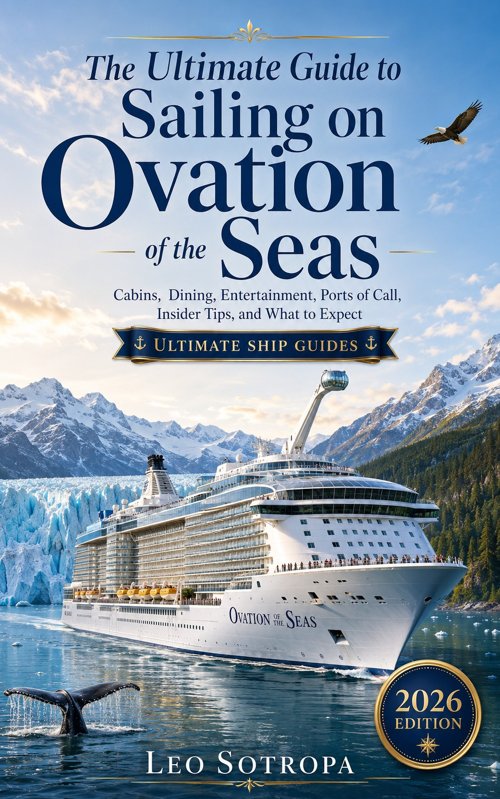
Everything in this article and far more, deck by deck, in The Ultimate Guide to Sailing on Ovation of the Seas.
Get the book →Why Ovation of the Seas suits Alaska so well
Alaska is cold, often wet, and spectacular, and that combination punishes ships built for the Caribbean. Ovation of the Seas is a Quantum-Class megaship of around 168,000 gross tons with roughly 16 guest decks, and her defining feature is glass. She has a glass-roofed indoor pool, a glass-domed adults-only Solarium, and huge glass-walled public rooms that let you watch the coastline slide by while staying warm and dry — which matters far more near an Alaskan glacier than any number of open-air pools would in the tropics.
She also carries attractions that turn a scenery-heavy itinerary into an active one for every age. The North Star lifts you about 300 feet above the sea in a jewel-shaped glass capsule; RipCord by iFly is an indoor skydiving simulator; and SeaPlex, the largest indoor active space at sea, has bumper cars, roller skating and basketball. Two70 shows off the ocean through a glass wall by day and turns into an immersive show space at night. For a first-timer worried a cruise might feel boring on sea days, Ovation removes that worry, and for a fuller tour the Ovation of the Seas cruise guide lays out the layout deck by deck.
Booking your first Alaska cruise and choosing a cabin
The most important cabin decision in Alaska differs from the one you would make in the Caribbean. Down south, an interior room is fine because you spend your days off the ship or by the pool. In Alaska, the scenery is the whole point and it happens constantly — whales at breakfast, a waterfall mid-morning, a glacier all afternoon. That is why a real balcony earns its keep here far more than usual. Stepping outside your own room with a coffee to watch the coast go by, without hunting for a spot on a crowded deck, is worth the upgrade for most people.
Ovation gives you a full ladder of choices. The best value is the Virtual Balcony interior, which has a floor-to-ceiling screen showing a real-time ocean view — a clever way to feel connected to the outside on a tight budget. Above that sit Ocean View rooms, then true Balcony cabins, all facing the sea. Solo travelers have dedicated Studio cabins, and suites climb to the two-deck Royal Loft Suite. For a first Alaska sailing, the sweet spot for most couples is a midship Balcony on the mid-decks: scenery, more space, and the steadiest ride in open water.
Read the deck plan before you confirm. Avoid rooms directly under the pool deck or SeaPlex (noise overhead), rooms near Two70 or the Music Hall (late nightlife), forward high-deck cabins if anyone is prone to motion, and lower-deck balconies where lifeboats can block the view. The best cabins on Ovation of the Seas breakdown goes further into which categories reward the extra spend.
On price, book earlier rather than later. Alaska has a defined season and a finite number of sailings, so the best cabins and lowest relative fares tend to go first. Confirm current numbers in the Royal Caribbean app or with your travel agent rather than relying on a figure you read online.
Understanding the one-way Vancouver–Seward routing
This is the part that trips up nearly every first-timer, so read it twice. Ovation’s Alaska sailings are open-jaw, meaning one-way: she runs between Vancouver, Canada and Seward, the port that serves Anchorage, Alaska, going northbound on some sailings and southbound on others. She does not return to where she started — you board in one city and get off in the other.
The practical consequence is that you cannot book a normal round-trip flight to a single airport. You fly into the city where your cruise begins and home out of the city where it ends. A northbound sailing usually means flying into Vancouver and home out of Anchorage; southbound reverses it. Use a multi-city or “open-jaw” flight search so the two legs land at different airports — booking a standard round trip to one city is a classic and expensive mistake.
Two more details matter. First, Vancouver is in Canada, so international guests need whatever travel documents Canada requires for entry — check your passport and any authorization well ahead. Second, give yourself a buffer: arrive in your embarkation city the day before you sail rather than the morning of, so a delayed flight can never cause you to miss the ship. On the back end, do not book a tight departure flight on disembarkation morning; the transfer from the port takes time. The Vancouver to Seward routing guide covers the logistics.
When to sail Alaska and how the weather works
Alaska’s cruise season is short — roughly late spring through early autumn — and each part has a character worth understanding as you choose. Early in the season tends to be drier and cooler, with more snow on the peaks and long daylight building toward the solstice. High summer brings the warmest temperatures, greenest landscapes and longest days, when the sun barely sets. Later in the season the days shorten, fall color arrives, and salmon runs peak, which can mean excellent wildlife activity.
Set expectations honestly on weather: Southeast Alaska is a temperate rainforest, and rain is normal, not a disaster. You may get brilliant sun for a glacier day and grey drizzle the next morning. Temperatures on the water are cool even in high summer, and colder still with the wind on deck. Do not hope for perfect weather; pack for all of it. Ovation’s glass-walled indoor spaces mean a wet day never traps you.
Packing for a first Alaska cruise
Layers are the whole strategy. Rather than one heavy coat, bring several thinner pieces you can add or shed as the day changes: a base layer, a warm mid-layer such as a fleece or light down, and a waterproof outer shell. Weather can swing from sun to rain within an hour, and layering lets you adapt without returning to your cabin.
- Rain gear: a genuinely waterproof jacket, ideally with a hood. An umbrella is awkward in wind; a hood is better.
- Sturdy, broken-in shoes: waterproof walking shoes or light hiking boots for uneven port terrain, docks and trails. Do not bring brand-new footwear.
- Binoculars: the one item people most regret leaving home. Whales, bears, eagles and mountain goats are often distant, and binoculars transform the experience.
- Warm accessories: a hat, gloves and a scarf or buff for windy deck time and the North Star.
- Layer basics: long trousers, moisture-wicking tops, a fleece and a warm sweater.
Do not overpack formalwear: Ovation has a relaxed dress culture with a couple of dressier evenings, so a single smart outfit, plus a daypack for excursions, rounds out the kit.
Before you go: app, check-in and carry-on
Download the Royal Caribbean app before you leave home and set up your account. The app runs your day aboard — daily schedules, dining, show times, deck plans, your account balance and messaging. Complete online check-in as soon as it opens: it is where you upload your photo, enter your travel documents, add a payment method and select an arrival time for embarkation. Earlier check-in usually means an earlier, less crowded boarding window.
Pack a carry-on that stays with you, because your main bags are delivered to your cabin later in the afternoon. In it put anything you want for the first few hours: medications, travel documents, a change of layers, valuables and chargers. A classic mistake is packing your only warm jacket in a checked bag, then shivering at sailaway.
Embarkation day
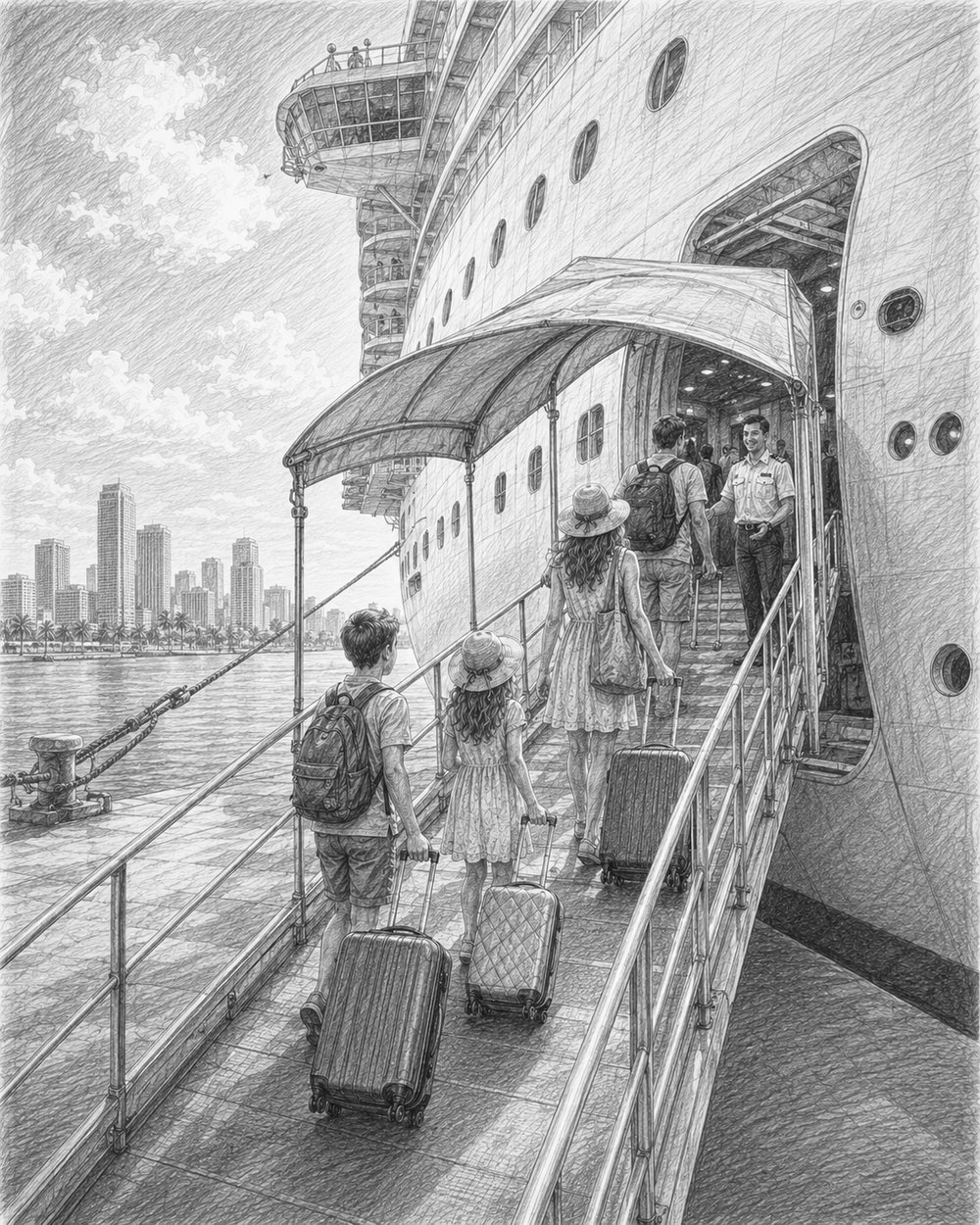
Arrive at the terminal near your assigned check-in time rather than as early as possible; showing up hours ahead of your window often just means waiting in line. Have your documents and app boarding pass ready.
Once aboard, your SeaPass card becomes your identity, room key and cashless payment for everything on the ship. The first afternoon is the best time to knock out the reservations below, before everyone else does.
Your first hours aboard
Your cabin may not be ready the moment you board, so head to the Windjammer buffet or Café Promenade for a first meal and start exploring. Walk the ship end to end to build a mental map of the Royal Esplanade indoor promenade, the Main Dining Room, the glass-roofed pool, the Solarium and the theater. Attend the required safety drill (muster) when instructed — checking in at your assigned station through the app is quick and mandatory before the ship sails.
For more on how the first day flows, the what to expect on Ovation of the Seas overview is a useful primer.
Reserve the North Star, RipCord and excursions early
Ovation’s marquee experiences and Alaska’s shore excursions have limited capacity and sell out, so book early — some before you sail, the rest in your first hours aboard.
The North Star deserves special attention. Riding the glass capsule 300 feet up while gliding past a glacier or fjord is one of the defining moments of an Alaska sailing, and it has very limited daily capacity. Reserve it as early as you can, ideally for a scenic cruising day. RipCord also fills its sessions and is worth booking ahead. The North Star in Alaska guide explains how to time your ride for the best views.
Shore excursions are the bigger financial and logistical decision, and Alaska’s best ones sell out earliest. Whale watching in Juneau or Icy Strait Point, the White Pass & Yukon Route railway in Skagway, dog-sledding, flightseeing and glacier trips are all popular and capacity-limited, so book the ones you care about most as soon as they open. You can book through the cruise line for convenience and the guarantee that the ship waits for its own tours, or independently for lower cost and smaller groups — but build in a time buffer if you go independent, because the ship will not wait for a late private tour.
Dining and shows
Your fare includes plenty of food. The Main Dining Room offers a full sit-down dinner each night, the Windjammer is the sprawling buffet, Café Promenade handles quick bites and coffee, and Sorrento’s covers pizza — you never need to spend extra to eat well. Specialty restaurants cost more and are worth choosing selectively: Wonderland serves imaginative dishes, Jamie’s Italian is rustic Italian, Chops Grille is the steakhouse, Izumi is Japanese, Johnny Rockets does diner classics, and Chef’s Table is an intimate multi-course event. If you want one special dinner, book it early for a scenic evening.
Entertainment leans on Ovation’s technology. Two70 hosts immersive shows using its Vistarama screens and moving Roboscreens at night, while by day the room’s glass wall frames the sea. The Music Hall stages live music, and the Bionic Bar has robot bartenders mixing drinks. Check show times in the app and reserve popular productions in advance. On cold or rainy days, SeaPlex and the indoor pool keep families busy without a coat.
Money and gratuities
Everything aboard runs on your SeaPass card, so no cash is used for onboard purchases. Daily gratuities are automatically added to your account to cover dining and housekeeping staff; budget for these as a standard part of the cost rather than a surprise. Drinks packages, specialty dining, spa treatments, the casino and the Wi-Fi plan are all extra. Wi-Fi is a paid plan, so decide before you sail how connected you want to be — many happily unplug in Alaska.
Bring some cash for off-ship spending in port: tips for independent guides and drivers, small shops and market vendors. On board, your card handles everything, and you can track your running balance in the app to avoid an end-of-cruise shock.
Port days and glacier viewing
Ports on an Ovation Alaska sailing typically include some mix of Juneau, Skagway, Sitka, Icy Strait Point (Hoonah) and Ketchikan, plus a day of scenic glacier cruising. Ports vary by sailing, so confirm your itinerary in the app.
- Juneau: the Mendenhall Glacier, whale watching, and the Mount Roberts Tramway rising above town.
- Skagway: the White Pass & Yukon Route railway and Klondike Gold Rush history.
- Sitka: Russian heritage at St. Michael’s Cathedral, the totems of Sitka National Historical Park, the Alaska Raptor Center and abundant wildlife.
- Icy Strait Point (Hoonah): whale watching, one of the world’s longest ziplines, and Tlingit culture.
- Ketchikan: historic Creek Street, the totem poles of Totem Bight, Misty Fjords and salmon.
The scenic glacier day is the emotional peak of the trip. Depending on the sailing, the ship spends a day near a tidewater glacier such as Hubbard Glacier or Dawes Glacier in Endicott Arm, holding position while you watch ice calve into the sea. Dress warmly, get out on deck early, and bring your binoculars — this is the ideal day for a North Star ride if you booked one. Watch quietly, too; you often hear calving before you see it.
Should you add a Denali or land tour?
Because Ovation ends (or begins) at Seward, the gateway to Anchorage and Denali, you have a natural opportunity to add a land tour and see interior Alaska. A cruisetour extends your trip with rail and lodge nights toward Denali National Park and the vast interior a coastal sailing never reaches. Seward is also the gateway to Kenai Fjords National Park.
Is it worth it for a first-timer? If this may be your only Alaska trip for years and you can spare the extra days and cost, a land segment gives you a completely different side of the state — mountains and tundra rather than fjords and islands. If time or budget is tight, the cruise alone is a full trip, and there is no shame in saving the interior for a future visit. Decide before you book, since the land tour is arranged alongside the sailing.
Disembarkation
On the final night you typically set your luggage outside your cabin door for collection, keeping a carry-on with essentials, documents and a warm layer. In the morning you leave in groups, either carrying your own bags off early (self-assist) or waiting to be called for your tagged luggage. Because you disembark in a different city from where you boarded, do not book a tight flight home; the port-to-airport journey, especially the Seward-to-Anchorage transfer, takes real time, so a relaxed late-morning or afternoon departure removes the stress.
First-timer mistakes to avoid
- Booking a round-trip flight to one city. The route is one-way; fly into one city and out of the other using a multi-city search.
- Cutting flight timing too close. Arrive the day before you sail, and leave a buffer on disembarkation day.
- Skipping the balcony to save money without thinking it through. In Alaska the scenery is constant, and a balcony pays off far more than in warm-weather cruising.
- Waiting to reserve the North Star and excursions. They sell out; book the moment you can.
- Packing for one kind of weather. Bring layers and real rain gear.
- Forgetting binoculars. The wildlife is often far away, and this is the most-regretted omission.
- Overlooking Canadian entry documents. Vancouver is in Canada; sort your passport and any authorization early.
Get the complete Ovation of the Seas playbook
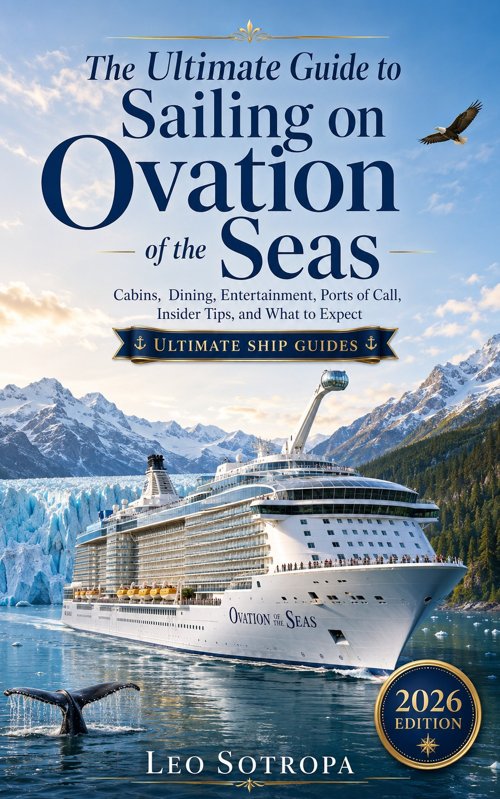
Want every reservation window, cabin pick and port plan in one place? “The Ultimate Guide to Sailing on Ovation of the Seas” is part of the Ultimate Ship Guides series by Leo Sotropa, with clear action steps in every chapter so a first-timer can book, pack and sail with confidence.
Frequently asked questions
Is Ovation of the Seas a good ship for a first Alaska cruise?
Yes. As a Quantum-Class ship with glass-roofed indoor spaces, a glass-domed Solarium and huge glass-walled public rooms, she is built for cool, wet Alaska weather, so you watch the scenery in comfort. Attractions like the North Star, RipCord and SeaPlex keep sea days interesting for beginners and families alike.
Why is the cruise one-way, and how do I book flights?
Ovation’s Alaska sailings are open-jaw, running one-way between Vancouver and Seward rather than returning to the start. Book flights into the city where your cruise begins and home out of the city where it ends, using a multi-city or open-jaw search. Confirm your sailing’s direction so you fly into the correct airport.
Do I really need a balcony cabin in Alaska?
You do not need one, but it is more worthwhile than in warm regions because the scenery is constant. A midship Balcony on the mid-decks lets you watch glaciers and wildlife from your own room with a steady ride. If budget is tight, the Virtual Balcony interior with its real-time ocean screen is the best-value alternative.
What should I pack for an Alaska cruise?
Think layers: a base layer, a warm fleece or light down mid-layer, and a waterproof outer shell. Add real rain gear, sturdy broken-in walking shoes, a hat and gloves, and binoculars for distant wildlife. Skip heavy formalwear — Ovation’s dress culture is relaxed with only a couple of dressier evenings.
When is the best time to sail Alaska?
The season runs roughly late spring through early autumn. Early sailings tend to be drier and cooler with snow on the peaks; high summer brings the warmest temperatures and longest days; later sailings offer fall color and strong salmon runs. Rain is normal throughout, so pack for all conditions and confirm dates in the Royal Caribbean app.
How early should I reserve the North Star and excursions?
As early as possible. The North Star has very limited daily capacity, and Alaska’s popular excursions — whale watching, the White Pass railway, glacier trips — sell out early. Book what you can before you sail, and lock in the rest during your first hours aboard rather than waiting.
Should I add a Denali or land tour to my cruise?
Because the ship uses Seward, the gateway to Anchorage and Denali, adding a cruisetour lets you see interior Alaska by rail and lodge. If this may be your only Alaska trip and you have the time and budget, it adds a whole different landscape. If time is tight, the cruise alone is a complete trip — decide before you book, since land tours are arranged alongside the sailing.
Ready for the whole ship in one place? It is all in The Ultimate Guide to Sailing on Ovation of the Seas.
Get the book →
Meet Leo: The Heartbeat Behind ‘A Country A Month’
Journeying through the pages of A Country A Month, you might often feel the rhythm of a storyteller’s heartbeat, pulsating through each line, each image, and each adventure shared. That heartbeat belongs to none other than our remarkable website editor, Leo.
With a lens in one hand and a pen in the other, Leo seamlessly marries his passions for photography and writing. His eye captures moments that words can barely describe, yet his eloquence brings those images to life, transcending borders and connecting us all through shared stories. An avid traveler, every country he’s visited has added another chapter to his expansive tale, and through our platform, he generously shares these chapters with us.