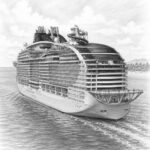
What should you expect on MSC World Asia? In short: a huge, brand-new ship organised as seven distinct districts, a distinctly European atmosphere with an international mix of guests, a genuinely port-intensive Western Mediterranean week, and a split between generous included dining and tempting extras. She is the newest and most complete ship in MSC Cruises’ flagship World Class, so she carries forward everything her sisters pioneered and adds a little more. This guide walks you through a realistic picture of daily life aboard, from the scale of the place to the small surprises that catch first-timers off guard.
Everything in this article and far more, deck by deck, in The Ultimate Guide to Sailing on MSC World Asia.
Get the book →The scale, and the seven districts
The first thing to expect is size. MSC World Asia carries more than 5,000 guests across roughly 20 decks and comes in at around 216,000 gross tons. Those numbers translate into a ship you cannot fully learn in a single day. Rather than one endless corridor of shops and pools, the design breaks the ship into seven districts, each with its own character, so that a vessel this large still feels navigable and human-scaled once you get your bearings.
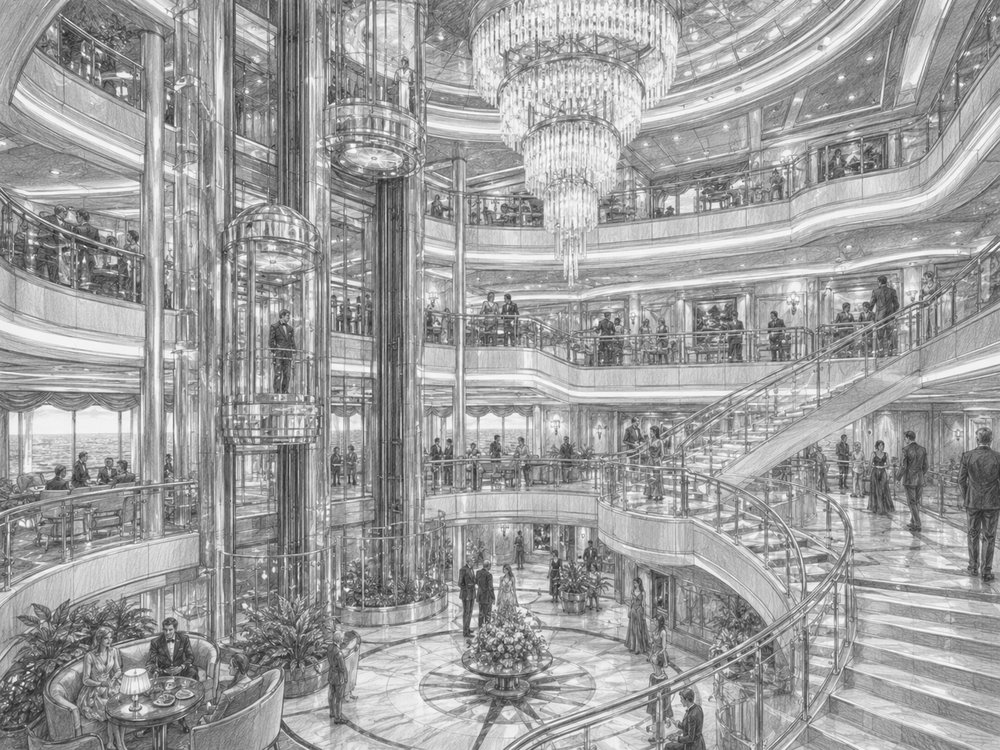
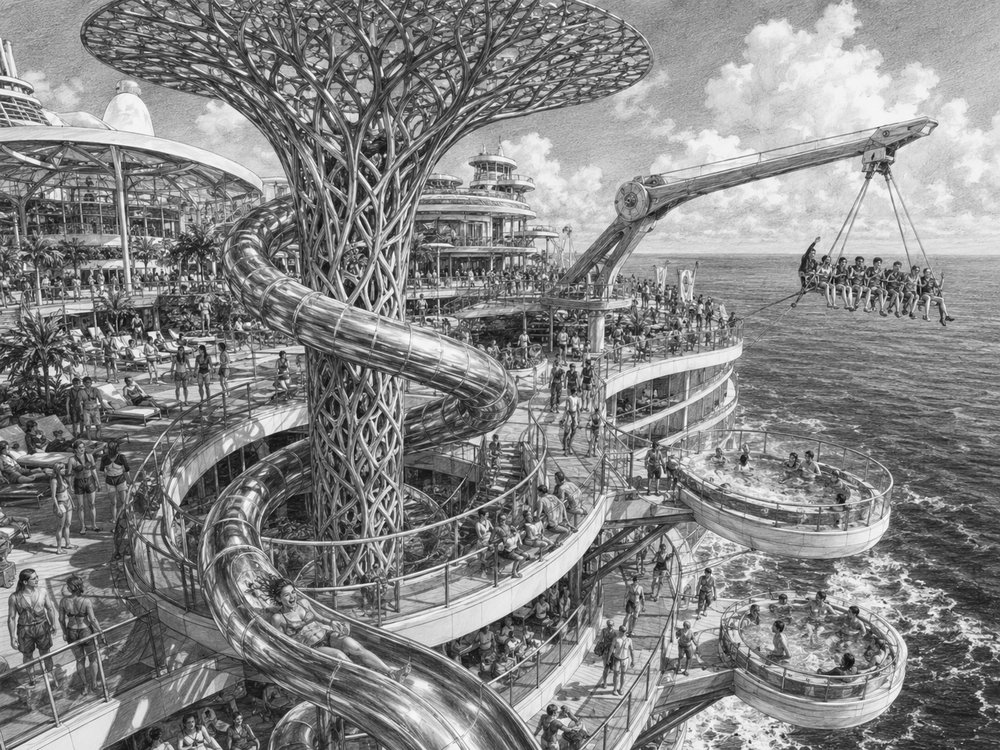
The centrepiece is the World Promenade, an indoor-outdoor main street that runs through the ship and acts as the social spine of the whole experience. This is where you will find bars, casual food, shopping and people-watching, and it is also home to the Spiral @ Tree of Life, a record-length multi-deck dry slide that spirals down through the middle of the action. Nearby, the Galleria atrium rises through the ship with glass elevators, giving you that vertical sense of scale that big modern ships do so well.
Families gravitate to the Family District and the new Clubhouse, a retro-fun space built for play. Adults looking to escape the buzz head instead to the Zen area, an adults-only district best known for its whirlpools that cantilever out over the sea, so you soak while looking straight down at the water passing beneath you. Finally, there is the MSC Yacht Club, the private ship-within-a-ship, and on this vessel it is the biggest MSC Yacht Club yet. Between these named districts and the rest of the seven, the ship gives you distinct places to be depending on your mood, which is exactly the point.
The practical takeaway on your first day is simple: give yourself a lap. Walk the World Promenade end to end, ride the Galleria elevators up and down, and note where the pool decks, the theater and your muster station sit relative to your cabin. Once you have a mental map of the seven districts, the ship shrinks in the best possible way.
A European feel and an international crowd
MSC is a European cruise line, and MSC World Asia feels like it. Expect a more Continental style than some travellers are used to: announcements and signage in several languages, an international mix of guests from across Europe and beyond, and a slightly more relaxed, later rhythm to the day. Dinner runs later than on some lines, the bars stay lively into the evening, and the whole atmosphere leans social rather than regimented.
The multinational crowd is part of the appeal. You will share the pool deck and dining room with families and couples speaking a dozen languages, and the entertainment is often designed to work visually so that it lands regardless of the language you speak. If you are travelling from further afield and expect a single-nationality crowd, adjust that expectation: the mix is genuinely international, and it gives the ship a cosmopolitan energy that suits her Mediterranean itineraries.
None of this should intimidate a first-timer. Staff are used to guiding guests in multiple languages, the MSC for Me app carries menus and schedules in your language, and the practical business of finding dinner or a show is straightforward. But the flavour of the trip is European, and going in expecting that makes the whole week more enjoyable. If you want a fuller orientation before you sail, the broader MSC World Asia cruise guide sets out the ship deck by deck.
A typical day on a port-intensive Med week
In her current program, MSC World Asia sails seven-night Western Mediterranean weeks, and these are port-intensive itineraries rather than lazy sea-day cruises. A typical loop calls at Barcelona in Spain, Marseille in France, Genoa in Italy, Rome via Civitavecchia, Messina in Sicily for Taormina, and Valletta in Malta. Several of these double as embarkation ports, so always confirm where you board and the exact ports for your specific week before you plan anything on land.
A day in port on this kind of itinerary starts early. Because you are in a new city almost every day, the ship wakes up sooner than a Caribbean sailing might, and the smart move is to be off early and back with time to spare. Breakfast in the buffet or main dining room, then ashore, then back aboard in the late afternoon or early evening as the ship sails to the next city. Rome is the marquee call and also the trickiest: the cruise port is Civitavecchia, roughly a 1.5-hour transfer from central Rome by train or road, so that day in particular rewards careful planning and an early start.
Here is a realistic sense of what each stop offers, all of which you should confirm and, where relevant, book ahead:
- Rome (Civitavecchia): the Colosseum, the Vatican and St. Peter’s, the Trevi Fountain and the Roman Forum, with a long transfer each way that you must budget for.
- Barcelona, Spain: the Sagrada Família, Park Güell, La Rambla, the Gothic Quarter and Gaudí architecture across the city.
- Marseille, France: Notre-Dame de la Garde and the Vieux-Port, and a gateway to Aix-en-Provence inland.
- Genoa, Italy: the historic old town and aquarium, and a springboard to the Cinque Terre and Portofino.
- Messina/Taormina, Sicily: clifftop Taormina with its ancient Greek theatre, and the looming presence of Mount Etna.
- Valletta, Malta: St. John’s Co-Cathedral, the Grand Harbour, and the walled old city of Mdina nearby.
Because the port days are long and full, the ship itself is quieter during daylight hours, which is the perfect time to enjoy the pools, the slides and the spa with smaller crowds. The rhythm of the week tends to be: hard-charging mornings and afternoons ashore, then evenings back aboard for dinner, a show and a drink. For a deeper look at the standout stop, the dedicated guide to Rome from Civitavecchia is worth reading before that day.
Dining: what’s included and what costs extra
Dining is one of the areas where expectations matter most, because MSC World Asia draws a clear line between generous included venues and paid specialty restaurants. On the included side you have the main dining rooms and the buffet, which cover breakfast, lunch and multi-course dinners at no extra charge. For most guests, these included venues are where the majority of meals happen, and they are perfectly satisfying for a full week.
The extra-cost specialty venues are where this ship gets interesting. The signatures unique to MSC World Asia are an immersive Pan-Asian restaurant and a street-food counter, both built around Asian flavours and designed as an experience rather than just a meal. Alongside them sit the familiar MSC specialty concepts: a sushi and teppanyaki spot, a steakhouse, and a taqueria. All of these carry an additional charge, either à la carte or through a dining package, so budget for them as treats rather than assuming they are part of your fare.
A sensible approach is to pick one or two specialty meals for the week rather than trying them all. The immersive Pan-Asian restaurant is the one most worth planning around given it is unique to this ship, and the street-food counter is an easy, lower-commitment way to sample the theme. Everything else you can happily cover in the included dining rooms and buffet. Here is a quick way to think about it:
| Venue type | Examples | Cost |
|---|---|---|
| Included | Main dining rooms, buffet | In your fare |
| Signature specialty | Immersive Pan-Asian restaurant, street-food counter | Extra |
| Classic specialty | Sushi and teppanyaki, steakhouse, taqueria | Extra |
One more thing to expect: dinner in the main dining room usually runs on assigned seating times, and those times skew later in the European style. If you are booked on a fixed early or late sitting, note it and plan your evenings around it, or use the more flexible options where your Experience allows. Drinks are generally not included unless you buy a beverage package, which is a separate decision covered further down.
Entertainment, bars, the Clubhouse and casino
Evenings aboard MSC World Asia are busy. Expect theater productions with the kind of staging modern megaships specialise in, live music spread across multiple bars and lounges, and a general sense that there is always somewhere to go after dinner. Because the crowd is international, the big theater shows lean on spectacle, dance and music that work without a shared language, which makes them easy to enjoy no matter where you are from.
The World Promenade is the natural hub for nightlife, with bars opening onto the main street and the crowd flowing between them as the evening goes on. Two standout venues shape the after-dark scene: the retro-fun Clubhouse, a playful space in the Family District that leans into a nostalgic, games-and-fun atmosphere, and the casino for guests who want to try their luck. Between the promenade bars, the lounges, the theater and these named venues, a single evening can easily fill itself.
Thrills on deck
For all her European polish, MSC World Asia is also a proper thrill ship. The headline attraction is the Spiral @ Tree of Life, the record-length multi-deck dry slide that twists down through the World Promenade. It is the kind of feature you ride once for the novelty and then again because it is genuinely fun, and its position on the main street means it is part of the ship’s daily theatre rather than tucked away on a top deck.
The most dramatic thrill is the Cliffhanger, an over-water swing ride cantilevered off the side of the ship so that at the top of each arc you are swinging out over open sea. It is the ride that draws the crowds and the phone cameras, and it is worth doing early in the week before the queues build. Beyond those two, there is an aquapark for families and warm-weather days, and the cantilevered Zen whirlpools that reward you with an over-sea soak rather than an adrenaline rush.
The smart way to enjoy the thrills is to use the long port days to your advantage. When most guests are ashore in Barcelona or Genoa, the slides, aquapark and whirlpools are at their emptiest. If you fancy a slower day aboard while the ship is in port, you can have the top-deck attractions almost to yourself. For more of this kind of timing advice, the collected MSC World Asia tips are a useful companion to this guide.
The greener, newest-ship advantage
Part of what you are getting on MSC World Asia is simply the advantage of the newest ship. As the youngest and most complete member of the World Class, she gathers what her sisters MSC World Europa and MSC World America introduced and refines it, which means fewer teething problems and the most developed version of the design. If being on the latest, most polished ship matters to you, this is the current answer within the fleet.
She also keeps the greener LNG propulsion of the World Class. Liquefied natural gas burns cleaner than traditional marine fuel, and for travellers who weigh the environmental footprint of a cruise, the LNG angle is a meaningful part of the picture. It does not change your day-to-day experience directly, but it is a genuine differentiator worth knowing about, and it pairs with the modern efficiency you would expect from a ship of this generation.
The MSC for Me app and how Experiences shape the trip
Two things quietly run your week on MSC World Asia: the MSC for Me app and the Experience you booked. The app is your daily control panel. Use it to check the schedule, browse menus, find your dinner time, book specialty restaurants and shows, and navigate the ship. On a vessel with seven districts and more than 5,000 guests, keeping the app on your phone genuinely changes how smoothly the week goes, and it is where you should confirm the latest schedule and ports for your sailing.
The Experience is the more important booking decision, and it is the one first-timers most often misunderstand. On MSC you book a cabin and an Experience together, and the Experience determines a great deal about your week. From most affordable to most exclusive, they run: Bella, the entry fare, where MSC assigns your cabin’s exact location; Fantastica, which lets you choose your cabin and dining, adds room-service breakfast and extra loyalty points; Aurea, the premium tier with the best-located cabins, priority boarding, thermal spa access and often a drinks package; and the Yacht Club, the private ship-within-a-ship with butler-and-concierge suites, a private restaurant, lounge, bar, pool and sun deck, and premium all-inclusive drinks.
Which Experience you choose shapes everything from where you sleep to whether your drinks are covered, so it deserves real thought before you book. Exact inclusions vary by sailing and promotion, so always confirm the current details for your week. The dedicated breakdown of MSC World Asia Experiences explains how to match a tier to your travel style, and if this is your first MSC cruise, the first-time guide to MSC World Asia is the gentlest place to start.
What might surprise a first-timer
Even seasoned cruisers can be caught out on their first MSC sailing, because a few things work differently here. Going in aware of them turns potential frustration into a smooth week. Here are the ones that come up most often:
- Experiences are a real decision, not a formality. The Bella/Fantastica/Aurea/Yacht Club choice affects your cabin, your flexibility and your inclusions, so understand it before you book rather than after.
- Drinks are not automatically included. Unless you buy a beverage package or your Experience bundles one, drinks are charged as you go, so decide on a package early if you expect to drink regularly.
- Daily gratuities are added to your account. These service charges appear automatically, so factor them into your budget rather than treating them as optional extras.
- Wi-Fi is a paid plan. Connectivity is not free, so buy an internet package if you need to stay online, and expect it to be a separate purchase.
- Dining times skew later and may be assigned. Main dining room seatings run on the European clock and can be at fixed times, so check your sitting and plan evenings around it.
- Port days are long and start early. This is a port-intensive Mediterranean itinerary, so expect early mornings ashore and full days, particularly on the Rome call with its lengthy Civitavecchia transfer.
None of these are drawbacks so much as differences. Once you know that the Experience matters, that drinks and Wi-Fi are add-ons, that gratuities are automatic, and that the week is built around long, early port days, MSC World Asia is an easy ship to love. The guests who struggle are almost always the ones who expected an all-inclusive, sleep-in kind of holiday and did not read the fine print first.
Get the complete MSC World Asia playbook
If you want every district, dining venue, Experience and port day mapped out in one place, “The Ultimate Guide to Sailing on MSC World Asia” is the book to pack. It is part of the Ultimate Ship Guides series by Leo Sotropa, with clear action steps in every chapter so you always know exactly what to do next.
Frequently asked questions
How big is MSC World Asia and how many guests does she carry?
She carries more than 5,000 guests across roughly 20 decks and comes in at around 216,000 gross tons, making her one of the largest cruise ships afloat. As the newest and most complete ship in MSC Cruises’ World Class, she is organised into seven districts so that all that scale still feels navigable once you learn the layout.
Where does MSC World Asia sail?
In her current program she sails seven-night Western Mediterranean weeks, with a loop that typically calls at Barcelona, Marseille, Genoa, Rome via Civitavecchia, Messina for Taormina, and Valletta. Several ports double as embarkation points, so always confirm where you board and the exact ports for your week in the MSC for Me app before planning shore days.
What dining is included, and what costs extra?
The main dining rooms and the buffet are included in your fare and cover all your everyday meals. The specialty venues cost extra, including the immersive Pan-Asian restaurant and street-food counter unique to this ship, plus the sushi and teppanyaki spot, the steakhouse and the taqueria. Treat those as paid highlights rather than assuming they are part of your fare.
What are MSC Experiences and why do they matter?
On MSC you book a cabin and an Experience together, and the Experience shapes your whole trip. Bella is the entry fare where MSC assigns your cabin, Fantastica lets you choose your cabin and dining, Aurea adds premium perks like spa access and often a drinks package, and the Yacht Club is a private ship-within-a-ship. Inclusions vary by sailing, so confirm the current details before booking.
What thrill rides does MSC World Asia have?
The signatures are the Spiral @ Tree of Life, a record-length multi-deck dry slide on the World Promenade, and the Cliffhanger, an over-water swing ride cantilevered off the side of the ship. There is also an aquapark and, for a calmer thrill, the Zen whirlpools that cantilever out over the sea. Ride the popular attractions during port days when the ship is quietest.
Are drinks, Wi-Fi and gratuities included?
Generally not by default. Drinks require a beverage package unless your Experience bundles one, Wi-Fi is a separate paid plan, and daily gratuities are added automatically to your onboard account. Budget for all three, and decide on drinks and internet packages before you sail so there are no surprises on your final statement.
Is MSC World Asia a good choice for first-time cruisers?
Yes, provided you understand a few MSC-specific quirks first: the Experience decision, the paid extras, the assigned and later dining times, and the long, early port days on her Mediterranean weeks. She is the newest ship in the class with the most developed version of the design, so once you know how she works she is an easy and rewarding ship for a first cruise.
Ready for the whole ship in one place? It is all in The Ultimate Guide to Sailing on MSC World Asia.
Get the book →
Meet Leo: The Heartbeat Behind ‘A Country A Month’
Journeying through the pages of A Country A Month, you might often feel the rhythm of a storyteller’s heartbeat, pulsating through each line, each image, and each adventure shared. That heartbeat belongs to none other than our remarkable website editor, Leo.
With a lens in one hand and a pen in the other, Leo seamlessly marries his passions for photography and writing. His eye captures moments that words can barely describe, yet his eloquence brings those images to life, transcending borders and connecting us all through shared stories. An avid traveler, every country he’s visited has added another chapter to his expansive tale, and through our platform, he generously shares these chapters with us.