What should you expect on MSC World America? In short: a very large, brand-new ship that rarely feels as crowded as its numbers suggest, a distinctly European style of cruising wrapped around Italian and Mediterranean flavours, and a layout split into seven themed districts so that thrill-seekers, families, spa-goers and quiet couples can each find their own corner. She is the second ship in MSC Cruises’ flagship World Class and the largest, newest MSC ship based in the United States, sailing seven-night Caribbean weeks out of PortMiami with a stop at MSC’s private island on every voyage. If you are coming from another cruise line, a handful of things work differently here, and knowing them before you board makes the whole week smoother.
Everything in this article and far more, deck by deck, in The Ultimate Guide to Sailing on MSC World America.
Get the book →This guide walks through the scale of the ship, how the districts spread people out, what a typical day feels like, where the food is included versus extra, the entertainment and thrills, the app that quietly runs everything, and the surprises that catch first-timers off guard. Read it once before you sail and you will step aboard already knowing where you want to be.
The scale, and why seven districts matter
MSC World America measures around 216,000 gross tons, carries more than 5,000 guests, and rises about 20 decks above the waterline. Numbers like that can sound intimidating, and the honest truth is that a ship this size is a small floating town. What changes the experience is how the space is organised. Rather than one endless promenade and a single pool deck where everyone piles up, the ship is built as seven themed districts, each with its own mood, its own venues, and its own reasons to linger. That deliberate spreading of the crowds is the single most important thing to understand about how she feels day to day.
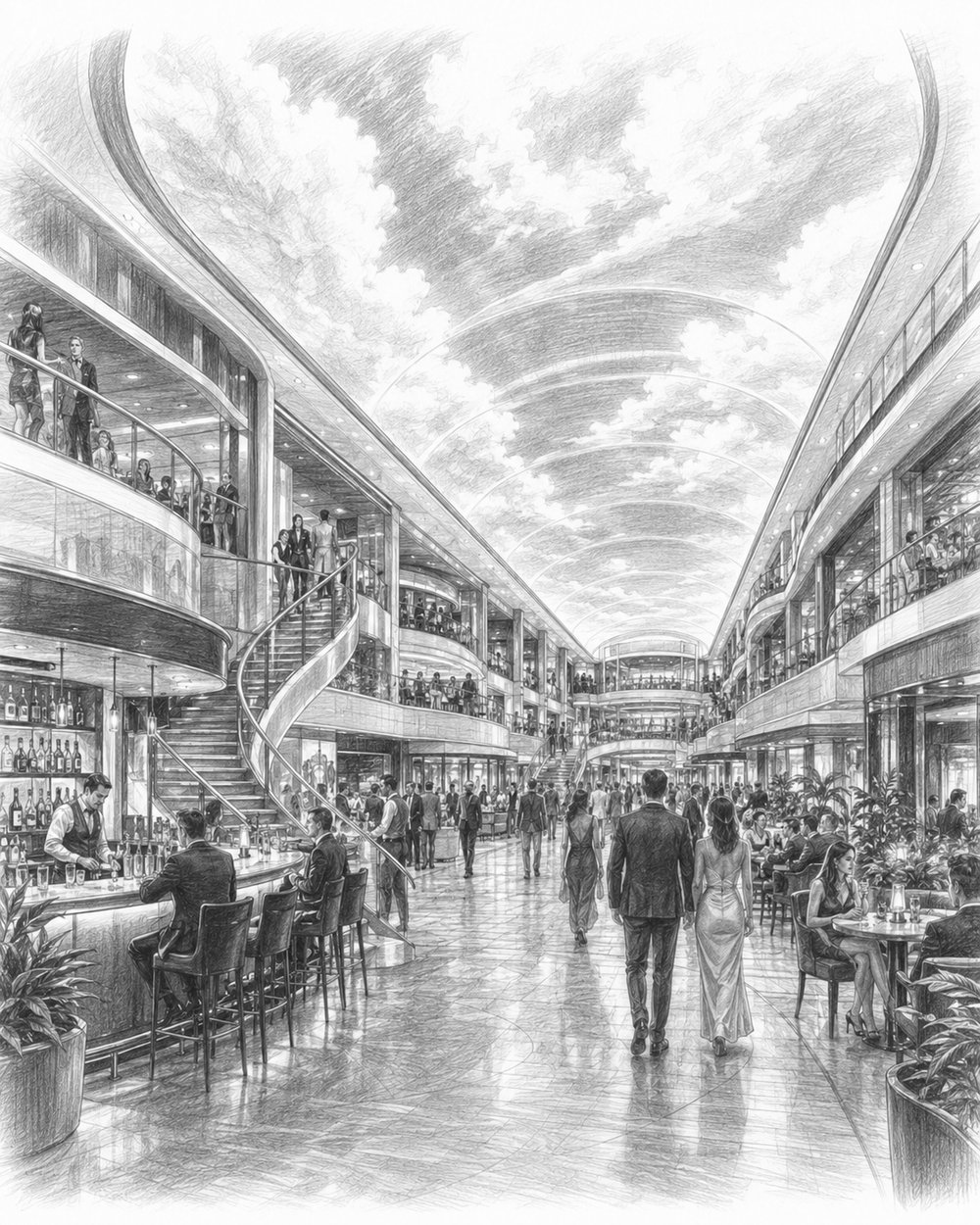
The World Promenade is the lively indoor-outdoor main street, lined with bars, shops and places to eat, and open to the sea air in a way that makes it the natural gathering point in the evening. The Galleria is the glittering atrium at the heart of the ship, crowned by an enormous LED dome that shifts through skies, colours and shows overhead. The Harbour is the family adventure district, home to the aquapark and the headline thrill ride. The adults-only Zen area is the calm counterweight, all spa and quiet. There is a dedicated Family District built around kids and teens, and, gated off from the rest, the exclusive MSC Yacht Club, a private ship-within-a-ship for suite guests. Together these make up the seven districts, and once you learn which one suits your mood, navigation stops being a chore.
The practical payoff is real. On a sea day you can send the kids to the Harbour, retreat to the Zen area yourself, and meet for dinner having barely crossed paths with the same crowds. If you want the full breakdown of how the layout works deck by deck, the complete MSC World America cruise guide maps it out in detail.
A more European feel
MSC is a European line, and that heritage shows even on a ship built for the American market. Expect a more international mix of fellow passengers, multilingual announcements and crew, and a design sensibility that leans Italian and Mediterranean rather than all-American. The styling is glossy and fashion-forward, the coffee is taken seriously, and the pace of the day can feel a touch more relaxed and grown-up than you might be used to.
None of this is a barrier. The ship is set up for English-speaking guests, the food ranges well beyond Italian, and the crew are used to a Caribbean-cruising crowd from PortMiami. But it is worth arriving with the right expectations. This is not a carbon copy of the big US-based lines. The rhythm, the flavours and the little cultural cues are their own thing, and for a lot of guests that difference is exactly the appeal. If it is your first MSC sailing, it helps to read up on the line’s quirks in advance, and the first-time guide to MSC World America is written for precisely that.
A typical day on board
No two days are identical, but a rhythm emerges quickly. Mornings tend to be gentle. Early risers grab coffee and pastries, walk laps, or claim a lounger before the pool decks fill. Breakfast runs across the buffet and the main dining rooms, and depending on your booking you may have room-service breakfast as an option. Sea days build slowly toward the middle of the day, when the pools, the aquapark and the top-deck action reach their peak, so if you want a quieter swim, aim early or late.
Afternoons are for choosing your district. Thrill-seekers head to the Harbour, spa guests drift to the Zen area, families settle into the kids’ and teens’ zones, and anyone who just wants a drink and a view finds a bar along the World Promenade. Late afternoon is prime time for booking dinner, checking the evening’s shows, and deciding whether tonight is a specialty-restaurant night. Evenings tilt toward the theatre, live music, the bars and the casino, with the Galleria dome often putting on a show of its own overhead. Port days flip the pattern: mornings are for getting ashore, and the ship is at its calmest and least crowded while most guests are off exploring.
Every voyage from PortMiami visits Ocean Cay MSC Marine Reserve, MSC’s private Bahamas island, so at least one of your days will be built around a beach rather than a busy port town. It is a restored former industrial sand island turned marine reserve, with quiet beaches, a lagoon and an evening lighthouse light show. Beaches are included; some experiences and excursions cost extra. For a fuller look at where the ship calls and how to plan each stop, see the guide to MSC World America ports and Ocean Cay.
Dining: what is included and what costs extra
This is where a lot of first-timers get pleasantly surprised and occasionally confused. Your fare already includes plenty of food. The main dining rooms serve multi-course meals with a rotating menu, and the buffet covers casual breakfast, lunch and dinner across a wide spread. You can eat well all week without spending a cent beyond your fare. The included dining is the backbone of the ship, and for many guests it is all they need.
Then there are the specialty venues, which cost extra and are worth understanding before you board. The headline is Eataly, the only Eataly at sea, an Italian marketplace and restaurant that leans into proper regional cooking and quality ingredients. Kaito handles sushi and teppanyaki, with a hibachi-style show at the teppanyaki tables. Butcher’s Cut is the steakhouse, the go-to for a celebratory dinner. HOLA! brings tacos and Mexican plates in a livelier, more casual setting. And Jean-Philippe Maury is the sweet stop, a chocolate, crepes and coffee destination named for the master chocolatier, perfect for an afternoon treat or a late dessert.
The smart approach is to plan one or two specialty meals for the nights that matter and rely on the included venues the rest of the time. Prices are set per venue and can shift with promotions, so check current pricing and any dining packages in the app rather than assuming. Booking popular tables early in the week is wise, especially for Butcher’s Cut and the teppanyaki seats at Kaito, which fill fastest.
| Venue | What it is | Cost |
|---|---|---|
| Main dining rooms | Multi-course sit-down dinners, rotating menu | Included |
| Buffet | Casual breakfast, lunch and dinner spread | Included |
| Eataly | Italian marketplace and restaurant | Extra |
| Kaito | Sushi and teppanyaki | Extra |
| Butcher’s Cut | Steakhouse | Extra |
| HOLA! | Tacos and Mexican | Extra |
| Jean-Philippe Maury | Chocolate, crepes and coffee | Extra |
Entertainment, bars and the casino
Evenings are busy in the best way. The theatre stages full productions with music, dance and staging built for the space, and the shows rotate through the week so there is a reason to go back. Beyond the main theatre, live music threads through the districts, from lounge acts to bar sets, and the World Promenade becomes the social spine of the ship after dark. The Galleria dome overhead runs light shows that turn the atrium into an event on its own, and it is worth timing a drink to catch one.
The bars span a wide range of moods, from bright and social along the promenade to quieter, more intimate spots tucked into corners of the ship. The casino brings the usual tables and slots for guests who want a flutter in the evening. And for families, a Luna Park-style zone keeps younger guests entertained with a carnival energy that fits the ship’s playful side. The point is that you never have to hunt for something to do after dinner; the harder task is choosing.
The thrills: Cliffhanger, dry slide and the aquapark
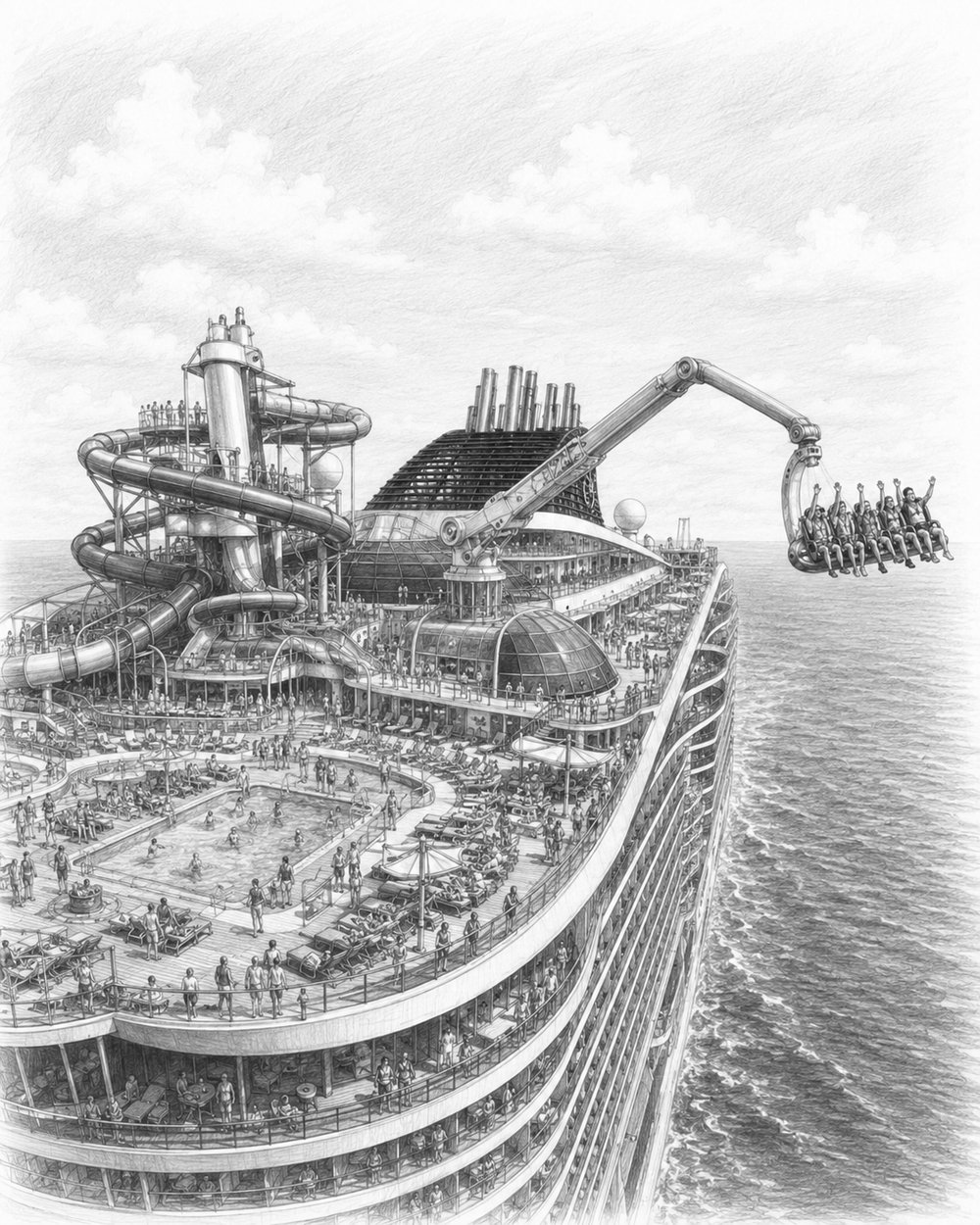
The ship earns its headlines with three standout attractions, and the Cliffhanger is the star. It is an over-water swing ride cantilevered off the side of the ship, so at the peak of its arc you are swinging out beyond the hull with nothing but the Caribbean below. It is the sort of thing you either queue for on day one or spend the week talking yourself into. Either way, it is the ride guests photograph and remember.
For a different kind of rush there is a dry slide on the World Promenade, a fast, twisting descent that sends you down through the ship rather than into water. And the Harbour aquapark is the wet counterpart, with several waterslides and the splashy chaos that keeps kids happy for hours. Rounding it all out are sports facilities and a ropes course for anyone who likes their thrills a little more athletic. The Harbour district is deliberately built to concentrate this energy in one place, which is part of how the rest of the ship stays calmer.
A word of planning: the top-deck and Harbour attractions are busiest in the middle of a sea day. If you want the shortest waits, go early in the morning or later in the afternoon, and consider hitting the headline ride on embarkation day while much of the ship is still finding its feet.
The MSC for Me app and how Experiences shape your trip
The MSC for Me app is the quiet engine of the whole week. It holds the daily schedule, the deck maps, restaurant and show bookings, your account and more. On a ship this size, learning the app early is not optional; it is the difference between drifting and actually catching the things you wanted to see. Download it, log in with your booking, and get comfortable with it before you sail. Note that staying online generally requires a paid Wi-Fi plan, so check the current options rather than assuming free coverage.
The bigger conceptual thing to understand is the MSC Experience. On MSC you do not just book a cabin; you book a cabin and an Experience package together, and that choice shapes your whole trip. From most affordable to most exclusive, the tiers run Bella, Fantastica, Aurea and Yacht Club. Bella is the entry Experience and the lowest fare, but MSC assigns your cabin’s exact location, so you cannot pick it, and you get standard dining and basic inclusions. Fantastica is the mid-tier: you choose your specific cabin and preferred dining, and you get room-service breakfast, extra loyalty points and more flexibility. Aurea is the premium non-suite tier, with the best-located cabins, priority boarding, access to the thermal spa and relaxation area, and often a drinks package included.
At the top sits the Yacht Club, the gated ship-within-a-ship: a private, keycard-only enclave of suites with a 24-hour butler and concierge, a private restaurant, lounge and bar, a private pool and sun deck, and a premium all-inclusive drinks package. It is the most exclusive way to sail her. Exact inclusions vary by sailing and promotion, so always confirm the current details when you book. Because this decision affects both your cabin and your daily perks, it is worth getting right; the deep dive on MSC World America Experiences compares the tiers in detail, and the Yacht Club guide covers whether the top tier is worth it.
What might surprise a first-timer
If you are switching from another cruise line, a few things work differently on MSC, and none of them are dealbreakers once you know to expect them.
The Experience system is not just a room type
On other lines you pick a cabin category and you are done. Here, Bella, Fantastica, Aurea and Yacht Club bundle the cabin choice with dining flexibility, boarding priority and spa access, and the cheapest fare gives up your right to choose your exact cabin location. Read the tiers carefully before you book so you are not surprised by what you did or did not get.
Drinks packages and pricing are their own decision
Beverage packages are sold separately unless your Experience or promotion includes one, and there are different tiers to match different drinking styles. If you like a glass of wine at dinner and a cocktail or two in the evening, do the maths on a package versus paying as you go. Prices shift with promotions, so compare in the app before committing.
Gratuities are added automatically
Daily gratuities are added to your onboard account rather than left entirely to your discretion at the end. This is standard practice, but if you have not budgeted for it, it can be a small shock when the account tallies up. Factor it in when you plan your spending.
Dining times and style
Depending on your booking and dining preference, main-dining meals may follow assigned seating times rather than the fully flexible any-time approach some lines default to. Confirm your dining arrangement in the app, and if the timing does not suit, sort it out early in the week rather than turning up and hoping. The buffet and specialty venues give you flexibility around whatever your main-dining setup is.
Get these four things straight before you board and the rest of the week runs on rails. Most of the friction first-timers feel comes from expecting an American-line default and finding an MSC one instead. Once you adjust, the ship is easy to love.
Choosing your cabin still matters
On a ship this large, location shapes your week. A midship balcony on the mid-decks gives you space, light and the steadiest ride, while rooms directly under the pool deck or the Harbour aquapark can carry noise. If you value picking your spot, that alone is a reason to book at least a Fantastica fare rather than Bella. The rundown of the best cabins on MSC World America walks through which decks and positions are worth targeting and which to avoid.
Get the complete MSC World America playbook
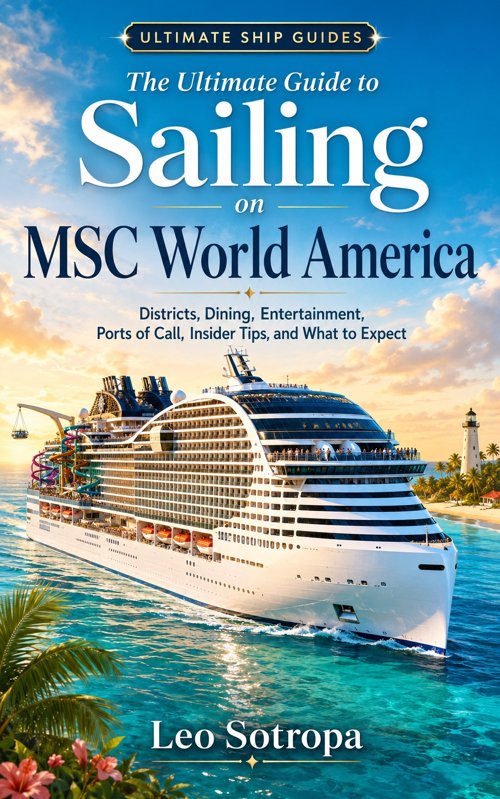
Ready to plan the whole week with confidence? “The Ultimate Guide to Sailing on MSC World America” is part of the Ultimate Ship Guides series by Leo Sotropa, packed with clear action steps in every chapter so you know exactly what to book, when to book it, and how to make the most of every district on board.
Frequently asked questions
How big is MSC World America and does it feel crowded?
She is around 216,000 gross tons, carries more than 5,000 guests, and rises about 20 decks. Despite the size, she is designed as seven themed districts specifically to spread people out, so she rarely feels as packed as the headline numbers suggest. The busiest pinch points are the pools and top-deck attractions in the middle of a sea day; go early or late to dodge them.
What are the seven districts?
The named districts include the World Promenade, the lively indoor-outdoor main street; the LED-domed Galleria atrium at the heart of the ship; the Harbour, the family adventure zone with the aquapark and the Cliffhanger swing; the adults-only Zen area for spa and calm; the Family District for kids and teens; and the gated MSC Yacht Club for suite guests. Together they make up the seven districts that give the ship its structure.
Which restaurants are included and which cost extra?
The main dining rooms and the buffet are included in your fare. The specialty venues cost extra: Eataly, the only Eataly at sea, plus Kaito for sushi and teppanyaki, Butcher’s Cut steakhouse, HOLA! for Mexican, and Jean-Philippe Maury for chocolate, crepes and coffee. Plan one or two specialty meals and use the included venues the rest of the week. Check current pricing and any dining packages in the MSC for Me app.
What is the Cliffhanger?
The Cliffhanger is an over-water swing ride cantilevered off the side of the ship, so at the top of its arc you swing out beyond the hull above the sea. It is the ship’s headline thrill, alongside a dry slide on the World Promenade and the Harbour aquapark with several waterslides. Sports facilities and a ropes course round out the active offerings.
What is an MSC Experience and why does it matter?
On MSC you book a cabin and an Experience package together. Bella is the lowest fare but MSC assigns your exact cabin location; Fantastica lets you choose your cabin and dining and adds perks; Aurea adds the best cabins, priority boarding and spa access, often with a drinks package; and the Yacht Club is the private ship-within-a-ship with butler service and all-inclusive extras. The Experience shapes both your room and your daily perks, so choose it deliberately. Inclusions vary by sailing, so confirm at booking.
Do I need the MSC for Me app?
Yes, effectively. The app runs your day, holding the schedule, deck maps, bookings and your account. On a ship this size it is the easiest way to keep track of what is on and where. Download it and log in before you sail. Staying connected to the internet generally needs a paid Wi-Fi plan, so review the current options rather than assuming free access.
What surprises guests coming from another cruise line?
Four things most often: the Experience system bundles your cabin choice with perks rather than being a simple room category; drinks packages are usually a separate purchase unless included in your Experience or a promotion; daily gratuities are added automatically to your account; and main-dining meals may follow assigned seating times depending on your booking. Sort each of these out early and the week runs smoothly.
Ready for the whole ship in one place? It is all in The Ultimate Guide to Sailing on MSC World America.
Get the book →
Meet Leo: The Heartbeat Behind ‘A Country A Month’
Journeying through the pages of A Country A Month, you might often feel the rhythm of a storyteller’s heartbeat, pulsating through each line, each image, and each adventure shared. That heartbeat belongs to none other than our remarkable website editor, Leo.
With a lens in one hand and a pen in the other, Leo seamlessly marries his passions for photography and writing. His eye captures moments that words can barely describe, yet his eloquence brings those images to life, transcending borders and connecting us all through shared stories. An avid traveler, every country he’s visited has added another chapter to his expansive tale, and through our platform, he generously shares these chapters with us.