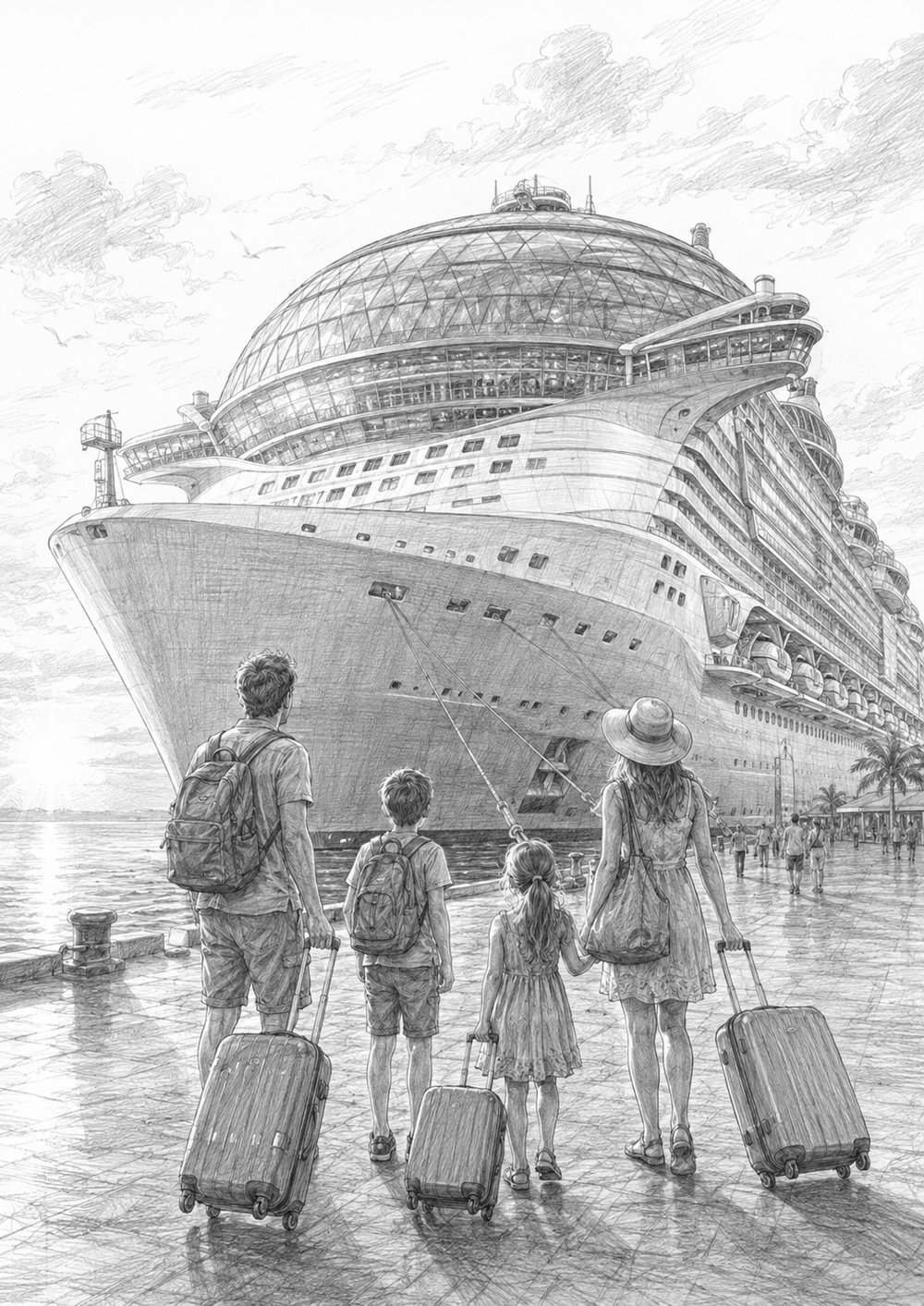
Star of the Seas is the newest of the world’s largest cruise ships, and unlike her sister Icon, she sails from Port Canaveral near Orlando. That single fact shapes everything from who cruises her to how you plan the trip, because an Orlando departure puts the theme parks an hour up the road. This guide covers what the ship is, how she differs from Icon of the Seas, where she goes, and what to sort out before you sail, so a 20-deck megaship feels manageable from the moment you start planning.
Everything in this article and far more, deck by deck, in The Ultimate Guide to Sailing on Star of the Seas.
Get the book →The ship at a glance
Star of the Seas measures 248,663 gross tons across roughly 20 decks. She carries well over 5,000 guests at double occupancy and closer to 7,600 when every berth is full, plus a crew of several thousand. Those numbers translate into eight distinct neighborhoods, seven pools, more than 20 places to eat, and the largest waterpark at sea. Rather than one enormous space with everything jumbled together, Star is deliberately broken into neighborhoods so families, couples, and thrill-seekers can each find a corner that feels built for them.
She is the second ship in Royal Caribbean’s Icon Class and recently entered service, which makes her one of the newest big ships you can book. For a first-timer, the practical takeaway is simple: everything is new, everything is large, and a little orientation goes a long way toward a relaxed week rather than an overwhelmed one. The scale is real, but it is organized scale, and once you understand how the ship is divided vertically and by neighborhood, the walking distances stop feeling random.
How Star differs from Icon of the Seas
If you are choosing between Star and Icon, the ships are near-identical in size and layout, so the real differences come down to home port, itinerary, and a handful of signature venues and shows. Star sails from Orlando while Icon sails from Miami. Star’s headline theater production is Back to the Future: The Musical, staged in the main theater as the week’s marquee show. Her premium supper club is Lincoln Park, themed to 1930s Chicago with live jazz and a dinner-and-show format, where Icon’s equivalent takes a different theme. A few of the AquaDome Market food-hall stalls differ too, with Star offering spots like La Cocinita for South American plates, Pig Out BBQ, and Mai Thai, alongside Feta Mediterranean and Creme de la Crepes. The ship’s dog mascot is named Sailor. Beyond those touches, what you read about one ship’s layout largely applies to the other.
Practically, the home port is the deciding factor for most people. If you are already planning Orlando theme parks, Star is the obvious pick because you can chain the two halves of the trip together with a short drive. If you are flying into South Florida or want a Miami city break, Icon makes more sense. Beyond the headline musical, Star runs her own slate of an aqua show, an ice-skating production, and a robot-themed original, with live music most evenings, so you will not run out of things to watch on a seven-night sailing.
Think of the ship in three bands
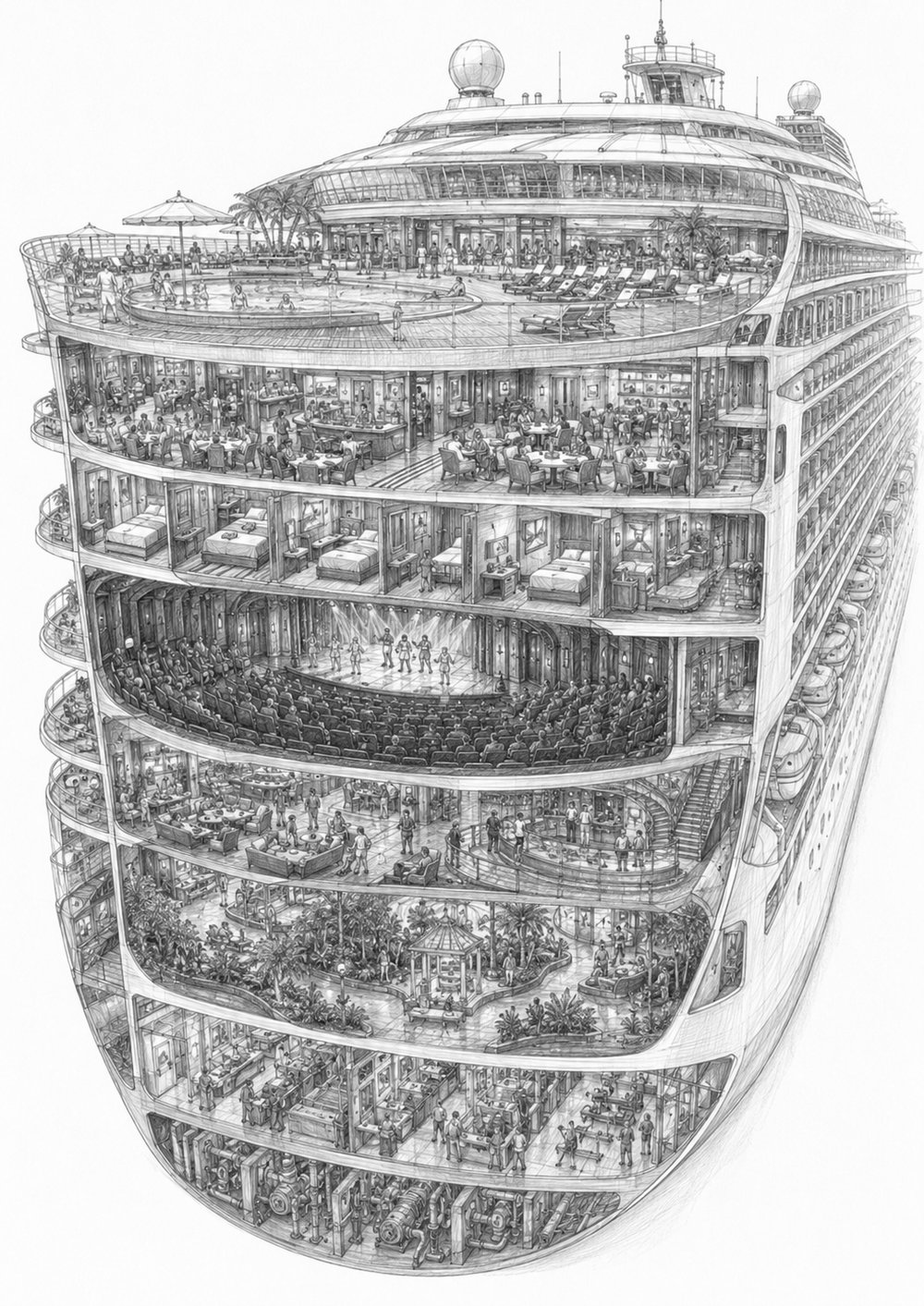
The fastest way to stop feeling lost is to picture Star in three vertical bands. The lower public decks hold the Royal Promenade, the theaters, and the main dining rooms. The middle decks are mostly staterooms. The upper decks are where the fun lives: the pools, the Category 6 waterpark, and the outdoor venues. Almost every trip you make is either up to play or down to eat and be entertained, and once that clicks the ship shrinks in your mind.
The lower band is your evening ground: dinner in the Main Dining Room, a pre-show drink on the Royal Promenade, the theater for Back to the Future, and Central Park for a quieter stroll before bed. It is worth walking this band once on embarkation day so you know which elevator bank drops you closest to the theater and the dining room. The middle band is where you sleep, and midship staterooms feel the least motion while sitting a short walk from the elevators that serve both the fun above and the dining below. The upper band is a daytime world: Chill Island and Royal Bay for lounging, Thrill Island for the slides, The Hideaway for adults, and the buffet for lunch without a reservation. Your day naturally drifts upward and your evening drifts downward, and that is most of what you need to navigate the ship confidently.
The eight neighborhoods
Each neighborhood has its own character, and learning the names early pays off because all the signage refers to them:
- Royal Promenade — the indoor main street and social heart, lined with bars and shops.
- Central Park — an open-air garden of real plants ringed by some of the best restaurants.
- AquaDome — the glass-domed bow, home to a show theater and a food hall.
- Chill Island — the main pool neighborhood for easy sea-day lounging.
- Thrill Island — the adventure zone with the Category 6 waterpark and the boldest rides.
- Surfside — the family neighborhood built for younger kids.
- The Hideaway — an adults-only pool with a suspended infinity edge at the stern.
- Suite Neighborhood — a private enclave for Royal Suite Class guests.
The Royal Promenade is the indoor spine of the ship and the place you will pass through most, running like a covered street of bars and shops. When there is a parade or a party aboard it usually happens here, and it is the easiest landmark to name if someone in your party gets turned around. Central Park is the quiet counterweight: an open-air garden of real plants, sheltered in the middle of the ship and ringed by some of the best sit-down restaurants, and it stays remarkably still even when there is a breeze on the pool deck. The AquaDome caps the bow under a huge glass dome, doubling as a show venue and the AquaDome Market food hall, one of the better casual lunches aboard thanks to stalls like La Cocinita, Pig Out BBQ, and Mai Thai.
Up top, the pool and thrill neighborhoods split the crowd by mood. Chill Island holds the main pools, including Royal Bay, the largest pool at sea, plus a swim-up bar for sea-day afternoons. Thrill Island is the adrenaline end of the ship, home to the Category 6 waterpark, the FlowRider surf simulator, the Crown’s Edge skywalk over the water, and a rock wall. Surfside is engineered for families with young children, with a carousel, a splash zone, and casual food where a stroller and a toddler are the norm rather than the exception. The Hideaway is the adults-only escape at the stern, built around a suspended infinity pool with a livelier, party-leaning atmosphere. The Suite Neighborhood rounds out the eight as a private enclave for Royal Suite Class guests, with its own sun deck and suite-only restaurants. A few minutes with the map before you board saves hours of wandering later, and it makes every dinner reservation and show time easier to place. Our what to expect guide goes deeper on each zone.
Sailing from Orlando: the theme-park advantage
Star’s home port, Port Canaveral, sits about an hour from the Orlando theme parks, her biggest practical difference from Icon. Many families build a combined trip: a few days at the parks, then a week at sea, or the reverse. If that is your plan, arrive in Orlando at least a day before your cruise to absorb travel delays, and consider a hotel with a port shuttle. Even if you skip the parks, the Orlando airport is a straightforward gateway and the drive to the terminal is short.
Getting from Orlando to Port Canaveral comes down to a few options. A cruise-line transfer booked through Royal Caribbean meets you and handles luggage but costs more per person. A private car or rideshare is often faster and can be cheaper for a family of four. Renting a car gives you the most flexibility if you are pairing the cruise with a park stay, though you then park at the port for the week for a daily fee. Whichever you choose, aim to reach the terminal in the late morning of embarkation day, which avoids both the earliest boarding crush and the risk of rushing the check-in cutoff.
Where Star sails
Both marquee itineraries leave from Port Canaveral and run seven nights. The Eastern Caribbean route stops at Perfect Day at CocoCay early, then San Juan in Puerto Rico and Philipsburg in St. Maarten, with sea days on either side. The Western Caribbean route also opens with CocoCay, then calls at Costa Maya and Cozumel in Mexico and Roatan in Honduras. Exact ports can shift by sailing date, so confirm your week when you book, and see our ports and excursions guide for what to do ashore.
A sample Eastern Caribbean week, day by day
Here is how a seven-night Eastern sailing tends to flow:
- Day 1 — depart Port Canaveral. Board around midday, drop your carry-on, and explore the ship while everyone else is at lunch. Muster drill and sail-away happen in the afternoon; use the evening for an unhurried dinner rather than trying to see everything at once.
- Day 2 — Perfect Day at CocoCay. Royal Caribbean’s private island, with included beaches, the Oasis Lagoon pool, and a tram, plus paid extras like the Thrill Waterpark and beach clubs. An early tender or walk-off gets you a lounger before the crowds.
- Day 3 — sea day. The first full day to try the Category 6 slides, the FlowRider, and Crown’s Edge before port days pull people ashore. This is also the day specialty restaurants book up, so reserve ahead.
- Day 4 — San Juan, Puerto Rico. Old San Juan’s blue cobblestone streets and the El Morro and Castillo San Cristóbal forts are walkable from the pier, and as a US territory it is an easy port for US citizens.
- Day 5 — Philipsburg, St. Maarten. A two-nation island with Front Street shopping in the Dutch capital, the famous plane-spotting at Maho Beach, and catamaran or snorkel trips to fill the day.
- Days 6 and 7 — sea days. Two relaxed days to circle back to anything you missed, catch the shows you have not seen, and enjoy the ship as it empties out toward the end of the week.
- Day 8 — return to Port Canaveral. Disembark in the morning; self-carry walk-offs leave the ship fastest if you have an early flight.
The Western itinerary follows the same shape but swaps the middle port days for Costa Maya, Roatan, and Cozumel. Both weeks front-load CocoCay and keep a couple of sea days in reserve, which is ideal on a ship where the onboard experience is as much the point as the ports.
When to sail
Caribbean weather is warm year-round, so the choice is about crowds and price. Summer and the winter holidays are busiest and most expensive, and they draw the most families. Late spring and the autumn shoulder months are quieter and cheaper, with the trade-off that autumn overlaps the Atlantic hurricane season, when itineraries can occasionally change for safety. If you are tied to school holidays, book early; if you are flexible, the shoulder seasons offer the best value.
What to book before you sail
Star rewards planning, because the highest-demand experiences sell out weeks ahead through the Cruise Planner in the Royal Caribbean app. Treat the pre-cruise window as part of the trip and prioritize these:
- Specialty dining reservations, especially for the first sea day and any celebration night.
- Show reservations for Back to the Future: The Musical and the AquaDome aqua show.
- A drink package or Wi-Fi plan, but only if the daily math genuinely favors it.
- Perfect Day at CocoCay extras like the Thrill Waterpark or a beach club, if you know you want them.
- Any theme-park tickets or transfers if you are pairing the cruise with Orlando.
Prices for all of these move constantly, so watch for pre-cruise sales rather than assuming the onboard price. The app is also where your boarding pass, deck maps, daily schedule, and check-in live, so download it and complete online check-in as soon as your window opens; check-in time influences your boarding group. Our cabin guide covers choosing the right room, which is the other decision that shapes the whole week.
Choosing a cabin
Star offers roughly 28 stateroom types across four tiers: Interior, Ocean View, Balcony, and Suite. For most people the decision is less about the tier and more about location. A midship Ocean View Balcony on the middle decks is the best all-round choice for space, light, and the least motion. If you want value over a view, the Interior Plus category adds a bigger walk-in closet without the balcony premium. Central Park-view balconies are quiet and sheltered, but you trade the sea view and the breeze for that calm.
Families have purpose-built options. The Family Infinite Ocean View Balcony sleeps up to six with real bunk beds, individual TVs, and a split bathroom, while the Surfside Family Suite adds a semi-private kids area plus Sky Class perks like priority dining and included internet. The multi-level Ultimate Family Townhouse, with its own slide, is the priciest family room and tends to sell out first. One quirk to understand: the Infinite Balcony is a drop-down window wall inside the room rather than a separate open-air ledge, so if a traditional step-out balcony matters, choose a standard balcony category instead. The rooms worth avoiding are those directly under the pool deck, The Hideaway, or the AquaDome, where early-morning noise carries; check the deck plan before you lock in a number.
Dining, shows, and thrills
Your fare already covers the Main Dining Room, the Windjammer buffet, the AquaDome Market food hall, the Surfside Eatery, and a range of casual bites, which can fill a week well without a single extra charge. The specialty venues cost extra: the Lincoln Park Supper Club, with its 1930s Chicago theme and live jazz, plus Chops Grille for steak and Izumi for Japanese. A useful strategy is to eat mostly on the included venues and pick one or two specialty nights for celebrations.
On stage, Back to the Future: The Musical is the headliner, alongside an aqua show, an ice-skating production, and a robot-themed original, with live music filling the bars most evenings. Up top, the Category 6 waterpark leads with six record-setting slides, including the tallest drop at sea and an open free-fall slide, backed by the FlowRider surf simulator, the Crown’s Edge skywalk, a rock wall, and seven pools ranging from the giant Royal Bay to the kid-focused Splashaway Bay. Between the shows, the slides, and the pools, the ship itself is a destination on the sea days.
What’s already included, and budgeting
A great deal is covered by your fare: your cabin, the main dining rooms and buffet, most casual eateries, the headline shows, the pools and the waterpark, the fitness center, and the kids’ programs including Adventure Ocean. The paid extras are specialty restaurants, alcohol and specialty coffees, the spa, the casino, shore excursions, Wi-Fi, and a few premium thrill activities. Daily gratuities are automatically added to your onboard account, and your SeaPass card runs everything cashlessly, so spending is easy to lose track of if you are not watching it.
Build a realistic all-in budget rather than fixating on the fare alone:
| Included in your fare | Extra cost |
|---|---|
| Cabin and all main dining | Specialty restaurants |
| Windjammer buffet and casual eateries | Alcohol and specialty coffee |
| Headline shows and live music | Shore excursions |
| Pools and the Category 6 waterpark | Wi-Fi plans |
| Fitness center and kids’ clubs | Spa, casino, some premium thrills |
There is no free ship-wide Wi-Fi, so factor a connectivity plan in if you need to stay online, and decide early which two or three splurges will actually make your week. Most people find a single specialty dinner, one big shore excursion per port they care about, and a modest drink strategy covers the wants without the bill spiraling.
Who Star is best for
Star is, above all, a phenomenal family and active-vacation ship, and the Orlando home port makes a cruise-plus-parks trip effortless. If you want energy, choice, and the newest experiences at sea, few ships compete. She is a less natural fit if your ideal cruise is small, quiet, and slow, and as one of the fleet’s newest ships she carries a price premium. Knowing that going in is the difference between the ship feeling like too much and feeling built for exactly the vacation you wanted.
Plan your ports of call
Make the most of every day ashore with our in-depth port guides for the stops on this ship’s itineraries:
Get the complete Star of the Seas playbook
This guide is a preview of The Ultimate Guide to Sailing on Star of the Seas, which covers every neighborhood, cabin, restaurant, show, and port in depth. It is part of the Ultimate Ship Guides series by Leo Sotropa, with clear action steps in every chapter so you board knowing the ship like a regular.
Frequently asked questions
Where does Star of the Seas sail from?
Star of the Seas sails from Port Canaveral, about an hour from Orlando and its theme parks. That makes her a natural choice for a combined cruise-and-parks vacation, and a different home port from her Miami-based sister ship Icon of the Seas.
Is Star of the Seas bigger than Icon of the Seas?
They are essentially the same size, both around 248,663 gross tons and among the largest cruise ships in the world. The meaningful differences are home port, itinerary, and a few signature venues and shows rather than scale.
Where does Star of the Seas cruise?
Seven-night Eastern and Western Caribbean cruises from Port Canaveral. Eastern sailings feature San Juan and St. Maarten; Western sailings feature Costa Maya, Roatan, and Cozumel. Both include Perfect Day at CocoCay. Confirm the ports for your exact date.
How long is a cruise on Star of the Seas?
The headline itineraries are seven nights, round-trip from Port Canaveral, though shorter sailings appear on some dates. Confirm the exact length and ports for your chosen week when you book.
How do I get from Orlando to the port?
Port Canaveral is about an hour from Orlando. You can book a cruise-line transfer, take a private car or rideshare, or rent a car and park at the terminal for the week. Aim to arrive late morning on embarkation day, and come in a day early if you are flying to avoid travel delays.
Is Star of the Seas good for first-time cruisers?
Very much so, as long as you plan a little. The neighborhood layout makes the ship easier to navigate than its size suggests. Our first-time cruiser guide walks through the whole process.
How much does a Star of the Seas cruise cost?
Fares vary widely by season, cabin, and how far ahead you book, so there is no single figure. Build an all-in budget covering the fare, gratuities, packages, excursions, and Wi-Fi, and confirm current numbers in the app before you commit.
Ready for the whole ship in one place? It is all in The Ultimate Guide to Sailing on Star of the Seas.
Get the book →
Meet Leo: The Heartbeat Behind ‘A Country A Month’
Journeying through the pages of A Country A Month, you might often feel the rhythm of a storyteller’s heartbeat, pulsating through each line, each image, and each adventure shared. That heartbeat belongs to none other than our remarkable website editor, Leo.
With a lens in one hand and a pen in the other, Leo seamlessly marries his passions for photography and writing. His eye captures moments that words can barely describe, yet his eloquence brings those images to life, transcending borders and connecting us all through shared stories. An avid traveler, every country he’s visited has added another chapter to his expansive tale, and through our platform, he generously shares these chapters with us.