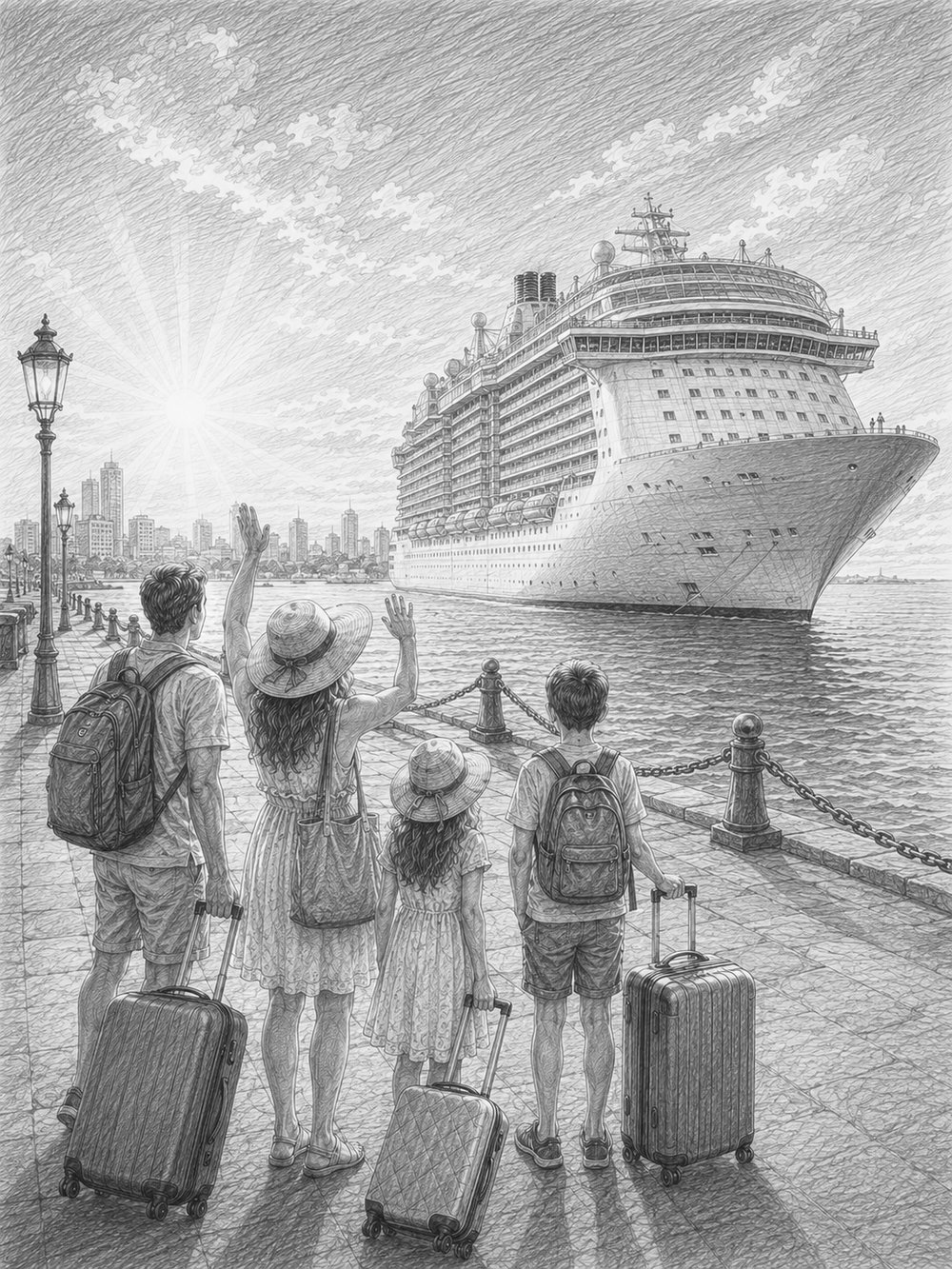
What do you actually need to know before booking Oasis of the Seas? In short: she is the original Oasis-class megaship, the one that invented the seven-neighborhood layout every giant Royal Caribbean ship copied afterward, and she sails round-trip from Cape Liberty in Bayonne, New Jersey, right across the harbor from Lower Manhattan. For much of the Northeast that means you can drive to a ship carrying more than 5,400 guests, skip the airport entirely, and be on a Caribbean itinerary the same afternoon. This guide walks through the ship at a glance, why her home port matters, how to picture the layout so you never feel lost, the itineraries she runs, and what to lock in before you sail.
Everything in this article and far more, deck by deck, in The Ultimate Guide to Sailing on Oasis of the Seas.
Get the book →The ship at a glance
Oasis of the Seas was the first of her class, debuting in 2009, and she rewrote what a cruise ship could be. Before Oasis, a big ship was essentially one tall tower of decks with a pool on top. Oasis split the vessel open down the middle, dropped in an actual open-air park, and organized everything into distinct districts she called neighborhoods. That idea worked so well it became the template for every megaship that followed. Since her debut she has been “amplified,” Royal Caribbean’s term for a major refit that adds newer features, so the ship you board today carries thrills and venues that did not exist when she first launched.
By the numbers she is roughly 226,838 gross tons across about 18 guest decks, carrying more than 5,400 guests at standard occupancy and up to around 6,800 when full. Those figures sound overwhelming, and Oasis is enormous. But the neighborhood design is what keeps it from feeling like a stadium. You spend your day in a garden, on a seaside pier, or on an indoor promenade, not in an anonymous crowd. The scale becomes an asset: more restaurants, more shows, more places to disappear when you want quiet.
One more thing worth setting straight. Oasis is not the newest ship in the fleet, and if you are chasing the single largest vessel afloat, that is a different ship. What Oasis offers is the mature, proven version of the concept, on an itinerary the Northeast can reach without flying. For a first cruise or a family trip, that combination is hard to beat. If you are still deciding whether this class of ship suits your style, our overview of what to expect on Oasis of the Seas goes deeper on the day-to-day rhythm.
Why sailing from Cape Liberty matters
Here is the detail that changes the entire calculation for anyone in the New York, New Jersey, Connecticut, or eastern Pennsylvania area. Oasis of the Seas home-ports at Cape Liberty in Bayonne, New Jersey. That terminal sits in the New York City area, across the water from Manhattan, with the Statue of Liberty in view as the ship pulls away. A giant Oasis-class ship you can drive to is genuinely rare, and it removes the two most stressful, most expensive parts of a warm-weather cruise: the flights and the risk of your luggage arriving a day late in a different port than you did.
Think about what a drive-to embarkation actually saves. No airfare for a family of four. No airport parking, no security lines, no weather delays that make you miss the ship. You load the car, drive to the port, hand off your bags at the pier, and park on site. For a longer sailing you can bring more of what you actually want without agonizing over weight limits, and the money you would have spent flying can go toward a better cabin or a specialty dinner instead.
One caveat to confirm: some Oasis sailings later shift to a Florida home port depending on the season. The Cape Liberty advantage only applies if your specific departure leaves from Bayonne, so check the departure port on your booking before you plan the drive. When a sailing does leave from Cape Liberty, budget for parking at the port and give yourself a comfortable arrival window, because thousands of cars converge on the same terminal on turnaround day. For a full breakdown of the drive, parking, and terminal logistics, see our guide to the Oasis of the Seas Cape Liberty cruise.
The seven neighborhoods
The seven-neighborhood layout is the single most useful concept for understanding this ship, because once you know the neighborhoods, you know where everything is. Oasis invented this design, and each district has its own character, its own crowd, and its own reason to exist.
- Central Park — an open-air garden running down the middle of the ship with thousands of live plants, winding paths, and quiet sit-down restaurants along the edges. It is the ship’s calm center, and it does not feel like a boat at all.
- Boardwalk — a seaside-pier family zone with a hand-carved carousel, casual eats, and the open-air AquaTheater carved into the very back of the ship. This is where kids gravitate.
- Royal Promenade — the indoor main street, lined with cafes, bars, and shops. It is the ship’s crossroads and the place parades and events happen.
- Pool and Sports Zone — the top-deck stack of pools, the Solarium, and the active features like the surf simulator and climbing wall.
- Vitality Spa and Fitness — the gym, treatment rooms, and wellness spaces for guests who want a workout or a massage.
- Entertainment Place — home to the casino, the ice-skating rink, and live-music venues, the ship’s after-dark heart.
- Youth Zone — the dedicated kids’ and teens’ areas that keep younger guests occupied and give parents room to breathe.
The practical payoff is that you can plan your day by neighborhood. Breakfast on the Royal Promenade, a lazy afternoon in Central Park, an evening show at the AquaTheater, then live music in Entertainment Place. You are not trekking randomly from deck to deck; you are moving between destinations that each make sense.
The three-band way to picture the ship
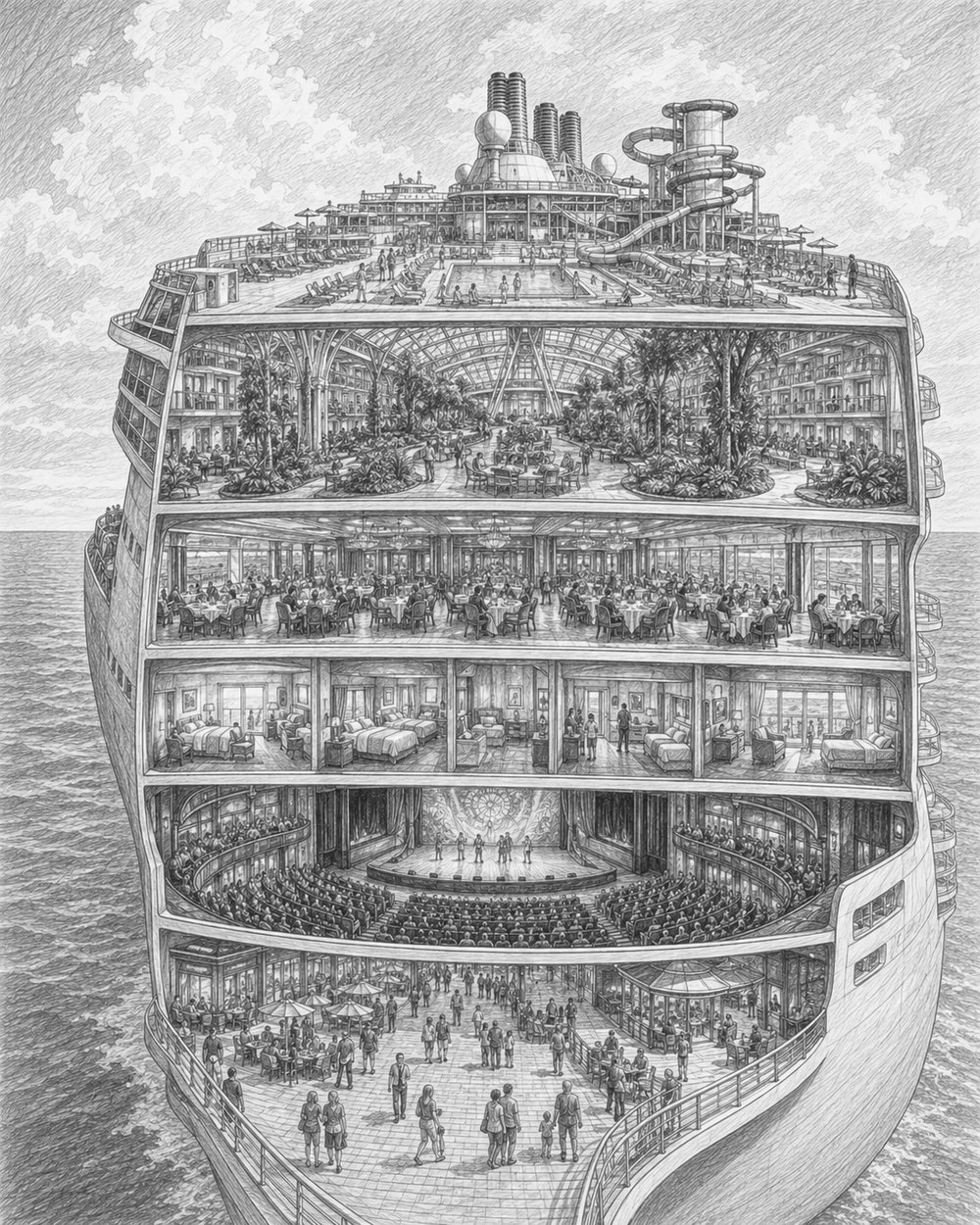
Deck maps of an Oasis-class ship look intimidating, so here is a mental model that makes the whole thing click. Picture the ship in three horizontal bands, and the neighborhoods sort themselves into place.
The top band is the sun-and-action layer: the pools, the Solarium, the surf simulator, the climbing wall, the tallest slide, and the sports areas. This is where you go to be outside, active, and loud. The middle band is the neighborhoods layer: Central Park and the Boardwalk sit here as open-air canyons cut into the middle of the ship, with cabins looking down into them, plus the shops and restaurants that line each one. This is the ship’s living room. The lower band is the indoor entertainment and dining core: the Royal Promenade, the main theater, the ice rink, the casino, and the main dining room, all the big enclosed venues you use after dark and in bad weather.
Hold those three bands in your head and you can navigate almost intuitively. Want sun? Go up. Want to stroll, shop, or eat outdoors? Stay in the middle. Want a show, a drink, or dinner? Head down and toward the center. It also helps you choose a cabin, because where your room falls relative to these bands determines how much noise and motion you get.
The itineraries she sails
Oasis of the Seas runs warm-weather itineraries round-trip from Cape Liberty, and the two you will see most often are a shorter Bahamas run and a longer Eastern Caribbean loop. Because schedules and ports change by season, treat the descriptions below as the shape of what she offers and confirm the exact ports for your sailing in the Royal Caribbean app before you book excursions.
Seven-night Perfect Day and Bahamas
The seven-night sailing pairs relaxing sea days with two marquee stops: Nassau in the Bahamas and Perfect Day at CocoCay, Royal Caribbean’s private island. Because you sail from the Northeast rather than Florida, the sea days are a genuine feature of this route, not wasted time. They give you full days to actually use the ship, which is the whole point when the ship is Oasis. At Nassau you are within reach of Paradise Island and Atlantis, the Queen’s Staircase and Fort Fincastle, and Junkanoo Beach. At CocoCay, the included beaches, the Oasis Lagoon pool, the freshwater areas, and the island tram come with your fare, while the Thrill Waterpark, the zip line, the Coco Beach Club, and the adults-only Hideaway Beach carry extra charges you can add in advance.
Nine-night Eastern Caribbean
The nine-night itinerary reaches farther south and adds ports such as Puerto Plata in the Dominican Republic alongside Nassau and CocoCay. Some longer sailings also call at San Juan, St. Thomas, or St. Maarten. Puerto Plata offers the Mount Isabel de Torres cable car, the Amber Cove port area, Fort San Felipe, and nearby beaches. If your sailing reaches San Juan you have Old San Juan and the fortresses of El Morro and Castillo San Cristóbal; St. Thomas puts Magens Bay and Charlotte Amalie’s shopping within reach; and St. Maarten brings Maho Beach, Philipsburg’s Front Street, and the French side at Marigot. The extra length also means more sea days, so the balance of ship time to port time shifts even further toward enjoying Oasis herself.
Which one is right depends on what you want. The seven-night run is the easier week off, lighter on cost and time, and heavy on the two crowd-pleasing stops. The nine-night run suits travelers who want more islands and do not mind extra sea days. Either way, verify the ports on your specific departure, because the same ship can run different sequences across the calendar. For help matching an itinerary to your family, our Oasis of the Seas ports and excursions guide breaks down each stop.
What to book before you sail
Oasis rewards planning more than a smaller ship does, simply because there is more to do and the best experiences fill up. A few things are worth handling before you ever set foot on the pier.
- The app. Download the Royal Caribbean app first. It holds your boarding pass, deck maps, the daily schedule, dining and show reservations, and check-in. It is the single tool that makes a ship this size manageable.
- Check-in time. Complete online check-in as soon as your window opens to claim an earlier boarding slot. On turnaround day at Cape Liberty, an earlier slot means more of your first day aboard.
- Specialty dining and shows. The AquaTheater diving show, the ice-skating show, and the Broadway-style production are popular, and specialty restaurants like Chops Grille and Giovanni’s book up. Reserve the ones you care about before you sail.
- CocoCay add-ons. If you want the Thrill Waterpark, the zip line, a Coco Beach Club day, or Hideaway Beach, book them ahead. They sell out, and prices are typically better in advance than onboard.
- A Wi-Fi plan, if you need one. There is no free ship-wide Wi-Fi; connectivity comes as a paid plan. Decide before you board whether you need it.
A note on how money works aboard. Your SeaPass card is the cashless key to everything, daily gratuities are automatically added to your account, and specialty dining, drinks packages, and shore excursions are extra on top of your cruise fare. Sorting the paid extras you actually want in advance keeps sticker shock off your final bill. More small-but-useful habits like these live in our Royal Caribbean Oasis of the Seas tips.
Dining, shows, and thrills in brief
You do not have to spend a dollar beyond your fare to eat well. Included dining covers the Main Dining Room, the Windjammer buffet, Café Promenade, Park Café, Sorrento’s for pizza, and El Loco Fresh for casual Mexican. When you want to mark an occasion, the specialty restaurants carry an extra charge and are worth it selectively: Chops Grille for steak, Giovanni’s Italian, Izumi for Japanese, Hooked Seafood, the fine-dining 150 Central Park, Portside BBQ, Playmakers sports bar, and Johnny Rockets. A good strategy is to eat included most nights and pick one or two specialty dinners as treats.
The entertainment is genuinely a highlight. Across a single cruise you get a Broadway-style theater production, a high-diving show at the open-air AquaTheater, and an ice-skating show on a full rink at sea, plus live music around the ship. Reserve the big productions early and you can see all of them without rushing.
For thrill-seekers, Oasis carries the amplified features that make this class famous. The Ultimate Abyss is a ten-story dry slide, the tallest slide at sea, dropping from the top deck down toward the Boardwalk. The Perfect Storm trio of waterslides, the FlowRider surf simulator, a rock-climbing wall, and a zip line strung across the Boardwalk keep active guests busy for days. The AquaTheater has the deepest pool at sea for its high-diving performers. For families there is Splashaway Bay for younger kids and multiple pools, while adults can retreat to the Solarium. Kids and teens have the Adventure Ocean program organized by age, dedicated teen spaces, and that hand-carved carousel. If this is your first sailing on the ship, our first-time cruise on Oasis of the Seas guide sequences all of it into a sane plan.
A short cabins overview
Cabin choice matters more on Oasis than on many ships, partly because of the neighborhood design and partly because a longer nine-night sailing from the Northeast is a long time to spend in the wrong room. The categories run from Interior rooms, some of which are Virtual Balcony cabins with a real-time ocean view on a screen, up through Ocean View, Ocean View Balcony, the inward-facing Central Park-view and Boardwalk-view balconies, and suites climbing to the Royal Loft and various loft and family suites.
For most travelers the value pick is an interior, or a Virtual Balcony interior if you want a little daylight feel without the price of a real balcony. The best all-round choice is a midship Ocean View Balcony on the mid-decks, where you get space, natural light, and the steadiest ride. The inward-facing balconies are a personality choice: Central Park balconies are quiet and green but have no sea view, while Boardwalk balconies are fun and put the AquaTheater below you, at the cost of show noise on performance nights.
A few locations to avoid, all of which you can check on the deck plan before booking: cabins directly under the pool deck, which get early scraping and dragging noise; cabins above or below the AquaTheater and Boardwalk venues, which catch show noise; rooms beside elevator banks; and far-forward high-deck cabins, which feel the most motion. On a nine-night run especially, spending a little effort to place your cabin well pays off every single night. Our deep dive on the best cabins on Oasis of the Seas names specific areas worth targeting.
Who Oasis of the Seas is best for
Oasis is at her best for Northeast families and groups who want a big-ship Caribbean vacation without the hassle and cost of flying. If you value driving to the pier, want enough onboard variety to keep a range of ages happy, and like the idea of sea days spent on a ship that feels like a floating resort town, she is an excellent fit. Multi-generational trips work especially well, because the neighborhood layout lets everyone pursue their own day and reconvene for dinner and a show.
She is a weaker match if you want the single newest or largest ship, if you prefer small intimate vessels, or if your priority is maximizing port time over ship time, since the Northeast itineraries lean into sea days. But for the core audience of drive-to families and first-time cruisers who want proven, well-rounded, big-ship fun, Oasis of the Seas remains one of the smartest choices on the water.
Plan your ports of call
Make the most of every day ashore with our in-depth port guides for the stops on this ship’s itineraries:
Get the complete Oasis of the Seas playbook
Ready to sail with a plan instead of a maybe? “The Ultimate Guide to Sailing on Oasis of the Seas,” part of the Ultimate Ship Guides series by Leo Sotropa, turns everything above into clear action steps in every chapter, from booking the right cabin to timing the shows and the ports. It is the shortcut to getting the most out of your Cape Liberty cruise.
Frequently asked questions
Where does Oasis of the Seas depart from?
Oasis of the Seas home-ports at Cape Liberty in Bayonne, New Jersey, in the New York City area, across the harbor from Lower Manhattan. That makes her a drive-to ship for much of the Northeast, with parking at the port and no need to fly. Some sailings later shift to a Florida departure, so always confirm the departure port on your specific booking.
How big is Oasis of the Seas?
She is roughly 226,838 gross tons across about 18 guest decks, carrying more than 5,400 guests at standard occupancy and up to around 6,800 when full. She was the first Oasis-class ship and the one that introduced the seven-neighborhood layout, later amplified with newer features.
What are the seven neighborhoods?
They are Central Park, the Boardwalk, the Royal Promenade, the Pool and Sports Zone, Vitality Spa and Fitness, Entertainment Place, and the Youth Zone. Each is a distinct district with its own character, which is what keeps a ship this large from feeling like a single crowded tower.
Which itineraries does Oasis of the Seas sail?
From Cape Liberty she typically runs a seven-night Bahamas sailing with sea days plus Nassau and Perfect Day at CocoCay, and a nine-night Eastern Caribbean sailing that adds ports such as Puerto Plata, with some longer runs reaching San Juan, St. Thomas, or St. Maarten. Confirm the exact ports for your sailing in the Royal Caribbean app.
What should I book before I sail?
Download the Royal Caribbean app, complete online check-in early for a better boarding time, and reserve the major shows, any specialty dinners, and paid CocoCay experiences like the Thrill Waterpark or zip line in advance. Decide on a Wi-Fi plan before boarding, since there is no free ship-wide Wi-Fi.
Which cabin should I choose?
For value, an interior or Virtual Balcony interior; for the best all-round experience, a midship Ocean View Balcony on the mid-decks for space, light, and a steady ride. Central Park balconies are quiet with no sea view, and Boardwalk balconies are fun but can be noisy on show nights. Check the deck plan to avoid rooms under the pool deck, near the AquaTheater, beside elevators, or far-forward high up.
Is Oasis of the Seas good for families?
Yes. Between Splashaway Bay, the Adventure Ocean youth program, the carousel, the slides, and the range of dining, she suits families and multi-generational groups especially well, and the drive-to home port removes the cost and stress of flying with kids. Everyone can pursue their own day across the neighborhoods and meet for dinner and a show.
Ready for the whole ship in one place? It is all in The Ultimate Guide to Sailing on Oasis of the Seas.
Get the book →
Meet Leo: The Heartbeat Behind ‘A Country A Month’
Journeying through the pages of A Country A Month, you might often feel the rhythm of a storyteller’s heartbeat, pulsating through each line, each image, and each adventure shared. That heartbeat belongs to none other than our remarkable website editor, Leo.
With a lens in one hand and a pen in the other, Leo seamlessly marries his passions for photography and writing. His eye captures moments that words can barely describe, yet his eloquence brings those images to life, transcending borders and connecting us all through shared stories. An avid traveler, every country he’s visited has added another chapter to his expansive tale, and through our platform, he generously shares these chapters with us.