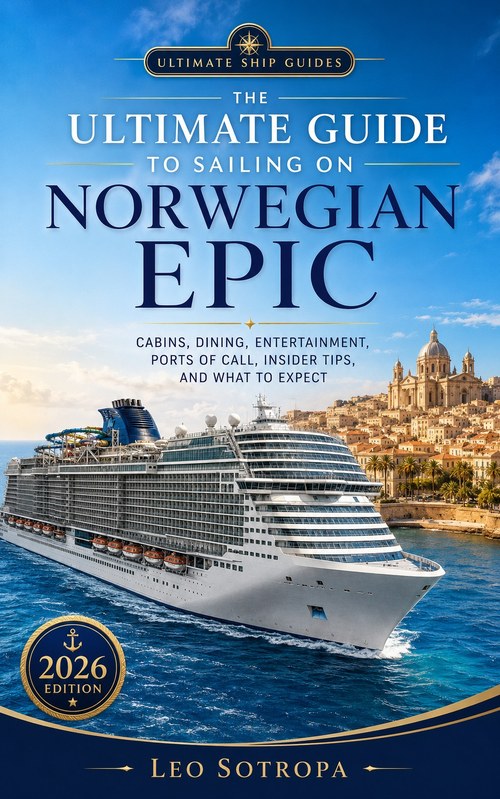
Is there a single, honest handbook that gets you ready for a sailing on Norwegian Epic without drowning you in generic cruise advice? Yes. The Ultimate Guide to Sailing on Norwegian Epic by Leo Sotropa is exactly that — an independent, ship-specific handbook devoted to one vessel, Norwegian Cruise Line’s boldest one-off megaship. If you have a voyage booked, or you are still deciding, this Norwegian Epic book walks you through her decks, her cabins, her restaurants, her thrills, and her Mediterranean ports so you board knowing what to do first and what to skip.
Epic is a strange and wonderful ship. She has curved cabin walls, split “wave” bathrooms, the first bowl slide at sea, a real ice bar kept at seventeen degrees Fahrenheit, and a whole complex of solo studio cabins that no ship had tried before her. She rewards people who understand her quirks and quietly frustrates the ones who don’t. This guide exists to put you firmly in the first group. Below is a full picture of what the book covers, who it helps, and why a book written about one ship beats a broad primer that treats every cruise as the same.
What this book actually is
This is an independent, unofficial handbook to Norwegian Epic, part of Leo Sotropa’s Ultimate Ship Guides series. It is not published by the cruise line and it is not a sales brochure. That independence matters, because it means the book can tell you plainly which cabins to avoid, when a specialty restaurant is worth the extra charge and when it isn’t, and where the ship’s layout will trip you up. A generic cruise primer can only speak in averages. This one is written around the actual spaces on Epic — her roughly nineteen decks, her Aqua Park, her Studios, The Haven, and the specific ports she calls on in the Western Mediterranean.
The book comes in two formats: a Kindle ebook you can keep on your phone through the whole trip, and a 6×9 paperback that travels well and makes an easy gift. It is illustrated with graphite chapter illustrations, and — this is the part frequent readers of the series come back for — every chapter ends with clear, practical Action Steps. Those are the concrete to-dos: reserve this before you board, check that on the deck plan, pack this for that port. You are never left with a pile of interesting facts and no idea what to do with them.
One honest note the book makes early and often: ships change. Venues get refreshed, itineraries shift by season, and prices move. So the guide is written in the present tense and points you to the Norwegian Cruise Line app to confirm the current lineup, your exact ports, and today’s pricing. It gives you the judgment and the strategy; the app gives you the live details. Used together, they cover you.
What’s inside
The book follows the structure that runs through the whole Ultimate Ship Guides series, applied specifically to Epic. Here is what each part gives you.
The ship, deck by deck
Epic is big — around 155,000 gross tons, roughly nineteen decks, and about 4,100 guests at double occupancy — and she is laid out in a way that surprises first-timers. The opening chapters give you a tour of her decks and spaces and, more usefully, teach you how to move around her without burning vacation time getting lost. You learn where the pools, the buffet, the theater, the Aqua Park, and the quiet corners sit relative to each other, so on day one you are orienting yourself instead of wandering. The book also explains what makes Epic a one-off: she has no sister ships, she pioneered ideas that later shaped the modern NCL fleet, and she was built around Freestyle Cruising from the keel up.
The cabin guide — which to book, which to avoid
This is the chapter that pays for the book. Epic’s cabins run from the value Inside and the famous solo Studios up through Oceanview, Balcony, Mini-Suites, Spa cabins, and The Haven suites at the top. The guide walks through each category with a plain recommendation. For value on your own, a solo Studio; for value as a couple, an Inside. For the best all-round experience, a midship Balcony on the mid-decks, where you get light, space, and the steadiest ride. For the top of the range, The Haven.
Just as important, it names the cabins to avoid and tells you why: rooms directly under the pool deck or the Garden Café, where you will hear scraping deck chairs early in the morning; rooms near nightlife venues like Spice H2O or the theater; forward high-deck cabins for anyone prone to seasickness; and lower-deck rooms with obstructed views. It also warns you about something specific to this ship — Epic’s curved-wall layouts and split “wave” bathrooms, where the sink, toilet, and shower are separated. Some guests love the design; some laugh at it; a few would rather have known before booking. The book makes sure you are in the first two camps by choice, not the third by accident. You will be sent to the deck plan to confirm your exact room, which is the single habit that prevents most cabin regret.
The dining guide and Freestyle Cruising
To eat well on Epic you first have to understand Freestyle Cruising, and the book explains it clearly. There are no fixed dining times, no assigned tables, and no formal dress codes. You dine when, where, and with whom you like across a large range of restaurants. The complimentary options include the main dining rooms — Taste and the Manhattan Room — and the Garden Café buffet. Many specialty restaurants carry an extra charge or run through a dining package, and reservations genuinely help at peak times.
The dining chapter sorts all of this out for you. It covers which venues are included, which specialty spots are worth the splurge, and what to reserve before you board. On Epic the specialty roster includes Cagney’s Steakhouse, Le Bistro for French, La Cucina for Italian, Teppanyaki for Japanese hibachi, Moderno Churrascaria for Brazilian, and Ocean Blue for seafood, among others. The guide helps you decide where a dining package pays off and where a free option is genuinely the better meal, so you spend on the experiences that reward it. It also points you to the ship’s distinctive bars, from the Ice Bar with its frozen glasses to the Maltings whiskey bar and the Latin and mojito spots.
Entertainment and the signature thrills
Epic has always taken entertainment seriously. She has staged full Broadway-scale productions — shows such as “Priscilla, Queen of the Desert” and “Burn the Floor” — alongside a comedy club, the Cavern Club Beatles tribute, and live music around the ship. The book covers the headline shows and, crucially, the insider timing that lets you enjoy them without standing in long lines. Because the lineup rotates, it tells you to confirm the current shows in the app, but it teaches you the strategy that works regardless of what is playing.
Then there are the thrills. The Aqua Park has two pools, several hot tubs, a kids’ area, and multi-story waterslides — including the Epic Plunge, the first bowl slide at sea. The Ice Bar is a genuine novelty, an authentic seventeen-degree room with ice sculptures where your drink arrives in a glass made of ice. Spice H2O is the adults-only sundeck and lounge, calm relaxation by day and dancing under the stars by night. The guide tells you when to hit each of these to beat the crowds, which is the difference between a two-minute wait and a forty-minute one.
The ports of call
The ports chapter is one of the fullest in the book, because Epic’s marquee season in this guide is the Western Mediterranean, and that itinerary is a serious travel opportunity, not just a string of beach days. She sails seven-night voyages round-trip from Barcelona and one-way between Barcelona and Rome, spring through autumn. The ports typically include Palma de Mallorca in the Balearics, Marseille or Toulon for Provence, Cannes on the French Riviera, Ajaccio in Corsica, Florence and Pisa from Livorno, Rome from Civitavecchia, and Naples for Pompeii, Capri, and the Amalfi Coast. Exact ports vary by sailing, so you are told to confirm your own itinerary — but the destination guides, top excursions, and must-do shortlists give you a plan for each.
The chapter is honest about the real challenge of this itinerary: several of the greatest sights are inland. Florence and Pisa are a distance from Livorno, Rome is well inland from Civitavecchia, and Pompeii and the Amalfi Coast are a trip from Naples. That makes an organized tour or a well-planned independent train or transfer essential, and it makes returning before all-aboard critical, because the distances are unforgiving. The book helps you weigh a ship excursion against going independent for each port, and it flags the landmarks — the Sagrada Família in Barcelona, the Colosseum and the Vatican in Rome, the Leaning Tower, La Seu cathedral in Palma, the Croisette in Cannes, Napoleon’s birthplace in Ajaccio — where timed tickets sell out and advance booking saves your day. The payoff it keeps in view is real: this is one of the few cruises that pairs beaches and glamour with Gaudí, ancient Rome, Renaissance Florence, and Pompeii, all reachable on day trips from the ship.
Honest money advice
The money chapter is where independence really shows. It lays out what is already included in your fare so you don’t pay twice for things you already have, explains when packages — dining, drinks, Wi-Fi — actually pay off and when they don’t, and shows you how to avoid the upcharges that quietly inflate a bill. Prices are always discussed in relative terms, because numbers change, but the logic of when to spend and when to hold back does not. Your key card runs your onboard account as a cashless system, service charges and gratuities apply, and Wi-Fi is a paid plan; the book makes sure none of that catches you off guard.
Family, adults-only, embarkation, and pro tips
Epic works for very different travelers on the same sailing, and the book speaks to each. There is family know-how for parents balancing the Aqua Park, kids’ areas, and dining logistics, and there are the adults-only escapes — Spice H2O above all — for people who want quiet. Solo travelers get special attention, because Epic is where NCL pioneered its Studios: compact cabins priced for one, with keycard access to a private Studio Lounge. That is a genuine point of difference, and the guide explains how to make the most of it.
There is a dedicated embarkation-day strategy, because how you handle boarding sets the tone for the whole week — what to carry on, what to do first while everyone else queues, how to start enjoying the ship before your cabin is even ready. And the book closes with a chapter of pro tips, common pitfalls, and FAQs that catch the small mistakes people make on this specific ship. As with every chapter, each one ends with Action Steps, so you finish reading with a checklist rather than a vague sense of being informed.
The Haven
Epic also carries The Haven by Norwegian, an exclusive, keycard-only suite complex — effectively a ship-within-a-ship with its own private courtyard, pool, restaurant, lounge, and butler service. The guide explains who The Haven is really for and whether the step up is worth it for the kind of trip you have in mind, which is exactly the sort of judgment call a brochure will never make for you.
Who it’s for
The book is written for four kinds of reader, and it earns its place with each of them.
- First-timers who have never sailed and feel the pre-cruise nerves. Freestyle Cruising, the cabin choices, and Epic’s odd layout are all explained from the ground up, so a complete beginner boards feeling capable.
- Families juggling different ages, budgets, and energy levels, who need a plan that keeps kids happy and adults sane across a port-heavy week.
- Seasoned cruisers who know their way around a ship but have never sailed Epic specifically. She is unusual enough that even veterans pick up things they didn’t know — the split bathrooms, the Studio system, the quirks of her deck plan.
- Gift buyers looking for something thoughtful for a friend or family member with a sailing booked. The paperback, with its illustrations and Action Steps, makes a genuinely useful present rather than a token one.
Why a ship-specific guide beats a generic primer
A general cruise book has to hedge. It cannot tell you which cabin number to avoid, because it doesn’t know your ship. It cannot say which restaurant is the better splurge, because it isn’t looking at Epic’s menu of venues. It cannot warn you that your bathroom might be split into three separate cubicles, because that is an Epic peculiarity, not a rule of cruising. Averages are safe and nearly useless when you are standing on a real deck plan trying to make a real decision.
Specificity is also what lowers pre-cruise stress. Most of the anxiety before a cruise comes from unanswered questions — where do I go first, did I book the right room, what do I reserve, how do I do the inland ports without missing the ship. This book answers those questions for Epic in particular, and the Action Steps convert each answer into something you actually do. You trade a swirl of what-ifs for a short list of done-its. That is the quiet value of a guide built around one ship: it doesn’t just inform you, it settles you.
About the author and the series
Leo Sotropa writes the Ultimate Ship Guides series, a growing set of independent, ship-by-ship handbooks for cruisers who want honest, practical detail about the exact vessel they are sailing. The through-line across the series is the same one you get here: real recommendations, clear warnings, relative pricing that stays useful over time, and Action Steps that end every chapter.
The series has a free companion library at acountryamonth.com, where you can read about Epic before you decide to buy the full book. If you want a feel for the coverage and the voice, start with the Norwegian Epic cruise guide, then read what to expect on Norwegian Epic for a first-timer’s overview. Solo travelers should look at the piece on Norwegian Epic’s solo Studio cabins, and anyone sailing the Med will want the Western Mediterranean season overview and the deeper Mediterranean ports guide. The free articles are a fair preview; the book is the complete, organized version you carry with you.
Get The Ultimate Guide to Sailing on Norwegian Epic
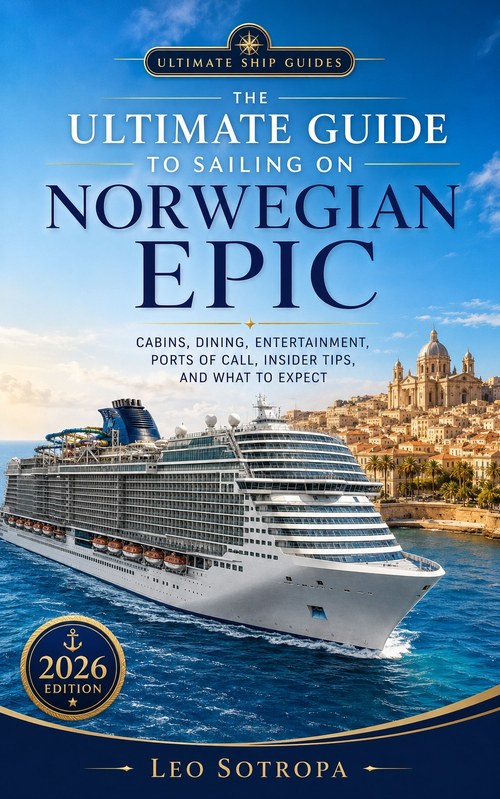
The Ultimate Guide to Sailing on Norwegian Epic by Leo Sotropa, part of the Ultimate Ship Guides series, is an independent handbook to NCL’s quirkiest megaship — cabins, dining, thrills, and Western Mediterranean ports — available on Kindle and paperback, with clear Action Steps in every chapter.
Frequently asked questions
Is this an official Norwegian Cruise Line book?
No. It is an independent, unofficial handbook written by Leo Sotropa as part of the Ultimate Ship Guides series. Because it isn’t published by the cruise line, it can be candid about which cabins to avoid, which specialty restaurants are worth the extra charge, and where Epic’s layout works against you — the kind of honest detail a promotional booklet won’t give you.
Should I get the Kindle or the paperback?
Both cover the same material, so it comes down to how you like to use it. The Kindle ebook lives on your phone and is easy to search in the moment — handy in port or when you are choosing a restaurant. The 6×9 paperback, with its graphite illustrations, is pleasant to read cover to cover before the trip and makes a natural gift. Plenty of readers keep the ebook for the ship and give the paperback to a fellow traveler.
Is the book up to date?
The guide reflects the latest edition and is written in the present tense. Because ships change — venues get refreshed, itineraries shift by season, and prices move — it deliberately keeps pricing relative and tells you to confirm the current venues, your exact ports, and today’s prices in the Norwegian Cruise Line app. You get the strategy and judgment from the book; you get the live details from the app.
Does it cover Epic’s specific ports?
Yes. The ports chapter is built around Epic’s Western Mediterranean season — Barcelona, Palma de Mallorca, Marseille or Toulon, Cannes, Ajaccio, Florence and Pisa from Livorno, Rome from Civitavecchia, and Naples for Pompeii and the Amalfi Coast — with destination guides, top excursions, and must-do shortlists. It is especially useful for the inland sights, where timing your return before all-aboard really matters. Since exact ports vary by sailing, you are told to confirm your own itinerary.
Is it good for first-time cruisers?
Very much so. It explains Freestyle Cruising, the cabin categories, dining, and embarkation from the ground up, and every chapter ends with Action Steps that turn what you have read into a short list of things to do. First-timers are the readers who tend to get the most out of it, because it removes the guesswork that causes most pre-cruise nerves.
Would it make a good gift?
It does. For anyone with an Epic sailing booked, the paperback is a thoughtful, genuinely useful present — illustrated, easy to read, and packed with practical steps rather than filler. It suits first-timers who could use the reassurance and seasoned cruisers who have never sailed this particular, unusual ship.
Does it replace the Norwegian Cruise Line app?
No, and it isn’t meant to. The app is where you confirm live details — the current show lineup, your exact itinerary, today’s prices, and your daily schedule. The book is where you get the planning, the judgment, and the strategy that the app doesn’t provide: which cabin to book, what to reserve before boarding, how to handle the inland ports, and where to spend. Use them together and you are covered from booking to disembarkation.

Meet Leo: The Heartbeat Behind ‘A Country A Month’
Journeying through the pages of A Country A Month, you might often feel the rhythm of a storyteller’s heartbeat, pulsating through each line, each image, and each adventure shared. That heartbeat belongs to none other than our remarkable website editor, Leo.
With a lens in one hand and a pen in the other, Leo seamlessly marries his passions for photography and writing. His eye captures moments that words can barely describe, yet his eloquence brings those images to life, transcending borders and connecting us all through shared stories. An avid traveler, every country he’s visited has added another chapter to his expansive tale, and through our platform, he generously shares these chapters with us.