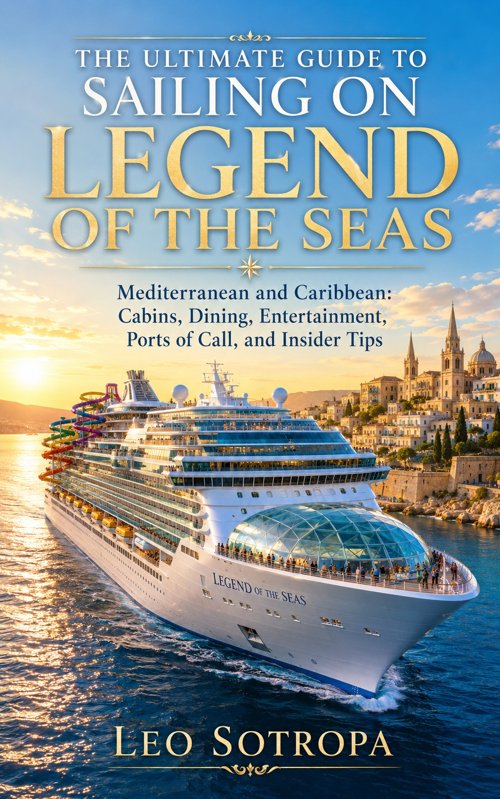
Looking for a straight answer on the Legend of the Seas book before you sail? The Ultimate Guide to Sailing on Legend of the Seas: Mediterranean and Caribbean by Leo Sotropa is an independent, ship-specific handbook to Royal Caribbean’s Legend of the Seas — the largest and newest of the Icon Class. It exists to answer the questions people actually ask before a cruise: which cabin should I book, what is worth reserving before I board, how do I skip the worst lines, and how do I avoid paying for things already included. If you have a sailing booked, or are deciding whether to book one, this page explains what the guide covers, who it helps, and why a book written for one ship beats a general cruise primer.
Legend of the Seas is unusual even within its own class. She is the only Icon-Class ship that splits her year across two regions — the Western Mediterranean in summer and the Caribbean in winter — and she revives a legacy name from Royal Caribbean’s 1990s fleet, with a scale model of the original ship displayed aboard. That dual personality is why a dedicated guide matters: a book that treats her as just another big ship misses half of what makes a sailing on her work.
What the Legend of the Seas book actually is
This is not an official Royal Caribbean publication, and it does not pretend to be. It is an independent, unofficial handbook written for real passengers, part of the Ultimate Ship Guides series. That independence is the point: the author has no cabins to sell and no packages to push, so the advice can tell you plainly which staterooms to avoid and when an add-on is a waste of money. The book is built around one ship rather than the fleet, so every deck, venue, and recommendation is specific to Legend of the Seas rather than a watered-down average of a dozen vessels.
The guide comes in two formats — a Kindle ebook you can search in port, and a 6×9 paperback you can mark up and hand to a travel companion. It is illustrated with graphite chapter illustrations, and every chapter closes with a short set of practical Action Steps, so you are never left with interesting information and no idea what to do with it. Because cruise details change, the book repeatedly tells you to confirm current specifics — venues, itineraries, and prices — in the Royal Caribbean app rather than trusting any printed figure. Prices are kept relative on purpose: it tells you when something tends to be worth the money, not a number that will be out of date by your sailing.
If you want to sample the approach before you buy, the same author maintains free companion guides for this ship. You can start with the Legend of the Seas cruise guide and the overview of what to expect on Legend of the Seas, then decide whether the full book is worth it for your trip.
What is inside the book
The guide follows the shape of a real cruise, from the moment you are trying to find your way around to the day you disembark. Here is what each part of it does for you.
The ship, deck by deck
Legend of the Seas is enormous — roughly 250,800 gross tons across about 20 decks, carrying up to around 7,600 guests at full occupancy — and organized into eight neighborhoods: Royal Promenade, Central Park with its real plants, the glass-domed AquaDome, Chill Island, Thrill Island, Surfside, the adults-only Hideaway, and the Suite Neighborhood. The book walks you through how these spaces connect and how to move between them without backtracking or riding the wrong elevators. On a ship this size, simply knowing where things are — and which routes are shortcuts — is the difference between spending your first two days lost and spending them at the pool.
The cabin guide: which to book, which to avoid
This is the chapter most readers open first, and for good reason: your cabin is the single most expensive decision you make, and the one you cannot change once you sail. Legend has around 28 stateroom types across Interior, Ocean View, Balcony, and Suite tiers, plus specialty rooms like Central Park-view balconies, AquaDome Panoramic ocean-view cabins, Surfside family rooms, and the Infinite balcony, where a window wall drops down inside the room rather than opening onto a ledge.
The book gets specific about value. Interior Plus rooms, with a bigger walk-in closet, tend to be the smart budget pick. For the best all-round experience it points to midship Ocean View Balconies on Decks 8 to 10, where you get space, light, and the least motion, and it flags that a Central Park-view balcony is quiet and sheltered but has no sea view. Legend also introduces a ship-specific room the guide highlights: the Family Ocean View Balcony (Category FB), roughly 285 square feet with a genuine step-out verandah of about 50 square feet, unlike the infinite balconies elsewhere in the class; many adjoin through a shared vestibule so families can connect up to about a dozen people.
Just as important, it tells you what to avoid, and why. Rooms directly under the pool deck and Chill Island on Deck 14 catch scraping deck chairs; cabins under the adults-only Hideaway pool aft on Deck 14 catch party noise; rooms near the AquaDome on Decks 12 and 14 can feel show bass; interior-facing Central Park and Surfside rooms look onto busy walkways; and far-forward high suites on Decks 16 to 18 feel the most motion. The book tells you to confirm any specific cabin against the live deck plan before booking, because layouts get adjusted. For suite seekers it explains the Royal Suite Class tiers — Sea, Sky, and Star — and points to the Sky Junior Suite as the value entry into the Suite Neighborhood, with its private sun deck and suite-only restaurants. You can preview this thinking in the free best cabins on Legend of the Seas article before committing to a category.
The dining guide: included, splurge, and what to reserve
Dining on a modern Royal Caribbean ship is a maze of included venues and extra-cost specialty spots, and the book maps it cleanly. On the included side you have the Main Dining Room, the Windjammer buffet, Surfside Eatery, and the AquaDome Market food hall — which on Legend has its own line-up of stalls, including Seoulmate for Korean, Adobo for Mexican, Cajun Kitchen for New Orleans flavors, La Española for Spanish tapas, and Simply Pressed for juices and smoothies. You could eat well all week without paying a cent extra, and the guide shows you how.
Then it gets honest about the specialty restaurants that cost more. Two are unique to Legend and get real attention: Hollywoodland Supper Club, a dinner-and-show venue themed on Hollywood’s Golden Age, and Royal Railway — Legend Station, an immersive train-carriage restaurant themed on the Silk Routes of Marco Polo, serving cuisines of India, China, Persia, Italy, and Turkey — the only restaurant of its kind in the class. Alongside them sit familiar names like Chops Grille and Izumi. The book tells you which experiences are worth the splurge, which are more spectacle than meal, and — critically — what to reserve before you board, because the best tables and show slots sell out early. Its dining advice goes well beyond the free Royal Caribbean Legend of the Seas tips page.
Entertainment and the signature thrills
Legend carries a genuinely headline entertainment slate, and the book gives you the timing tricks to see it without queuing your vacation away. The main theater stages Roald Dahl’s Charlie and the Chocolate Factory in its debut at sea, and the ship hosts America’s Got Talent LIVE at Sea — the first time that format has been staged on a cruise ship. On ice there is Fusion at the Absolute Zero rink, and the AquaTheater runs Shockwave: A Battle for the Beat. There is also Casino Royale, the cruise line’s largest casino at sea, spanning two decks.
For thrill-seekers, Legend carries the Category 6 waterpark — the largest at sea — with six record-setting slides including the tallest drop at sea and an open free-fall slide, plus a FlowRider surf simulator, the Crown’s Edge skywalk out over the water, and a rock wall. There are seven pools, among them Royal Bay (the largest pool at sea), the Swim & Tonic swim-up bar, the adults-only Hideaway, the Chill Island pools, and Splashaway Bay for kids. The point of the entertainment chapter is not to list all this — you can find a list anywhere — but to tell you when to show up so you beat the lines and get a seat.
Ports of call: Mediterranean and Caribbean
Because Legend sails two very different seasons, the ports chapter effectively covers two cruises. In the Mediterranean summer she runs 7-night Western Mediterranean loops, alternating home ports between Barcelona and Rome (Civitavecchia), with calls that can include La Spezia, Marseille, Palma de Mallorca, Naples, and Málaga. The guide points you toward the landmarks worth planning around — Barcelona’s Sagrada Família and Gaudí architecture, Palma’s cathedral and old town, La Spezia as the gateway to the Cinque Terre and to Florence and Pisa inland, Marseille’s Old Port and Notre-Dame de la Garde, Naples for Pompeii and the Amalfi Coast, and Málaga’s Alcazaba fortress. It is honest about transfer times, too — Rome is roughly a 1.5-hour transfer from the Civitavecchia port — so you plan the day rather than lose it to a coach.
In the Caribbean winter she sails round-trip from Fort Lauderdale (Port Everglades) on 6-night Western Caribbean itineraries — Perfect Day at CocoCay, Falmouth in Jamaica, and Labadee in Haiti — and 8-night Southern Caribbean runs to Curaçao, Aruba, Cabo Rojo in Puerto Rico, and CocoCay. The book covers what is included versus what costs extra at Royal Caribbean’s private destinations (CocoCay’s beaches and Oasis Lagoon are included; the Thrill Waterpark, zip line, and Coco Beach Club are paid), and it shortlists the excursions worth booking, from Dunn’s River Falls near Falmouth to Willemstad’s colorful UNESCO waterfront in Curaçao. Exact ports vary by sailing, which is why it sends you to the app to confirm — and why the free Legend of the Seas ports and excursions guide is a useful planning companion.
Money, value, and avoiding upcharges
The money chapter is where an independent guide earns its keep. It lays out what is already included in your fare, when a package (drinks, dining, internet) actually pays off for how you travel, and how to sidestep the small upcharges that quietly add up over a week. It explains how the SeaPass card works as your cashless onboard account, that daily gratuities are added automatically, and that there is no free ship-wide Wi-Fi — connectivity comes as a paid plan. Having all of it laid out before you sail is what stops the end-of-cruise bill from being a surprise, and because the advice stays relative rather than quoting prices, it holds up regardless of when you sail.
Family know-how and adults-only escapes
Legend is built to carry families and couples at the same time, and the book treats both. For families there is Adventure Ocean for kids, Splashaway Bay for the youngest, a dedicated teen space, and the whole Surfside neighborhood with its carousel, splash zone, and casual food. For adults there is the Hideaway with its adults-only pool and the calmer end of the ship. The guide helps a family group split up and reconnect without friction, and helps couples find the pockets where the crowds thin out.
Embarkation-day strategy and the Action Steps
Embarkation sets the tone for the whole trip, and the book gives you a plan for it — how to use the Royal Caribbean app as your boarding pass, deck map, daily schedule, and reservation hub, and what to do in your first hour aboard before the crowds catch up. Then there is a full chapter of pro tips, common pitfalls, and FAQs. Tying it all together, every chapter ends with clear Action Steps: a short, concrete checklist that turns the reading into decisions. That structure is what makes the guide useful rather than merely interesting — you can read a chapter and immediately know your next three moves.
Who the book is for
The guide serves a wide range of travelers without watering itself down for any of them. First-timers get the orientation and reassurance they need — how a big ship works, what to book ahead, and how not to feel lost on day one. Families get the practical logistics of moving kids, teens, and grandparents around a floating resort. Seasoned cruisers get the ship-specific detail general cruise advice cannot give: the exact cabins to avoid, the Legend-only venues worth reserving, and the timing tricks for this ship’s shows and slides.
It also makes a genuinely thoughtful gift. If someone you know has a Legend of the Seas sailing booked, the paperback is a present that gets used — something they will actually open before the trip and carry during it, because it is tied to the specific cruise they are already excited about.
Why a ship-specific guide beats a generic cruise primer
General cruise books have to hedge. They cannot tell you which deck to avoid or which restaurant to book, because they are describing an entire industry at once. A ship-specific guide does the opposite: it commits. It names the exact cabin categories, the exact venues, and the exact ports, then tells you what to do about each. On a ship as large and unusual as Legend of the Seas — the biggest Icon-Class vessel, with a two-region itinerary and several venues found nowhere else in the class — that specificity is the whole value. Generic advice about “the buffet” or “a balcony room” does not help when the ship has a food hall of named stalls, a train-themed restaurant, and a step-out family verandah that behaves differently from every other balcony onboard.
The real problem the book solves is pre-cruise stress. A cruise this size can feel like a lot to figure out: hundreds of decisions, dozens of venues, reservations that open and close before you sail, and a fare structure full of things that may or may not be included. The guide replaces that anxiety with a plan. By the time you board, you already know your cabin logic, your dining reservations, your show timing, your port shortlists, and your budget guardrails, and you spend your vacation enjoying the ship instead of decoding it.
About the author and the Ultimate Ship Guides series
The book is written by Leo Sotropa as part of the Ultimate Ship Guides series — a collection of independent, single-ship handbooks that each do the same job for a different vessel. The series philosophy is consistent: cover one ship deeply, stay honest about what is worth it, keep prices relative so the advice stays useful, and end every chapter with Action Steps so readers leave with decisions rather than trivia. The companion website, acountryamonth.com, hosts free guides for the ships in the series, including the full set of Legend of the Seas articles, so you can read a good amount before deciding whether the complete book is right for you. The book pulls everything into one organized, offline-friendly place you can carry aboard.
Get The Ultimate Guide to Sailing on Legend of the Seas
The Ultimate Guide to Sailing on Legend of the Seas: Mediterranean and Caribbean by Leo Sotropa is an independent, ship-specific handbook in the Ultimate Ship Guides series, available on Kindle and paperback, with clear Action Steps in every chapter so you know exactly what to book, what to skip, and what to do next. It is the fastest way to turn a huge, unfamiliar ship into a cruise you have already figured out.
Frequently asked questions
Is this an official Royal Caribbean book?
No. It is an independent, unofficial guide written for passengers, not by the cruise line. That independence is deliberate — it lets the book tell you which cabins to avoid, which add-ons are not worth the money, and where the fare structure catches people out, without any pressure to sell you a room or a package.
Should I get the Kindle or the paperback?
Both formats have the same content, so it comes down to how you travel. The Kindle version lives on your phone, is searchable, and is easy to check in port or while booking reservations. The 6×9 paperback is nicer to read straight through, easy to mark up, and simple to hand to a companion or give as a gift. Plenty of readers use the ebook for the trip and keep the paperback for planning.
Is the book up to date?
The guide reflects the latest edition and is written to stay useful over time. Rather than printing prices and schedules that quickly go stale, it keeps money advice relative and points you to the Royal Caribbean app to confirm current venues, itineraries, and prices for your sailing, so the strategy still holds even as details shift.
Does it cover Legend of the Seas’ specific ports?
Yes, and because Legend sails two regions, the ports chapter effectively covers two cruises. It handles the Western Mediterranean season out of Barcelona and Rome — with calls like La Spezia, Marseille, Palma de Mallorca, Naples, and Málaga — and the Caribbean season out of Fort Lauderdale, including Perfect Day at CocoCay, Falmouth, Labadee, Curaçao, Aruba, and Cabo Rojo. It flags landmarks, transfer times, and which shore excursions are worth booking.
Is it good for first-time cruisers?
Especially so. First-timers get the orientation they need without being talked down to — how a ship this size works, what to reserve before boarding, how the app and SeaPass card function, and what to do on embarkation day. The Action Steps at the end of each chapter turn all of it into a short checklist, so a nervous first cruise becomes a planned one.
Would it make a good gift?
It does, particularly the paperback. If someone you know has a Legend of the Seas cruise booked, this is a present tied to a trip they are already looking forward to — something they will actually read and use rather than set aside. It reads as a thoughtful, specific choice instead of a generic travel gift.
Does the book replace the Royal Caribbean app?
No — it works alongside it. The app is your live tool onboard for the boarding pass, deck maps, the daily schedule, reservations, and check-in, and the book repeatedly tells you to confirm current details there. What the book adds is the judgment the app does not: which cabin to book and which to avoid, what is worth the splurge, when to show up for shows and slides, and how to spend your money well. The app tells you what is happening; the book tells you what to do about it.

Meet Leo: The Heartbeat Behind ‘A Country A Month’
Journeying through the pages of A Country A Month, you might often feel the rhythm of a storyteller’s heartbeat, pulsating through each line, each image, and each adventure shared. That heartbeat belongs to none other than our remarkable website editor, Leo.
With a lens in one hand and a pen in the other, Leo seamlessly marries his passions for photography and writing. His eye captures moments that words can barely describe, yet his eloquence brings those images to life, transcending borders and connecting us all through shared stories. An avid traveler, every country he’s visited has added another chapter to his expansive tale, and through our platform, he generously shares these chapters with us.