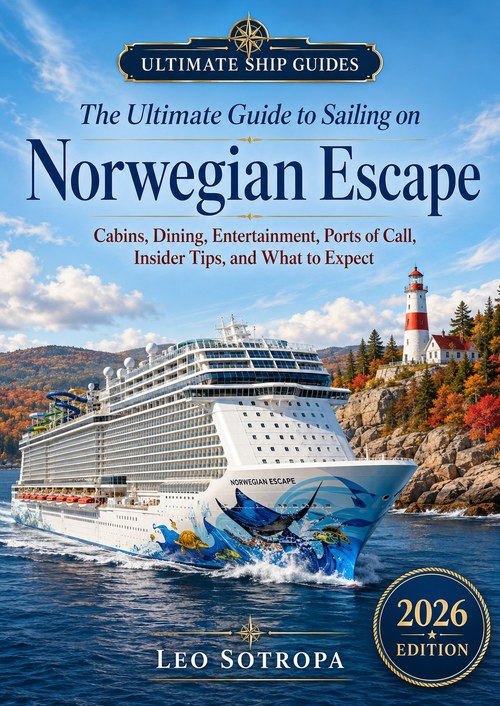
Is The Ultimate Guide to Sailing on Norwegian Escape the book that will actually make your cruise easier, or just another cruise primer? It is a ship-specific handbook to one ship — Norwegian Escape, from Norwegian Cruise Line — written by Leo Sotropa as part of the Ultimate Ship Guides series. If you have a sailing booked, or you are deciding whether Escape is the right ship for you, this Norwegian Escape book walks you through her decks, her cabins, her dining, her thrills, and the Canada and New England ports she calls, so you step aboard already knowing where to go and what to skip.
Escape is a big ship. Around 165,000 gross tons, roughly 20 decks, and about 4,218 guests at double occupancy — the ship that launched Norwegian’s Breakaway Plus Class and the design later carried forward into Joy, Bliss and Encore. That size is the whole point of the book. A ship this large rewards people who plan and quietly penalizes people who wander. This guide is the planning.
What this book actually is
This is an independent, unofficial handbook. It is not published by Norwegian Cruise Line, and it does not read like a brochure. It reads like advice from someone who has already made the mistakes so you do not have to — where the noisy cabins are, which specialty restaurant is worth the extra charge, when to ride the Free Fall slides before the queue builds, and how to pace a port-heavy week without burning out by day four.
It is also specific to one ship. That matters more than it sounds. A general “how to cruise” book has to speak in averages, because it is trying to cover a hundred different vessels at once. Escape has her own layout, her own signature features, and her own quirks. She does not carry the go-kart Speedway or the two-deck Observation Lounge that appear on the later Breakaway Plus ships. Her signatures are different: the Free Fall slides, the three-story ropes course, and the Waterfront promenade. A book written for Escape can tell you that. A generic primer cannot.
The latest edition comes as a Kindle ebook and a 6×9 paperback, illustrated with graphite chapter illustrations, and every chapter closes with a short set of practical Action Steps — the two or three things to actually do before you sail or once you are aboard. If you want to read more about the ship before you buy, there is a free companion guide, the Norwegian Escape cruise guide, on the series website.
What’s inside
The ship, decked out and demystified
The book opens with a tour of Escape’s layout — her decks, her public spaces, and how to move around a 20-deck ship without wasting vacation time hunting for a venue or waiting on a slow elevator. You learn where the pools sit relative to the buffet, where the quiet corners are, and how the Waterfront — a quarter-mile open-air oceanfront promenade lined with restaurants and bars — changes the way you spend an evening at sea. It is one of Escape’s best features, and most first-timers do not discover it until halfway through the week. The guide points you there on night one.
The cabin guide: which to book, which to avoid
This is the chapter most readers open first, and for good reason. Your cabin is the single biggest line on the bill, and the difference between a good pick and a bad one is often just a few decks. The book runs through Escape’s categories — the value Inside, the solo Studios, Oceanview, Balcony, the Club Balcony Suite, Mini-Suites, Spa cabins, and The Haven suites — and tells you honestly which deliver value and which to avoid.
The avoid list is the part you cannot easily work out from a booking site: rooms directly under the pool deck, the Garden Café or the ropes course, where you hear scraping deck chairs early in the morning; cabins near nightlife venues; forward high-deck rooms for anyone prone to motion; and lower-deck balconies with obstructed views. For most people the sweet spot is a midship Balcony on the mid-decks — the steadiest ride and the best seat for coastal scenery, which matters a great deal on a Canada and New England run.
Solo travelers get real attention here. Escape has one of the larger Studio complexes in the Norwegian fleet — cabins designed for one, priced without the traditional single supplement, with keycard access to a private Studio Lounge. If you are traveling alone, the book explains why a Studio is usually the smartest booking on the ship. There is a dedicated free companion piece on this too, the Escape solo Studio cabins guide, if you want the overview before you commit.
Dining, and how Freestyle Cruising really works
Escape is built around Freestyle Cruising, which is the core Norwegian difference and the thing most likely to confuse someone coming from another line. There are no fixed dining times, no assigned tables, and no formal dress codes. You dine when, where, and with whom you like, across a large range of restaurants. That freedom is wonderful once you understand it and mildly chaotic until you do — which is exactly what the dining chapter is for.
The book separates what is included from what costs extra. Complimentary options include the main dining rooms — Savor and Taste — and the Garden Café buffet. The specialty restaurants carry an extra charge or run through a dining package: Cagney’s Steakhouse, Le Bistro for French, La Cucina for Italian, Teppanyaki for Japanese hibachi, Food Republic, and Ocean Blue for seafood, among others. The guide tells you which splurges earn their price, which to reserve before boarding because they sell out, and how the dining packages change the math. It does the same for the bars — the District Brew House, the Sugarcane Mojito Bar, the Cavern Club, and the Skyline Bar — so you know where to point yourself for the evening.
Entertainment and the signature thrills
Escape’s top-deck attractions are genuine draws, and the book gives you the timing to enjoy them without the lines. The Aqua Park stacks multiple waterslides, headlined by the Free Fall — a near-vertical drop that ranks among the fastest slides at sea — plus the Aqua Racer tube-racing slide, a family slide, pools, and a kids’ aqua park. Above it all runs the three-story ropes course, one of the largest at sea, with sky rails and two planks that jut out over the side of the ship, high above the water. The guide tells you when to go so you are climbing and sliding rather than standing in a queue.
Indoors, Escape carries Broadway-style musical productions, comedy including an Improv-style comedy club, a Beatles tribute, and live music around the ship. Line-ups change, so the book’s advice is to lock in the shows you care about early and confirm the current schedule in the Norwegian Cruise Line app — a theme it returns to throughout, because the app is what runs your day on board.
The ports: Canada and New England
The guide’s marquee season is Canada and New England, sailing round-trip from New York City on seven-night voyages through the cooler, colorful months. This is a port-intensive itinerary — a new town or city almost every day — and the ports chapter is built to match, with destination guides, top excursions, and a must-do shortlist for each call. (Escape also repositions to the Caribbean from Florida in another season, so the book reminds you to confirm your own voyage.)
Ports across the itineraries typically include Newport, Rhode Island, with the Gilded Age mansions of the Cliff Walk; Boston, with the Freedom Trail and Faneuil Hall; Portland, Maine, and its Old Port, lighthouses and lobster; Bar Harbor, the gateway to Acadia National Park and Cadillac Mountain; Saint John, New Brunswick, for the Bay of Fundy and the world’s highest tides; Halifax, Nova Scotia, with the Citadel, Peggy’s Cove and its Titanic history; and Sydney on Cape Breton, for the Cabot Trail and the Fortress of Louisbourg. The book’s steady advice is to mix marquee excursions — Acadia, the Bay of Fundy, whale-watching — with relaxed town wanders, and to book the big tours early because they sell out. Two free companion pieces go deeper here: the Canada and New England overview and the Bay of Fundy and Acadia ports guide.
Autumn sailings coincide with the famous Northeast fall foliage, and the book is honest about it: foliage timing varies year to year and moves north to south, so there are no guarantees, but the season and the more northerly, inland stops give you the best chance of catching the colors. If that is your reason for sailing, the free fall foliage guide is worth reading alongside the book.
Money, honestly
The money chapter is where a ship-specific book pays for itself several times over. It lays out what is already included in your fare and what is not, when the drink and dining packages actually pay off versus when they quietly cost you more, and how to sidestep the upcharges that catch first-timers. Prices move constantly, so the book keeps its advice relative rather than quoting numbers — the point is teaching you how to think about the spend, not handing you a figure that will be out of date by your sailing. It also covers the practical mechanics: the key card is your cashless account on board, service charges and gratuities apply, and Wi-Fi is a paid plan.
Family, adults-only, and getting aboard
The book handles both ends of the passenger list. There is family know-how for making a big ship work with kids — the aqua park, the pools, the pacing of active days ashore — and there are the adults-only escapes, chiefly Spice H2O, the adults-only sundeck and lounge at the stern. At the top of the range sits The Haven by Norwegian: a keycard-only suite complex, a ship-within-a-ship with a private courtyard, pool, sun deck, restaurant, lounge and butler service, enlarged on Escape. The guide explains who The Haven is genuinely worth it for and who is better off putting that money elsewhere.
There is also an embarkation-day strategy, because the first few hours set the tone for the week. New York is your embarkation port, and the book’s advice is to arrive a day early — the city is worth its own day, and it takes the stress out of boarding. The final chapter gathers pro tips, common pitfalls and FAQs, so the small things that trip people up are dealt with before they happen.
Action Steps in every chapter
What ties the book together is the Action Steps at the end of each chapter. Cruise advice is easy to nod along to and hard to act on, so every chapter finishes with a short, concrete list — the reservations to make now, the cabin decks to double-check on the deck plan, the tours to book before they sell out, the app settings to sort before you sail. It turns reading into a plan you can actually follow.
Who it’s for
First-timers get the most obvious benefit. A ship the size of Escape, run on Freestyle Cruising, can feel like a lot on day one — the book turns that from overwhelming into manageable, and answers the questions you did not yet know to ask. The free first-time Freestyle guide is a good taste of the approach.
Families use it to make a big ship work — matching the right cabin to the group, timing the thrills, and balancing active port days against downtime. Seasoned cruisers use it differently: they already know how cruising works, so they skip to the ship-specific detail — the cabin avoid list, the specialty dining verdicts, the Canada and New England port shortlists — and mine the parts that are unique to Escape. And it makes a genuinely thoughtful gift for anyone who has a sailing on Escape booked. It is useful, it is specific to their trip, and it shows you paid attention to which ship they are on.
Why a ship-specific guide beats a generic cruise book
Most of the stress before a cruise comes from not knowing — not knowing whether the cabin you are about to book is under the buffet, whether the steakhouse is worth it, whether you need to reserve dining before you board, or how to spend seven ports without exhausting yourself. A generic cruise book cannot answer those, because the answers depend entirely on the ship and the itinerary. This one can, because it only has to be right about Escape.
The book is honest about its own limits, which is part of why it is useful. Venues, itineraries and prices change, so it does not pretend to be a live database. It teaches you how the ship works and how to make decisions, then tells you to confirm the current specifics — schedules, venues, prices — in the Norwegian Cruise Line app. Used that way, it does the thing a good guide should: it removes the guesswork so you arrive relaxed, already knowing your plan. For a broader sense of the onboard experience, the free what to expect on Norwegian Escape article covers the ground the book expands on.
About the author and the series
Leo Sotropa writes the Ultimate Ship Guides series — independent, ship-by-ship handbooks that each take on a single vessel rather than trying to cover the whole cruise world at once. The approach is consistent across the series: real layout knowledge, an honest cabin guide, a dining verdict you can trust, a proper ports chapter, straight money advice, and Action Steps that turn all of it into a plan. The companion website, acountryamonth.com, carries free articles for each ship, including the Norwegian Escape guides linked throughout this page, so you can read a good deal before you decide whether the full book is for you.
Get The Ultimate Guide to Sailing on Norwegian Escape
The Ultimate Guide to Sailing on Norwegian Escape by Leo Sotropa, part of the Ultimate Ship Guides series, is an independent, ship-specific handbook to Escape — her decks, cabins, dining, thrills and Canada and New England ports — available on Kindle and paperback, with clear Action Steps in every chapter. Read it once and step aboard already knowing your plan.
Frequently asked questions
Is this an official Norwegian Cruise Line book?
No. It is an independent, unofficial guide written by Leo Sotropa. It is not published by or affiliated with Norwegian Cruise Line, which is exactly why it can be candid about which cabins to avoid, which specialty restaurants are worth the extra charge, and where the ship’s real value sits.
Should I get the Kindle or the paperback?
Both cover the same material, so it comes down to how you like to use a guide. The Kindle ebook is easy to search and carry on your phone while you are on board. The 6×9 paperback, with its graphite chapter illustrations, is nicer to flip through while planning at home and makes a better gift. Some readers keep the paperback for planning and the ebook for the trip.
Is the book up to date?
The latest edition reflects Escape as she sails now. Because venues, itineraries and prices change over time, the book keeps its money advice relative rather than quoting figures and repeatedly points you to the Norwegian Cruise Line app to confirm current schedules, restaurants and prices for your specific sailing. Its lasting value is the layout knowledge, the cabin and dining verdicts, and the decision-making — the parts that do not change with the season.
Does it cover the specific ports Escape visits?
Yes. The ports chapter is built around her marquee Canada and New England season out of New York, with destination guides and must-do shortlists for calls like Newport, Boston, Portland, Bar Harbor for Acadia, Saint John for the Bay of Fundy, Halifax and Sydney on Cape Breton. Since Escape also sails other itineraries in other seasons, the book tells you to confirm your own voyage before planning around any single port list.
Is it good for first-time cruisers?
It is especially good for first-timers. It explains how Freestyle Cruising works, how to navigate a 20-deck ship, what is included versus what costs extra, and how to handle embarkation day — the things that make a first big-ship cruise feel overwhelming. The Action Steps at the end of each chapter turn all of that into a simple to-do list.
Would it make a good gift?
Yes, particularly for someone who already has a sailing on Escape booked. It is specific to their actual ship rather than a generic cruise title, the paperback presents well, and it is the kind of practical present that genuinely gets used before and during the trip.
Does the book replace the Norwegian Cruise Line app?
No, and it does not try to. The app is what runs your day on board — live schedules, reservations, the current show line-up and your onboard account — and the book tells you to rely on it for anything time-sensitive. The book does what the app cannot: it teaches you the ship in advance, tells you which choices are worth making, and gives you a plan to walk aboard with. The two work best together.

Meet Leo: The Heartbeat Behind ‘A Country A Month’
Journeying through the pages of A Country A Month, you might often feel the rhythm of a storyteller’s heartbeat, pulsating through each line, each image, and each adventure shared. That heartbeat belongs to none other than our remarkable website editor, Leo.
With a lens in one hand and a pen in the other, Leo seamlessly marries his passions for photography and writing. His eye captures moments that words can barely describe, yet his eloquence brings those images to life, transcending borders and connecting us all through shared stories. An avid traveler, every country he’s visited has added another chapter to his expansive tale, and through our platform, he generously shares these chapters with us.