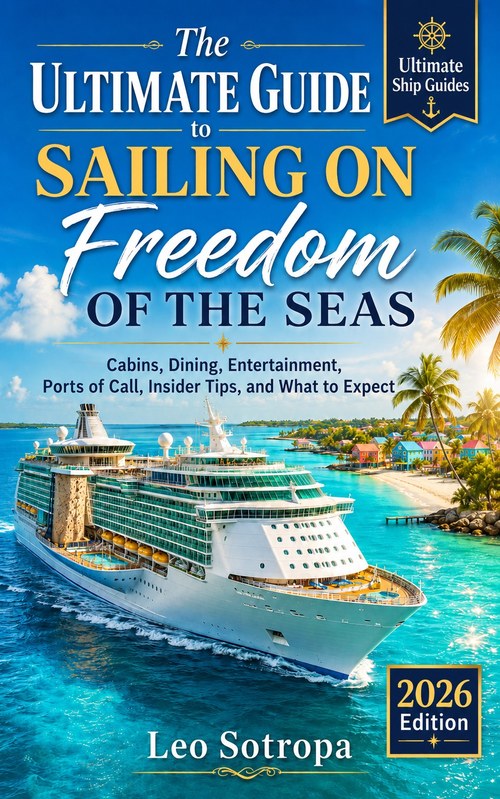
If you have a sailing booked on Freedom of the Seas and you want to walk aboard already knowing where to go and what to skip, the Freedom of the Seas book you are looking for is The Ultimate Guide to Sailing on Freedom of the Seas by Leo Sotropa. It is an independent, ship-specific handbook that answers the practical questions people actually have before a Royal Caribbean cruise: which cabin gives the best value, which dining venues are worth paying extra for, how to plan a short Bahamas getaway so no day is wasted, and how to spend a day at Perfect Day at CocoCay without overpaying. This page explains what the book covers, who it helps, and why a guide written for one ship beats a generic cruise primer.
Freedom of the Seas is a big ship with a lot going on, but she rewards a little planning. She is the Royal Caribbean vessel that introduced the FlowRider surf simulator to cruising, she has been amplified with newer features over the years, and she runs mostly short getaways from Miami. That combination of a large ship and a compressed itinerary is exactly where a focused handbook earns its keep, because you have fewer days to figure things out and more choices packed into each one.
What this book actually is
The Ultimate Guide to Sailing on Freedom of the Seas is part of the Ultimate Ship Guides series by Leo Sotropa. Each title in the series is built around a single ship, and this one is dedicated entirely to Freedom of the Seas. It is independent and unofficial, which matters more than it sounds: it is not marketing copy from the cruise line, so it is free to tell you which staterooms to avoid, when a specialty restaurant is worth the money and when it is not, and where the real value sits on a short sailing. It is written to be read before you go and carried with you once you are aboard.
The book comes as a Kindle ebook and as a 6×9 paperback, and it is illustrated with graphite chapter illustrations. The feature that ties the whole thing together is the set of Action Steps that closes every chapter. Instead of leaving you with a pile of information and no plan, each chapter ends by telling you what to actually do next: what to reserve, what to pack, what to book in the app, what to decide before you sail. That structure is what turns reading into a ready-to-go plan.
It helps to know where Freedom of the Seas sits in the fleet, because it shapes the whole trip. She was once the largest cruise ship in the world, and she is the ship that put the FlowRider on the map for cruising. She is still large by any normal measure, but she is deliberately a step smaller and more approachable than the Oasis and Icon giants, which means you can get to know her over a short sailing without feeling lost. The book leans into that: it treats Freedom as a ship you can genuinely learn in a few days, and it structures its advice around the short-getaway rhythm she is built for rather than the week-long expedition pace of a bigger vessel.
One thing the book is honest about from the start: details change. Venues, itineraries, and prices move around from season to season, so the guide teaches you how the ship works and then tells you to confirm the current specifics in the Royal Caribbean app. That is the right division of labor. The book gives you judgment and strategy; the app gives you today’s schedule.
What’s inside
The ship’s layout, deck by deck
The guide opens with a tour of how Freedom of the Seas is laid out — her roughly fifteen guest decks, the Royal Promenade that runs down the middle of the ship with its shops, cafés, and bars, and the top-deck pools and sports areas. At around 155,000 gross tons and carrying roughly 3,900 guests at double occupancy (and up to about 4,500 when full), she is a large ship, but she is a step smaller and more approachable than the Oasis and Icon giants. The layout chapter is about not wasting vacation time: knowing where things are, which routes get crowded, and how to move around the ship efficiently so you are not walking the length of the Promenade three times to find one bar.
The cabin guide: what to book and what to avoid
The cabin chapter is one of the most useful parts of the book, because the wrong room can quietly cost you sleep and money. Freedom offers Interior cabins (including some Promenade-view interiors that overlook the Royal Promenade), Ocean View, Balcony, and suites up to the Presidential and Owner’s Suites. On a short cruise the math is different from a long one: many first-timers do perfectly well in an interior for a three- or four-night trip, since they are barely in the room. The book calls an Interior or a Promenade-view Interior the best value on a short getaway, and a midship Balcony on the mid-decks the best all-round choice for light, space, and the steadiest ride.
Just as valuable is the list of cabins to avoid, which you confirm against the deck plan before booking: rooms directly under the pool deck or the Windjammer, where early-morning noise carries; rooms over the Promenade venues or near the nightlife; forward high-deck rooms for anyone prone to motion; and lower-deck balconies with lifeboat-obstructed views. These are the mistakes that are easy to make on a booking site and impossible to undo once you sail.
The dining guide: included versus worth the splurge
The dining chapter sorts the ship’s food into what you have already paid for and what costs extra. Included venues run from the Main Dining Room and the Windjammer buffet to Café Promenade, Sorrento’s pizza, and, on amplified sailings, options like El Loco Fresh. The specialty restaurants — Chops Grille, Giovanni’s Table or Italian dining, Izumi, Playmakers Sports Bar, and Johnny Rockets — cost more, and the book is candid about which are worth the splurge and what you should reserve before boarding rather than hoping for a walk-in. It also explains the mechanics that trip up first-timers: your SeaPass card is a cashless account, daily gratuities are added automatically, and Wi-Fi is a paid plan.
Entertainment and the signature thrills
Freedom is a ship you can play on, and the entertainment chapter covers the shows along with the active attractions and the timing tricks that keep you out of long lines. The FlowRider surf simulator is the ship’s original claim to fame, and alongside it are a rock-climbing wall, a full-size outdoor movie screen, mini-golf, the Vitality Spa, and a casino. Amplified additions have brought newer waterslides — The Perfect Storm — and a splash area over time, so the guide reminds you to confirm exactly what is aboard your specific sailing. The point of the chapter is not just to list the attractions but to tell you when to hit them, because the same slide has a twenty-minute wait at one hour and none at another.
Families and adults-only escapes
Because Freedom sails a lot of family-heavy short cruises, the book gives real attention to traveling with kids and to finding quiet when you need it. For families there is the H2O Zone kids’ water park, the Adventure Ocean kids’ program, sports courts, and the pools on the top decks. For grown-ups who want a break from the noise, the guide points you toward the calmer corners of the ship. Handled together, these sections help a mixed group — grandparents, parents, and children on the same sailing — actually get what each of them wants out of the same days.
The ports of call
The ports chapter is where a ship-specific guide pulls ahead of a general one, because it covers the places this ship actually visits. Freedom specializes in short getaways from Miami to the Bahamas and Caribbean — round-trip sailings of three, four, and five nights, with some longer Caribbean voyages — and the book treats each stop with destination notes, top excursions, and a must-do shortlist. Since these are short trips, every day counts, so the guide pushes you to plan the key stops carefully rather than improvise them.
The star stop is Perfect Day at CocoCay, Royal Caribbean’s private island in the Bahamas, and the book is clear about what is included versus what you book ahead. Included are Chill Island and the other beaches, the Oasis Lagoon freshwater pool, Splashaway Bay for families, the Skipper’s Grill and other complimentary eateries, and the run of the walk-around island. The extras sell out, so you reserve them early in the app: the Thrill Waterpark (home to Daredevil’s Peak, the tallest waterslide in North America), the zip line, the Up, Up and Away helium balloon, the Coco Beach Club with its overwater cabanas, and the private cabanas. The guide also covers Nassau — the Queen’s Staircase, Fort Fincastle, the straw market, Junkanoo Beach, and the Atlantis resort and aquarium on nearby Paradise Island — and the embarkation city of Miami itself, with South Beach and Ocean Drive, Little Havana’s Calle Ocho, Wynwood Walls, and the Everglades. Since PortMiami sits downtown, the book suggests arriving a day early and enjoying the city.
Money, value, and avoiding upcharges
The money chapter is straightforward and unsentimental. It lays out what is already included in your fare, when a package genuinely pays off and when it does not, and how to sidestep the upcharges that add up quietly over a few days. Prices are treated relatively rather than quoted, because they move, but the reasoning holds regardless of the number on the screen: on a short sailing, some spends are clearly worth it and others are traps, and the book helps you tell them apart before you are standing at the counter deciding. A three- or four-night trip changes the calculus on almost everything — a drinks package, a specialty dining plan, an internet plan — because there are simply fewer days to break even, and the guide walks through that arithmetic in plain terms so you can decide with your own trip in front of you.
Embarkation strategy and pro tips
Embarkation day sets the tone for a short cruise, and the guide gives it a proper strategy so you spend your first hours enjoying the ship instead of standing in lines. The final stretch of the book is a chapter of pro tips, common pitfalls, and frequently asked questions — the accumulated small lessons that keep you from making the mistakes most first-timers make. And, as everywhere in the book, each chapter closes with Action Steps so the advice turns directly into things you have done before you sail.
Who it’s for
The book is written for a few different readers at once. First-timers get the most obvious benefit: it removes the guesswork and the low-level anxiety of not knowing how any of it works, from the SeaPass card to the dinner reservations. Families use it to coordinate a trip that keeps kids busy and adults sane on a compressed schedule. Seasoned cruisers who know the Royal Caribbean rhythm but have not sailed this particular ship use it to get up to speed fast on what is specific to Freedom of the Seas — her layout, her best cabins, her ports.
It also makes a genuinely useful gift. If someone you know has a Freedom of the Seas sailing booked, the book is a thoughtful present that they will actually open and use, rather than a generic travel item. Because it is organized around one ship and ends every chapter with concrete steps, it is the kind of thing a nervous first-time cruiser is relieved to receive.
Why a ship-specific guide beats a generic cruise primer
General cruise books have to hedge. They describe cruising in the abstract, across dozens of ships and cruise lines, which means they can rarely tell you the one thing you want to know: on this ship, in this cabin, at this port, what should I do? A guide dedicated to Freedom of the Seas can name the actual venues, the actual decks, and the actual ports, and it can make specific calls — book the midship balcony, avoid the room under the Windjammer, reserve CocoCay’s Thrill Waterpark before it sells out. Specificity is the whole value.
The other thing a focused guide does is lower pre-cruise stress. A lot of the worry before a first cruise comes from not knowing what to expect and feeling like you might waste an expensive trip by getting the details wrong. Reading a book built around your exact ship replaces that vague worry with a plan. You know roughly how the days will go, you have already made the decisions that need making in advance, and you can enjoy the sailing instead of managing it. If you would rather read a bit before you buy, the free companion articles on this site cover a lot of the same ground.
About the author and the series
Leo Sotropa writes the Ultimate Ship Guides series, a set of independent handbooks that each focus on a single cruise ship rather than trying to cover everything at once. The Ultimate Guide to Sailing on Freedom of the Seas is the entry for this ship, and it follows the same practical pattern as the rest of the series: describe how the ship really works, make honest recommendations, and end every chapter with Action Steps you can carry out.
The series has a companion website at acountryamonth.com, where a set of free articles covers Freedom of the Seas for readers who want to start before they commit to the full book. You can begin with the broad Freedom of the Seas cruise guide, get oriented with what to expect on Freedom of the Seas, and dig into the room decision with the best cabins on Freedom of the Seas breakdown. For the itinerary and the island, there is a guide to sailing the Bahamas from Miami and a dedicated look at Perfect Day at CocoCay. If you are brand new to all of this, the first-time cruise on Freedom of the Seas article is a friendly place to start. The free articles and the book work together: the articles get you oriented, and the book gives you the complete plan.
Get The Ultimate Guide to Sailing on Freedom of the Seas
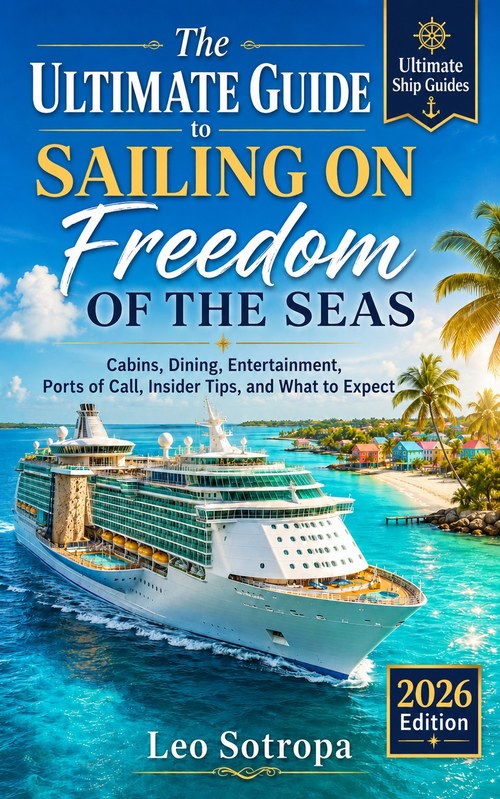
The Ultimate Guide to Sailing on Freedom of the Seas by Leo Sotropa, part of the Ultimate Ship Guides series, is an independent, ship-specific handbook available on Kindle and paperback, with clear Action Steps in every chapter so you board knowing exactly what to book, what to skip, and where to go.
Frequently asked questions
Is this an official Royal Caribbean book?
No. It is an independent, unofficial handbook written by Leo Sotropa for the Ultimate Ship Guides series. That independence is the point: because it is not produced by the cruise line, it can tell you which cabins to avoid, which specialty restaurants are worth the extra cost, and where the real value sits on a short sailing.
Should I get the Kindle or the paperback?
Both cover the same material, so it comes down to how you like to read. The Kindle ebook is easy to search and carry on your phone while you are aboard, which is handy for checking a recommendation on the spot. The 6×9 paperback, with its graphite chapter illustrations, is nice to read through before the trip and to hand to someone as a gift.
Is the book up to date?
The guide reflects the latest edition and is written to stay useful by focusing on how the ship works rather than on details that change every season. Because venues, itineraries, and prices do move, the book tells you to confirm the current specifics — schedules, dining, and prices — in the Royal Caribbean app. The strategy stays relevant; the app supplies today’s numbers.
Does it cover the specific ports Freedom of the Seas visits?
Yes. There is a full ports-of-call chapter built around this ship’s short Bahamas and Caribbean sailings from Miami, with detailed coverage of Perfect Day at CocoCay (including what is included versus what to reserve ahead), Nassau, and the embarkation city of Miami. Because these are short trips, the book focuses on planning each stop so no day is wasted.
Is it good for first-time cruisers?
It is especially good for first-timers. It explains the things nobody tells you — how the SeaPass card works, why gratuities are added automatically, what to reserve before boarding, and how to handle embarkation day — and every chapter ends with Action Steps that turn the advice into a checklist. It removes most of the guesswork that makes a first cruise stressful.
Would it make a good gift?
Yes. For anyone with a Freedom of the Seas sailing booked, it is a thoughtful and practical present, particularly for a nervous first-timer. The paperback in particular, with its illustrations and clear chapter-by-chapter structure, is the kind of gift that gets used rather than shelved.
Does the book replace the Royal Caribbean app?
No, and it is not meant to. The two do different jobs. The book gives you the strategy and judgment — which cabin, which restaurant, how to plan CocoCay, what to skip — while the app handles the live details like your daily schedule, reservations, and current prices. Use the book to make your decisions, and the app to execute them on board.

Meet Leo: The Heartbeat Behind ‘A Country A Month’
Journeying through the pages of A Country A Month, you might often feel the rhythm of a storyteller’s heartbeat, pulsating through each line, each image, and each adventure shared. That heartbeat belongs to none other than our remarkable website editor, Leo.
With a lens in one hand and a pen in the other, Leo seamlessly marries his passions for photography and writing. His eye captures moments that words can barely describe, yet his eloquence brings those images to life, transcending borders and connecting us all through shared stories. An avid traveler, every country he’s visited has added another chapter to his expansive tale, and through our platform, he generously shares these chapters with us.