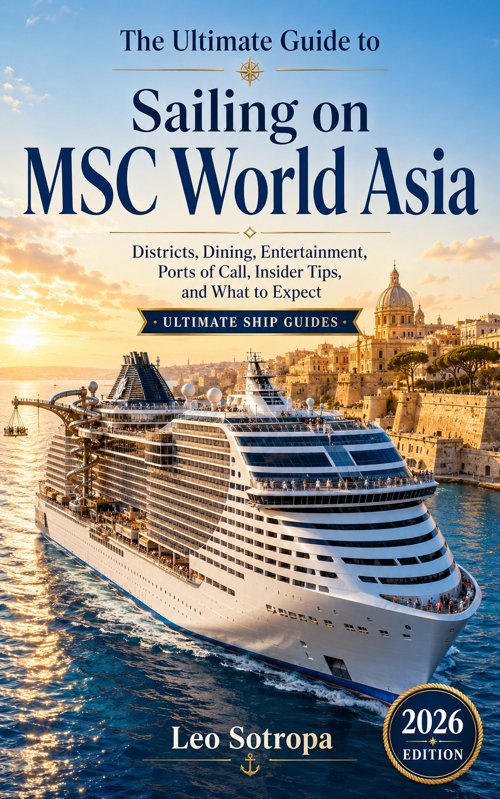
Have you booked a sailing on MSC World Asia and found yourself with more questions than answers? The Ultimate Guide to Sailing on MSC World Asia by Leo Sotropa is a single, ship-specific handbook that walks you through this particular vessel deck by deck, cabin by cabin, and port by port, so you step aboard already knowing where to go and what to skip. It is not a broad cruise primer that treats every ship the same. It is written for one ship, the newest and most complete member of MSC Cruises’ flagship World Class, and it exists to save you the hours of scattered forum searching that most people do before a first big cruise.
This page describes what the book covers, who it is written for, and how it helps. If you want to read a little before you commit, there are free companion articles on this site for the same ship, linked throughout. And if you are the sort who likes to arrive prepared, the book collects everything into one place you can read in an evening and reference on your phone at sea.
What this book actually is
The Ultimate Guide to Sailing on MSC World Asia is an independent, unofficial handbook. It is part of the Ultimate Ship Guides series, a family of titles that each take a single modern cruise ship and explain it honestly, without the marketing gloss. Because it is not published by the cruise line, it can tell you which cabins to avoid, when a specialty restaurant is worth the extra cost and when it is not, and where the crowds gather so you can be somewhere else. That independence is the whole point.
MSC World Asia is a large and genuinely complex ship. She carries more than 5,000 guests across around 20 decks, measures roughly 216,000 gross tons, and is organized into seven distinct districts rather than one continuous layout. She keeps the greener LNG propulsion and the seven-district design that her sisters, MSC World Europa and MSC World America, introduced, and as the youngest of the three she gathers what they pioneered and adds more. A ship on this scale rewards planning. Wandering to find dinner or a quiet deck chair on your first afternoon is a real way to lose an afternoon, and this book is built to prevent exactly that.
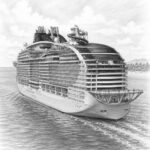
The book is illustrated with graphite chapter illustrations, and every chapter closes with clear, practical Action Steps. Those Action Steps are what separate it from a book you read once and forget. Instead of leaving you with general impressions, each chapter ends by telling you exactly what to do next, whether that is reserving a restaurant, checking a specific detail on the deck plan, or setting a reminder for a show. You can read the whole thing for context and then work the Action Steps like a checklist as your sailing approaches.
It is available as a Kindle ebook and as a 6×9 paperback, so you can carry it on your phone at sea or keep a printed copy to mark up. For a broad orientation to the vessel before you open the full guide, the free MSC World Asia cruise guide on this site is a good starting point.
What’s inside
The guide follows the shape of an actual cruise, from the moment you plan the trip to the moment you board and then through each day at sea and in port. Here is what each part gives you.
The ship’s layout and the seven districts
The book opens with a tour of the ship’s decks and spaces and, more usefully, how to move through them without wasting vacation time. MSC World Asia is arranged into seven districts, and knowing where each one sits changes how your day flows. There is the World Promenade, the indoor-outdoor main street that runs through the heart of the ship and is home to the record-length Spiral @ Tree of Life dry slide. There is the glass-elevator Galleria atrium, a bright vertical space that ties the decks together. There is the Family District and the new Clubhouse, a retro-fun social hub. There is the adults-only Zen area, with cantilevered whirlpools that hang over the sea. And there is the biggest MSC Yacht Club yet, the private ship-within-a-ship at the top of the vessel. The guide explains how these districts relate to one another so you can picture the ship before you ever walk it.
Understanding the layout is not trivia. It tells you why a cabin near the World Promenade might be lively at night, why the Zen area is worth seeking out if you want calm, and how to plan a route from your stateroom to the pool, the theater, and dinner that does not have you criss-crossing the ship. The free what to expect on MSC World Asia article sketches the same territory at a high level if you want a preview.
The cabin guide: which to book and which to avoid
Choosing a cabin on MSC World Asia is more involved than on many ships because you book a stateroom and an Experience together, and the two decisions interact. The book walks through every category: Interior, Ocean View, Balcony, the smart-value Infinite Ocean View, the premium Aurea cabins, and the MSC Yacht Club suites, which come in the widest range yet, from interior and deluxe suites up to grand and owner’s suites.
More important than the list is the judgment. The guide points you toward the best value, generally an Interior or Infinite Ocean View booked on a fare that lets you choose your location, and the best all-round choice, a midship balcony on the mid-decks where you get space, light, and the steadiest ride. Just as valuable is the list of cabins to avoid: rooms directly under the pool deck or aquapark, where you will hear deck chairs dragged across the floor early in the morning; rooms over or under the theater and the World Promenade nightlife; forward high-deck rooms that feel more motion in a swell; and any obstructed or unintended connecting rooms. The book tells you to confirm all of this against the current deck plan, because the exact rooms shift, but it gives you the pattern to look for. The free best cabins on MSC World Asia guide covers the same ground for readers deciding before they buy.
The dining guide
MSC World Asia has an unusually strong food scene for a mainstream ship, and the guide separates what is included from what costs extra so you are not surprised. Your fare covers the main dining rooms and the buffet. Beyond that, the ship has an immersive Pan-Asian restaurant and a street-food counter that are unique to this vessel, plus MSC specialty venues that appear across the fleet: a sushi and teppanyaki spot, a steakhouse, and a taqueria. The specialty venues carry a charge.
The book’s job here is to help you decide where the splurge is worth it and, just as important, what to reserve before you board. Popular specialty restaurants fill up, and the tables you actually want, at the times you actually want them, tend to go early. The dining chapter tells you what to book in advance and what you can leave to chance, so you spend your onboard time eating rather than queuing for a reservation that is no longer available.
Entertainment and the signature thrills
This is a ship built around big attractions, and timing is everything. The headline thrill is the Spiral @ Tree of Life, a record-length multi-deck dry slide that drops through the World Promenade. There is the Cliffhanger, an over-water swing ride cantilevered off the side of the ship. There is an aquapark, and there are the cantilevered Zen whirlpools that reach out over the sea. The guide explains each one and, crucially, when to go to beat the lines, because these attractions bunch up at predictable times and are near-empty at others.
On the entertainment side, the ship runs theater productions, live music across its bars, the retro-fun Clubhouse, and a casino. The book helps you slot the shows you care about into a week that also has six port days competing for your attention, and it flags which experiences reward getting there early. The MSC for Me app runs your day at sea, and the guide explains how to lean on it for schedules and bookings.
The ports of call
In her current program MSC World Asia sails seven-night Western Mediterranean weeks, and the ports chapter is one of the reasons a ship-specific guide is worth having. The loop calls at Barcelona in Spain, Marseille in France, Genoa in Italy, Rome via Civitavecchia, Messina and Taormina in Sicily, and Valletta in Malta. Several of these double as embarkation ports, so the book reminds you to confirm where you actually board and the exact ports for your specific week before you plan anything.
Each destination gets a real briefing with landmarks and a must-do shortlist. In Barcelona that means the Sagrada Família, Park Güell, La Rambla, the Gothic Quarter, and Gaudí’s architecture. In Marseille it is Notre-Dame de la Garde and the Vieux-Port, the gateway to Aix-en-Provence. Genoa gives you the historic old town and aquarium and a jumping-off point for the Cinque Terre and Portofino. Messina opens onto clifftop Taormina with its ancient Greek theatre and Mount Etna beyond. Valletta offers St. John’s Co-Cathedral, the Grand Harbour, and the walled old city of Mdina nearby.
Rome is the marquee call, and it is also the one most likely to trip up an unprepared traveler. The cruise port is Civitavecchia, roughly a 1.5-hour transfer from central Rome by train or car, which changes everything about how you spend the day. The book helps you plan realistically around the Colosseum, the Vatican and St. Peter’s, the Trevi Fountain, and the Roman Forum rather than assuming you can do it all on a whim. Mediterranean port days are long, and the guide’s advice is consistent: start early. For a deeper look at that specific day, the free Rome and Civitavecchia article is a useful companion.
Honest money advice and the Experiences decision
The single biggest booking decision on MSC is not just the cabin but the Experience attached to it, and the book gives this the attention it deserves. On MSC you choose a fare tier that determines your inclusions and how much control you have. Bella is the entry Experience with the lowest fare, but MSC assigns your cabin’s exact location. Fantastica lets you choose your cabin and dining, adds room-service breakfast and extra loyalty points, and gives you more flexibility. Aurea is the premium tier with the best-located cabins, priority boarding, thermal spa access, and often a drinks package. Yacht Club is the private ship-within-a-ship, with suites that come with a 24-hour butler and concierge, a private restaurant, lounge and bar, a private pool and sun deck, and premium all-inclusive drinks. On MSC World Asia the Yacht Club is the biggest yet.
The money chapter is honest rather than promotional. It explains what is already included in your fare, when a package genuinely pays off and when it does not, and how to avoid the upcharges that quietly add up. It notes the practical realities too: daily gratuities are added to your account, and Wi-Fi is a paid plan. Because inclusions vary by sailing and promotion, the book keeps prices relative and tells you to confirm the current details rather than trusting a number that may already be out of date. The free MSC World Asia Experiences guide breaks the tiers down further if you want to weigh them before booking.
Family know-how, adults-only escapes, and embarkation day
The ship is designed for a wide mix of travelers, and the guide serves all of them. Families get the Family District and the new Clubhouse, guidance on the aquapark and the thrills, and tips on managing a big ship with children in tow. Adults looking for quiet get the Zen area with its cantilevered whirlpools over the sea, and advice on where to find calm on a ship carrying thousands of people.
Embarkation day gets its own strategy, because the first few hours set the tone for the week. Knowing what to do the moment you board, what to book right away, and where to go while your cabin is still being prepared can turn a stressful arrival into a smooth start. The book closes with a chapter of pro tips, common pitfalls, and frequently asked questions, and, like every chapter, it ends with Action Steps that tell you precisely what to do next.
Who it’s for
First-time cruisers get the most obvious benefit. If you have never sailed, MSC World Asia can feel overwhelming, and the MSC booking system in particular, with its Experience tiers, is unfamiliar to people used to other lines or to no cruising at all. The book demystifies all of it and gives you the confidence to make choices instead of guessing. The free first-time cruise on MSC World Asia article is a gentle on-ramp if you are still deciding.
Families benefit from having the layout, the kid-friendly districts, the thrills, and the dining mapped out in advance, so the trip runs on a plan rather than on improvisation with tired children. Seasoned cruisers who already know their way around a ship still gain from a title written for this specific vessel, because MSC World Asia has features and a district structure that even experienced sailors have not seen. And the book makes a genuinely thoughtful gift for anyone who has a sailing booked, since it arrives as something useful they will actually open, not a generic travel volume that sits on a shelf.
Why a ship-specific guide beats a generic cruise primer
A general cruise book has to speak about every ship on every line, so it can only ever tell you things that are broadly true. It cannot tell you that a particular block of cabins sits under the aquapark, or that the Spiral @ Tree of Life is quiet at a certain hour, or that the Rome port is 90 minutes from the city center. Those specifics are exactly what determine whether your week goes smoothly, and they are exactly what a generic primer leaves out.
The value of a single-ship guide is that every sentence is about the ship you are actually sailing. It reduces the pre-cruise stress that comes from not knowing what to expect, because it answers the questions before you have to ask them. It replaces a dozen open browser tabs and contradictory forum threads with one considered source. And because it ends every chapter with Action Steps, it does not just inform you, it moves you through a concrete set of decisions so nothing important gets left until you are already aboard. For quick reference on the details that matter most, the free MSC World Asia tips article is worth a look alongside the book.
About the author and the series
The book is written by Leo Sotropa as part of the Ultimate Ship Guides series, which produces independent, unofficial handbooks for individual modern cruise ships. Each title takes the same practical approach: describe one ship honestly, tell readers which choices are worth making, and end every chapter with clear Action Steps. The companion website, acountryamonth.com, hosts the free articles for this ship that are linked throughout this page. The book and the free articles are meant to work together, with the articles giving you an overview and the book giving you the depth and the checklists.
Get The Ultimate Guide to Sailing on MSC World Asia
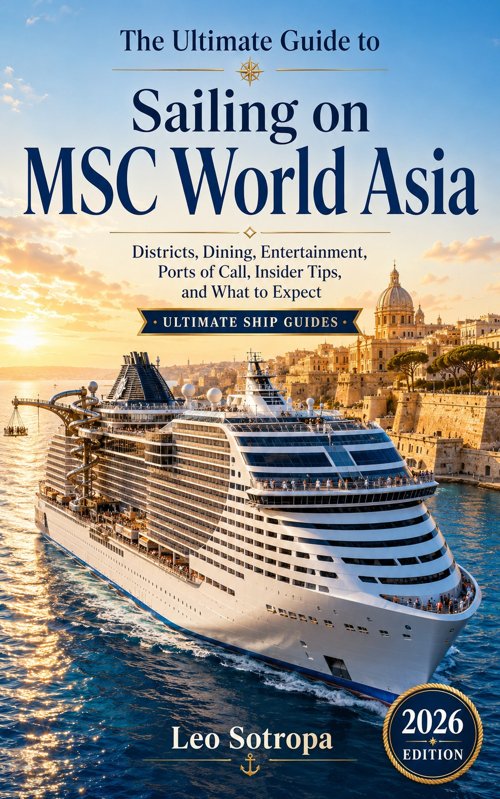
The Ultimate Guide to Sailing on MSC World Asia by Leo Sotropa, part of the Ultimate Ship Guides series, is an independent handbook to this ship, available on Kindle and paperback, with clear Action Steps in every chapter. Read it once for context, then work its checklists as your sailing approaches.
Frequently asked questions
Is this an official MSC book?
No. It is an independent, unofficial guide, and that is deliberate. Because it is not published by the cruise line, it can be candid about which cabins to avoid, when a specialty restaurant is not worth the extra cost, and where the crowds gather. It is written to serve the reader rather than to sell the sailing.
Should I get the Kindle or the paperback?
Both contain the same guide, so it comes down to how you like to use it. The Kindle ebook is easy to carry on your phone and reference at sea, which is handy when you are standing in a district trying to decide where to eat. The 6×9 paperback is nice if you prefer to read and mark it up before the trip, or if you are giving it as a gift. Many readers use the ebook aboard and keep the paperback for planning.
Is the information up to date?
The book reflects the latest edition and focuses on the things that stay stable: the ship’s layout, the district structure, the cabin patterns to seek out or avoid, and how the Experience tiers work. Details like venues, itineraries, and prices do change, so the guide keeps prices relative and tells you to confirm the current specifics in the MSC for Me app before you book or board.
Does it cover this ship’s specific ports?
Yes. The ports chapter covers the seven-night Western Mediterranean itinerary in detail, with destination briefings for Barcelona, Marseille, Genoa, Rome via Civitavecchia, Messina and Taormina, and Valletta, including landmarks and must-do shortlists. It also flags the practical realities, such as the roughly 1.5-hour transfer between the Civitavecchia port and central Rome, and reminds you to confirm the exact ports and embarkation point for your specific week.
Is it good for first-time cruisers?
It is written with first-timers firmly in mind. It explains the MSC booking system and the Experience tiers, walks you through embarkation day, and ends every chapter with Action Steps so you always know what to do next. If you have never sailed a ship this size, it gives you the confidence to make decisions instead of guessing.
Would it make a good gift?
Yes, especially for someone who already has a sailing on MSC World Asia booked. It is a practical, ship-specific book they will actually use, and the graphite chapter illustrations and paperback format make it feel like a considered present rather than a generic travel guide. The Action Steps mean it keeps being useful right up to embarkation day.
Does it replace the MSC for Me app?
No, they do different jobs and work best together. The MSC for Me app runs your day aboard with live schedules, bookings, and the latest venue and itinerary details. The book gives you the strategy: which cabin and Experience to choose, what to reserve before boarding, when to hit the thrills, and how to plan each port. Use the book to prepare and decide, and use the app to confirm the current specifics and manage things once you are on the ship.

Meet Leo: The Heartbeat Behind ‘A Country A Month’
Journeying through the pages of A Country A Month, you might often feel the rhythm of a storyteller’s heartbeat, pulsating through each line, each image, and each adventure shared. That heartbeat belongs to none other than our remarkable website editor, Leo.
With a lens in one hand and a pen in the other, Leo seamlessly marries his passions for photography and writing. His eye captures moments that words can barely describe, yet his eloquence brings those images to life, transcending borders and connecting us all through shared stories. An avid traveler, every country he’s visited has added another chapter to his expansive tale, and through our platform, he generously shares these chapters with us.