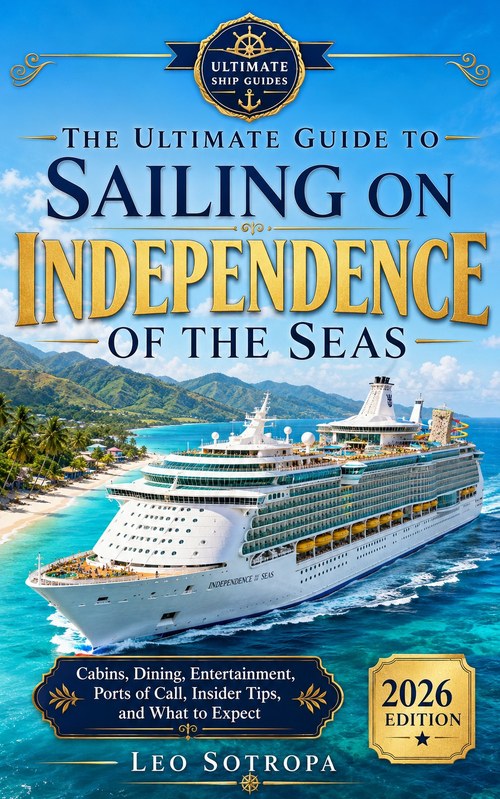
Is there a single book that tells you exactly how to sail Independence of the Seas without wasting a day of your vacation figuring things out? Yes. The Ultimate Guide to Sailing on Independence of the Seas by Leo Sotropa is a ship-specific handbook built around one Royal Caribbean ship and nothing else. It walks you through her decks, tells you which cabins are worth booking and which to skip, sorts the included dining from the specialty spots worth paying for, and lays out the ports she visits so you step ashore with a plan. If you have a sailing booked, or you are weighing one, this page explains what the book covers, who it helps, and why a guide written for this one ship beats a generic cruise primer.
What this book actually is
This is an independent, unofficial guide. It is not published by the cruise line, and that is the point. Because it answers to readers rather than to a marketing department, it can be honest about the things a brochure will not mention: the cabins that sit under the pool deck and wake you at dawn, the specialty restaurants that earn their upcharge and the ones that do not, the attractions that draw a line by mid-morning. It is one title in the Ultimate Ship Guides series, and each book in that series covers a single ship in depth instead of trying to summarize a whole fleet in a few pages.
Independence of the Seas is a specific ship with a specific personality, and the book treats her that way. She is the third Freedom-Class ship, a sister to Freedom and Liberty of the Seas, and she holds a particular place in Royal Caribbean history: she was the very first ship the line put through its amplification program. That matters because amplification gave her a feature set her sisters do not share, and a guide written for Independence specifically is the only kind that can tell you how to use those features well. At around 155,000 gross tons across roughly fifteen guest decks, carrying about 4,375 guests at double occupancy and up to roughly 4,635 when full, she is a big, busy ship, and knowing her before you board is the difference between a relaxed week and a scramble.
The book is illustrated with graphite chapter illustrations, and every chapter closes with a short set of clear, practical Action Steps. Those Action Steps are the spine of the whole thing. Rather than leaving you with a pile of facts, each chapter ends by telling you what to do about them: what to reserve, what to pack, what to book before you board, what to check in the app. You can read cover to cover or skim it and still walk away with a to-do list.
What is inside the book
The book follows the structure that runs through the Ultimate Ship Guides series, but every chapter is filled with details specific to this ship and her real itineraries.
The layout: how to find your way around
The first job of any big-ship guide is to make the ship feel smaller. The book gives you a tour of the decks and the main spaces and explains how to move around her without wasting vacation time backtracking. Independence is organized around the four-deck Royal Promenade, the indoor social boulevard that runs down the middle of the ship and serves as the landmark you orient everything else against. Once you know where the Promenade sits, where the pool deck is, and where the theater, Studio B ice rink, and the top-deck thrills live, you stop staring at deck plans and start enjoying yourself.
The cabin guide: which to book, which to avoid
This is the chapter most readers open first, and for good reason. Your cabin choice shapes your whole trip, and the price differences between categories are large. The book walks through the categories on Independence: Interior rooms, including the Promenade-view interiors that overlook the Royal Promenade, Ocean View, Balcony, and suites up to the top tiers. On a short three- or four-night getaway, many first-timers do perfectly well in an interior, and an Interior or Promenade-view Interior is often the smart-money pick. For the best all-round experience, a midship Balcony on the mid-decks gives you light, space, and the steadiest ride the ship offers.
Just as important is the list of cabins to avoid. The book flags rooms directly under the pool deck or the Windjammer buffet, where early-morning noise arrives whether you want it or not; rooms over the Promenade venues or near the nightlife, which stay lively late; forward high-deck cabins, which move more and matter to anyone prone to motion; and lower-deck balconies with lifeboat-obstructed views. It tells you to confirm any room against the current deck plan before you commit. If cabins are your main question, the free best cabins on Independence of the Seas article previews this thinking, and the book goes deeper.
The dining guide: what is included and what is worth paying for
Cruise dining confuses a lot of first-timers because some of it is included in the fare and some of it costs extra, and the difference is not always obvious from the daily planner. The book sorts it out. On the included side you have the Main Dining Room, the Windjammer Marketplace buffet, Sorrento’s pizza, Café Promenade, and the other complimentary spots that are already covered by what you paid. On the specialty side sit venues like Chops Grille, Giovanni’s Italian or its current equivalent, Izumi, and Playmakers Sports Bar, each with its own upcharge.
The book does not tell you to book everything or to skip everything. It tells you which specialty rooms tend to be worth the splurge on this ship and which you can pass on without missing much, and what to reserve before you board, because the best tables and times go quickly, especially on a short sailing where everyone is fitting a lot into a few nights. That reserve-ahead advice is exactly the kind of thing that becomes an Action Step at the end of the chapter.
Entertainment and the signature thrills
Independence carries the Freedom-Class signatures and then adds the amplified features that set her apart. The carried-over highlights include the FlowRider surf-and-bodyboard simulator, which the Freedom Class first brought to sea; Studio B, a real ice-skating rink with ice shows and open skating; a rock-climbing wall; a full theater; pools, a sports court, and mini-golf. The amplified additions are what make her special. The Sky Pad is a virtual-reality bungee-trampoline where you bounce in a harness while a VR headset drops you into a game, and it is not on Freedom or Liberty. Battle for Planet Z is a glow-in-the-dark laser-tag arena that families and teens love. The Perfect Storm waterslides give you the dueling Cyclone and Typhoon racers. There is also the Observatorium, a Royal Escape Room puzzle adventure, and Splashaway Bay, a colorful aqua park for younger kids, plus a redesigned pool deck.
All of that is fun, and all of it draws crowds. The book’s contribution is timing. It tells you when to hit the popular attractions to beat the lines, which matters more on Independence than on a slower, week-long ship because her itineraries are short and every hour counts. If the amplified features are the reason you picked this ship, the free Sky Pad and amplified features guide is a useful primer alongside the book.
Ports of call: what to do at every stop
This is one of the fullest chapters, and it is where a ship-specific guide really pays off, because the book covers the ports Independence actually visits rather than a generic list. She sails short, warm-weather getaways from Florida, using both Fort Lauderdale and Miami, to the Bahamas and Caribbean year-round. From Fort Lauderdale she runs short Bahamas trips, typically to Nassau and Perfect Day at CocoCay. From Miami she runs short Western Caribbean sailings to Falmouth in Jamaica and Nassau, and Eastern Caribbean sailings to Labadee in Haiti, with some itineraries adding Cozumel and Key West. Shorter cruises hit fewer ports, so the book helps you make the most of each one.
Two stops get special attention because they are Royal Caribbean’s own private destinations. Perfect Day at CocoCay in the Bahamas includes Chill Island and the beaches, the Oasis Lagoon freshwater pool, and Splashaway Bay, while the Thrill Waterpark, which holds Daredevil’s Peak, the tallest waterslide in North America, along with the zip line, the balloon, and the Coco Beach Club with its overwater cabanas, cost extra and sell out early. Labadee in Haiti is Royal Caribbean’s private peninsula, with beaches, the Dragon’s Breath zip line, one of the longest over water, an alpine coaster, snorkeling, and a Haitian craft market, all running on your SeaPass card. The book treats it as a beach day to rival CocoCay. For the CocoCay-and-Bahamas side, the free Bahamas from Florida guide covers the ground, and for Haiti the Labadee guide does the same.
Beyond the private islands, the book covers the real landmarks at each stop: Nassau’s Atlantis and Paradise Island, forts, and the Queen’s Staircase; Falmouth’s Dunn’s River Falls, beaches, and river tubing; Key West’s Duval Street and Hemingway’s house on the sailings that call there; and Cozumel’s snorkeling, Maya ruins, and beach clubs on the Western Caribbean runs. It also covers the two embarkation cities, Fort Lauderdale with its beaches and Las Olas Boulevard, and Miami with South Beach, Little Havana, and the Art Deco district, so an extra day at either end is not wasted. The recurring advice is to book the popular tours early, because they sell out.
Money and value: spend where it counts
Cruise pricing is a maze of add-ons, and this chapter is where the book pays for itself. It gives honest money advice: what is already included in your fare, when the various packages actually pay off and when they do not, and how to avoid the upcharges that quietly inflate a bill. It explains how the SeaPass card works as your cashless onboard account, that daily gratuities are added, and that Wi-Fi is a separate paid plan. None of this is meant to talk you out of spending; it is meant to help you spend on the things you will remember.
Family know-how and adults-only escapes
Independence carries a huge share of first-time and family cruisers, and the book is built with that in mind. On the family side it covers Adventure Ocean and the kids’ spaces, Splashaway Bay, and how to keep children of different ages happy on a busy ship. For grown-ups who want a break from the noise, it points to the adults-only Solarium and the Vitality Spa. The idea is that a family can split up and reconvene, with everyone getting the version of the vacation they wanted.
Embarkation strategy and pro tips
The first few hours set the tone for a cruise, and the book gives you an embarkation-day strategy so you are not standing in lines while other passengers are already up at the pool. It closes with a chapter of pro tips, common pitfalls, and frequently asked questions, the small lessons that make the second cruise smoother than the first. And, as with every chapter, it ends with Action Steps, so you leave each section with something concrete to do.
Who the book is for
The book is written for three kinds of reader, and it serves each one honestly.
- First-timers who have never cruised and feel a little lost. The book explains how the SeaPass card, gratuities, Wi-Fi plans, dining, and embarkation all work, so nothing catches you off guard. A short getaway on Independence is a common first cruise, and the book is a gentle on-ramp.
- Families juggling different ages and interests. With the amplified thrills, the pools, the kids’ clubs, and the private-island beach days, Independence rewards a bit of planning, and the book turns that planning into a checklist.
- Seasoned cruisers who know how ships work in general but not this ship in particular. They get the specifics that separate Independence from her sisters and from every other ship in the fleet: the Sky Pad, the amplified features, the short-itinerary rhythm, and the cabin quirks unique to her deck plan.
It also makes a genuinely useful gift. If someone you know has a sailing on Independence booked, the book is a thoughtful present that will get read and used, not shelved. If you are booking a first cruise for a family member, the free first-time cruise guide pairs well with the book as a starting point.
Why a ship-specific guide beats a generic cruise book
A general cruise primer has to hedge. It cannot tell you which cabin to avoid, because it does not know your ship’s deck plan. It cannot tell you which specialty restaurant is worth it, because the venues differ from ship to ship. It cannot give you port advice tuned to your actual itinerary. It ends up broad and safe, and it leaves the specific decisions to you.
A ship-specific book can commit. Because The Ultimate Guide to Sailing on Independence of the Seas is only about this one ship and the ports she visits, every recommendation can be concrete. The cabin advice names real problem areas. The dining advice names real venues. The port chapters name the excursions and landmarks you will actually encounter. And because Independence is the ship that started Royal Caribbean’s amplification program, her attractions are unusual enough that generic advice simply misses them. There is no substitute for a guide written for the exact ship you are sailing.
The deeper benefit is less about facts and more about calm. The stretch between booking a cruise and boarding it is full of small anxious questions: Did I pick the right room? Should I have paid for that package? What do we need to reserve, and when? The book answers those in advance, so you arrive at the terminal with decisions already made and a light plan in hand. It lets you spend your vacation enjoying the ship rather than decoding her.
A note on staying current
Cruise details move. Venues get renamed, itineraries shift with the season, and prices change constantly, which is why the book keeps its pricing relative rather than quoting numbers that would be wrong by the time you sail. The latest edition describes the ship and her ports in the present and tells you to confirm the current specifics, your exact itinerary, the open venues, and today’s prices, in the Royal Caribbean app. Think of the book as the strategy and the app as the live schedule: the book teaches you how to think about Independence of the Seas, and the app tells you what is happening on your particular sailing.
About the author and the series
The book is written by Leo Sotropa as part of the Ultimate Ship Guides series. The idea behind the series is simple: one book per ship, written independently, with honest advice and a set of Action Steps at the end of every chapter so readers finish with a plan rather than a pile of trivia. The graphite chapter illustrations give the books a consistent, uncluttered look. The series keeps a companion website at acountryamonth.com, where you will find the free articles linked throughout this page. The free pieces preview the approach; the book is the complete, organized version you can carry with you.
Get The Ultimate Guide to Sailing on Independence of the Seas
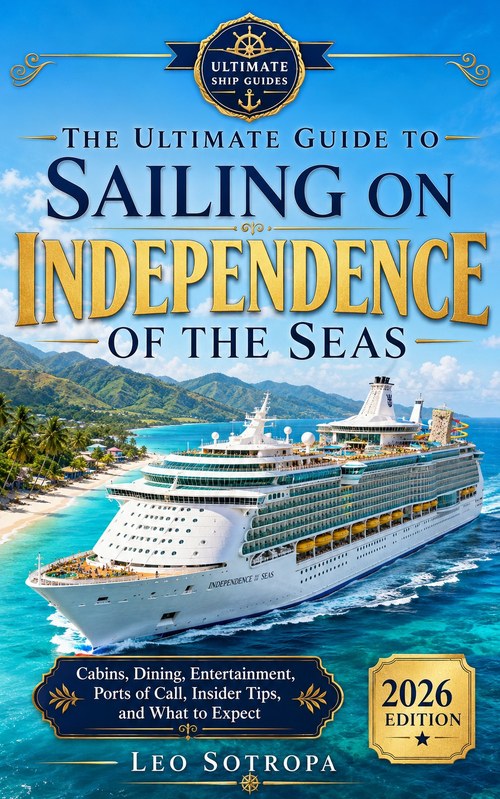
The Ultimate Guide to Sailing on Independence of the Seas by Leo Sotropa, part of the Ultimate Ship Guides series, is an independent, ship-specific handbook to Royal Caribbean’s Independence of the Seas, available on Kindle and paperback, with clear Action Steps in every chapter. It sorts the cabins, dining, thrills, and ports so you can plan a short Bahamas or Caribbean getaway with confidence and enjoy the ship instead of figuring her out.
Frequently asked questions
Is this an official Royal Caribbean book?
No. It is an independent, unofficial guide, and that independence is deliberate. Because it is not produced by the cruise line, it can be candid about the trade-offs a brochure tends to leave out, from the cabins to avoid to the packages that may not be worth the money. It is written to serve readers, not to sell the ship.
Should I get the Kindle version or the paperback?
Both cover the same content, so it comes down to how you like to read. The Kindle ebook is convenient to carry and search on your phone or tablet while you are aboard. The 6×9 paperback is easy to flag, mark up, and hand around the family while you plan, and it makes a nicer gift. Some readers keep the paperback for planning at home and the Kindle version for reference on the ship.
Is the book up to date?
The latest edition describes the ship and her ports in the present and keeps prices relative rather than quoting figures that quickly go stale. Because cruise details change, the book repeatedly tells you to confirm the current venues, itineraries, and prices in the Royal Caribbean app before you sail. That way the strategy stays useful even as the specifics move.
Does it cover the specific ports Independence visits?
Yes. The ports chapter is built around Independence of the Seas’ actual short itineraries from Fort Lauderdale and Miami, covering Perfect Day at CocoCay, Nassau, Labadee, Falmouth, and the stops some sailings add like Key West and Cozumel, along with the two embarkation cities. You get destination guides, top excursions, and must-do shortlists rather than a generic world tour.
Is it good for first-time cruisers?
Very much so. First-timers are one of the main audiences. The book explains the basics that trip up new cruisers, how the SeaPass card works, how gratuities and Wi-Fi are handled, how dining and embarkation flow, alongside ship-specific advice, and the Action Steps at the end of each chapter turn all of it into a simple to-do list. A short getaway on Independence is a popular first cruise, and the book is written to match.
Would it make a good gift?
Yes. For anyone who has a sailing on Independence booked, it is a thoughtful and genuinely useful present. The paperback in particular feels like a real gift, and unlike a generic travel book it is tied to the exact ship the recipient is about to sail, so it gets used rather than shelved. It works well for a first-timer, a family, or a seasoned cruiser.
Does the book replace the Royal Caribbean app?
No, and it does not try to. The app is your live schedule for a particular sailing: today’s venues, times, and prices. The book is the strategy that tells you how to think about the ship, which cabins and restaurants to choose, how to time the thrills, and what to do in each port. Use the book to plan and decide, and use the app to confirm the current details. Together they cover the whole trip.

Meet Leo: The Heartbeat Behind ‘A Country A Month’
Journeying through the pages of A Country A Month, you might often feel the rhythm of a storyteller’s heartbeat, pulsating through each line, each image, and each adventure shared. That heartbeat belongs to none other than our remarkable website editor, Leo.
With a lens in one hand and a pen in the other, Leo seamlessly marries his passions for photography and writing. His eye captures moments that words can barely describe, yet his eloquence brings those images to life, transcending borders and connecting us all through shared stories. An avid traveler, every country he’s visited has added another chapter to his expansive tale, and through our platform, he generously shares these chapters with us.