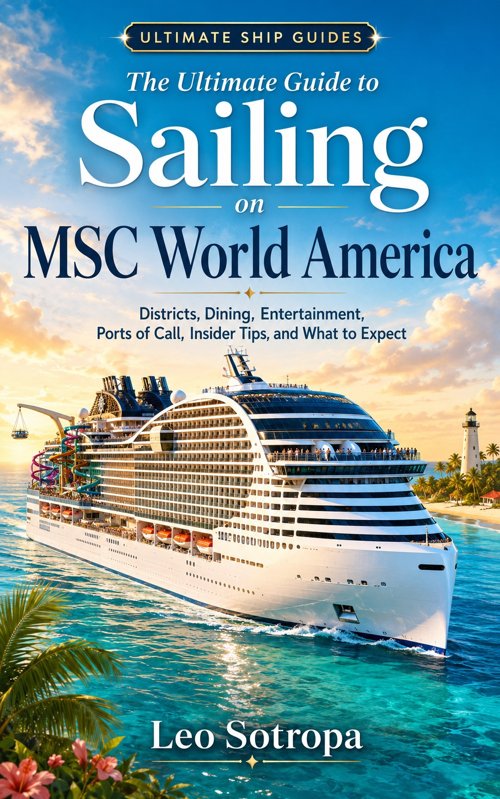
Is The Ultimate Guide to Sailing on MSC World America the book that will actually make your cruise easier, or just another glossy overview you could have skimmed for free? Here is the honest answer up front: it is an independent, ship-specific handbook to MSC World America, MSC Cruises’ newest and largest ship based in the United States, written to help you make the dozens of small decisions that decide whether a week aboard feels smooth or stressful. If you have a sailing booked, or you are deciding whether to book one, this page explains exactly what the book covers, who it helps most, and why a guide built around one ship beats a generic cruise primer.
The book is written by Leo Sotropa and is part of the Ultimate Ship Guides series. It focuses on one vessel and one experience: how MSC World America is laid out, which cabin to book and which to avoid, where to eat, what to reserve before you board, how the MSC Experience packages change your fare, and how to plan the ports so you are not scrambling on the gangway. It is not affiliated with MSC Cruises, and it does not try to sell you the cruise. It assumes you have already decided to sail, or are close to it, and it gives you the practical detail that the brochure leaves out.
What this book is
MSC World America is a big, complex ship. She runs to around 216,000 gross tons, carries more than 5,000 guests across roughly 20 decks, and is organized into seven themed districts that deliberately spread the crowds and set a different mood in each part of the vessel. That scale is the whole reason a dedicated guide exists. On a ship this size, the difference between a good week and a frustrating one usually comes down to information you did not have when you booked: that a cabin sits directly under the aquapark, that a specialty restaurant needs a reservation you should have made weeks earlier, that the swing ride has a quiet window most people miss.
The Ultimate Guide to Sailing on MSC World America is built to close those gaps. It is a single-ship reference, not a catalog of the whole fleet. Every chapter is written specifically for this vessel and her itineraries out of PortMiami, where she sails seven-night Caribbean weeks and calls at MSC’s own private island, Ocean Cay MSC Marine Reserve, on every voyage. The book is available in two formats, a Kindle ebook and a 6×9 paperback, it is illustrated with graphite chapter illustrations, and, most usefully, every chapter ends with a short set of Action Steps so that reading turns directly into a to-do list you can work through before you sail.
Because cruise details change with each sailing and promotion, the book stays deliberately practical rather than promising fixed specifics. It teaches you how the ship and the booking system work, then tells you to confirm the current venues, times, and prices in the MSC for Me app. What it gives you is judgment: how to read a deck plan, how to weigh an Experience package, how to plan a port day, so that whatever the app shows on your particular week, you already know what to look for.
What’s inside
The ship’s layout and the seven districts
The book opens with a tour of how MSC World America is arranged and how to move through her without wasting vacation time walking the wrong direction. The seven-district design is the organizing idea. You get oriented to the World Promenade, the lively indoor-outdoor main street that runs through the ship; the Galleria, the LED-domed atrium at the heart of the vessel; the Harbour, the family adventure district that holds the aquapark and the Cliffhanger swing; the adults-only Zen area built around the spa and calm; the Family District; and the gated MSC Yacht Club. Knowing which district does what, and where the quiet corners sit relative to the busy ones, is the first thing that makes a ship this big feel manageable. The guide walks you through it deck by deck so you are not learning the geography on day three.
The cabin guide: which to book, which to avoid
The cabin chapter is where many readers get the most value, because a stateroom decision is hard to undo once you have sailed. The book covers the full range of categories aboard MSC World America: Interior, Ocean View, and Balcony rooms, the smart-value Infinite Ocean View, the premium Aurea-experience cabins, and the MSC Yacht Club suites that run from interior up through deluxe, grand, and owner’s suites. More importantly, it tells you which rooms to book for value and which to avoid for noise, motion, and obstructed views.
The practical advice is specific. For value, the book points to an Interior or the Infinite Ocean View booked on a Fantastica fare, because that is what lets you choose your location rather than having it assigned. For the best all-round comfort, it steers you toward a midship Balcony on the mid-decks, where you get space, light, and the steadiest ride. And it names the rooms to be wary of, subject to checking the current deck plan: cabins directly under the pool deck or the Harbour aquapark, which pick up noise; rooms above or below the theater and the nightlife of the World Promenade; forward high-deck cabins for anyone prone to seasickness; and any obstructed or connecting rooms you did not mean to book. That last category catches people constantly, and the book explains how to spot them before you commit.
The MSC Experiences: the booking decision most guides skip
One thing that genuinely sets an MSC sailing apart from other lines is that you book two things at once: a cabin and an Experience package. The book gives this its own careful treatment because getting it wrong can cost you either money or the exact room you wanted. It walks through the tiers from most affordable to most exclusive.
- Bella is the entry Experience and the lowest fare. MSC assigns your cabin’s exact location, so you cannot pick it, and you get standard dining and basic inclusions. It suits budget travelers who are flexible about where they sleep.
- Fantastica is the mid-tier. You choose your specific cabin and your preferred dining, you get room-service breakfast and extra loyalty points, and you have more flexibility overall. This is the tier the book most often recommends for the best value.
- Aurea is the premium tier below the Yacht Club: the best-located cabins, priority boarding, access to the thermal spa and relaxation area, and often a drinks package included.
- Yacht Club is the ship-within-a-ship, a private keycard-only enclave of suites with 24-hour butler and concierge service, a private restaurant, lounge and bar, a private pool and sun deck, and a premium all-inclusive drinks package. It is the most exclusive way to sail her.
The book explains what each tier actually changes about your week, so you can decide whether the step up is worth it for how you travel, and it reminds you that exact inclusions shift by sailing and promotion, so you confirm the current details when you book. If you want to read more on this before you buy the book, the free companion article on the MSC World America Experiences is a good primer, and there is a separate deep look at the MSC World America Yacht Club.
The dining guide
The dining chapter sorts out what is included from what costs extra, and which of the extras are worth it. MSC World America carries the only Eataly at sea, an Italian marketplace and restaurant, alongside Kaito for sushi and teppanyaki, Butcher’s Cut steakhouse, HOLA! for tacos and Mexican, and Jean-Philippe Maury for chocolate, crepes, and coffee. Those specialty venues cost extra and sit next to the included main dining rooms and the buffet. The book tells you which spots reward the splurge and, just as usefully, what you should reserve before you board rather than hoping for a table once you are aboard. Reservations for the best specialty times go quickly on a full ship, and this is the kind of thing the guide flags early so it lands on your Action Steps list.
Entertainment and the signature thrills
The entertainment chapter covers the theater productions, the live music and bars spread across the districts, the casino, and the Luna Park-style family zone. It also gives the thrills the attention they deserve, because they are a real reason people choose this ship. The headline is the Cliffhanger, an over-water swing ride cantilevered off the side of the vessel; there is a dry slide on the World Promenade and the Harbour aquapark with several waterslides, plus sports and a ropes course. The book’s contribution here is timing: which parts of the day the lines are shortest, so you get the rides without spending your holiday queuing. It also notes the practical realities, that the MSC for Me app runs your day with the schedule, maps, and bookings, that daily gratuities are added to your account, and that staying online needs a paid Wi-Fi plan.
The ports of call
The ports chapter is one of the fullest in the book, with destination guides, top excursions, and must-do shortlists for each stop. Every voyage visits Ocean Cay MSC Marine Reserve, MSC’s private Bahamas island, a restored former industrial sand island turned marine reserve with quiet beaches, a lagoon, and an evening lighthouse light show; the beaches are included, while some experiences and excursions cost extra. From there the itineraries reach into the Caribbean, so the book also covers Puerto Plata in the Dominican Republic, with the Mount Isabel de Torres cable car, the Amber Cove area, and beaches; San Juan, Puerto Rico, with Old San Juan, El Morro, and Castillo San Cristobal; Cozumel, Mexico, for reef snorkeling, beach clubs, and the San Gervasio Mayan site; Costa Maya, Mexico, for the Mayan ruins at Chacchoben and Kohunlich and the beach at Mahahual; and Roatan, Honduras, for West Bay Beach and its world-class reef snorkeling.
Because ports vary between Eastern and Western weeks, the book teaches you how to plan whichever itinerary you have and reminds you to confirm your exact schedule and book the excursions that sell out. The free guide to the MSC World America ports and Ocean Cay on this site gives you a feel for that chapter’s approach.
Money, value, and avoiding upcharges
The money chapter is honest rather than promotional. It lays out what is already included in your fare, when a package genuinely pays off for the way you travel, and how to sidestep the small upcharges that quietly add up over a week. Prices are kept relative rather than quoted, because they move constantly, and the point is to give you a framework for deciding, not a number that will be stale by your sailing. Read alongside the Experiences chapter, it is the part of the book that most often pays for itself.
Family, adults-only, and embarkation day
The book handles the two ways people most often travel on a ship like this. There is family know-how, covering the Harbour district, the aquapark, and the family zones, and there are the adults-only escapes, built around the Zen area and the spa, for travelers who want the calm end of the vessel. And there is a dedicated embarkation-day strategy, because the first few hours set the tone for the whole cruise: where to go first, what to do before your cabin is ready, and how to start your week without standing in the longest lines. A closing chapter gathers pro tips, common pitfalls, and frequently asked questions, ending, as every chapter does, in Action Steps.
The Action Steps
The Action Steps at the end of each chapter are the feature that makes the book more useful than a passive read. Instead of finishing a section and hoping you remember the key points, you get a short, concrete checklist: reserve this before boarding, check the deck plan for that, download the app and set these bookings, pack for this excursion. Worked through in the weeks before you sail, they turn the whole book into a pre-cruise plan rather than background reading, which is exactly what reduces the last-minute scramble.
Who it’s for
The book is written to serve several kinds of reader without watering itself down for any of them. First-timers get the most reassurance: the guide assumes nothing, explains how an MSC cruise works, and walks you through the decisions in order, which is a large part of why people who have never sailed find it calming rather than overwhelming. The free first-time cruiser guide to MSC World America on this site gives a taste of that voice.
Families use it to match cabins, districts, and dining to the way they actually travel, and to plan the aquapark and the thrills so the kids get the most out of the week. Seasoned cruisers, including people who have sailed other lines but not MSC, use it to get up to speed fast on what is different here, the Experience packages above all, without rereading the basics they already know. And it works as a gift: it is a genuinely useful thing to give someone who has a sailing booked, more thoughtful than a generic accessory and more personal than a gift card, because it is about their exact ship.
Why a ship-specific guide beats a generic cruise primer
A general cruise book has to speak to every line and every ship at once, so it can only ever give you the average. It cannot tell you that the value pick on this vessel is an Infinite Ocean View on a Fantastica fare, or which cabins sit under the Harbour aquapark, or that MSC’s booking model pairs a cabin with an Experience tier in a way that other lines do not use. Those are the details that decide your week, and they only exist in a book built around one ship.
That specificity is also what lowers pre-cruise stress. Most of the anxiety before a big cruise comes from not knowing what you are supposed to do and by when: what to reserve, what is included, where to go on embarkation day, how to handle each port. A guide that answers those questions for your actual ship, and hands you Action Steps to work through, replaces that vague worry with a plan. You board knowing how the ship is laid out, which decisions you have already made well, and what is left to confirm in the app. For a lot of readers, that shift from guessing to knowing is the real value of the book.
None of this replaces the MSC for Me app, and the book does not pretend it does. The app is the live layer, your schedule, deck maps, and bookings for your specific sailing, and it is always the final word on current venues, times, and prices. The book is the planning layer: it teaches you how the ship and the system work so that when you open the app, you already understand what you are looking at and what to do with it. The two work together. If you want to browse the ship in more depth before deciding, the free MSC World America cruise guide and the overview of what to expect on MSC World America are both on this site.
About the author and the series
The book is written by Leo Sotropa as part of the Ultimate Ship Guides series, a set of independent, single-ship handbooks that each take one vessel and cover it in the same practical, honest way: layout, cabins, dining, entertainment, ports, money, and family and adults-only planning, with Action Steps closing every chapter. The series keeps free companion articles at acountryamonth.com, so you can read a good deal about MSC World America before you decide whether the full book is for you. The guides are unofficial and not affiliated with MSC Cruises, which is precisely what lets them tell you which cabins to avoid and where the value really sits, without a brochure’s need to make everything sound perfect.
Get The Ultimate Guide to Sailing on MSC World America
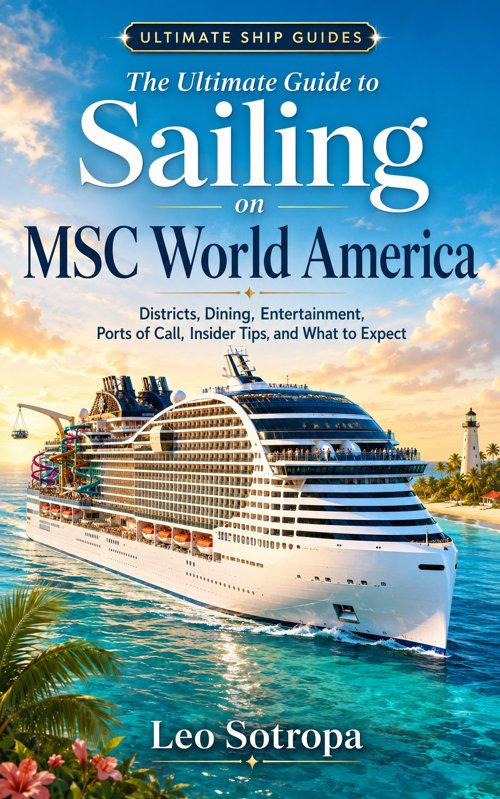
The Ultimate Guide to Sailing on MSC World America by Leo Sotropa, part of the Ultimate Ship Guides series, is an independent, ship-specific handbook available on Kindle and paperback, with clear Action Steps in every chapter so your reading turns straight into a plan. If you have a sailing booked, or you are close to booking one, it is the most useful thing you can read before you board.
Frequently asked questions
Is the book independent and unofficial?
Yes. It is an independent, unofficial handbook and is not affiliated with or endorsed by MSC Cruises. That independence is the point: it means the guide can tell you plainly which cabins to avoid, when an Experience package is worth it, and where the genuine value sits, without a marketing brochure’s obligation to make everything sound flawless.
Should I get the Kindle or the paperback?
Both contain the same material, so it comes down to how you like to read. The Kindle ebook is convenient to carry and search on your phone or tablet while you plan and while you sail. The 6×9 paperback, with its graphite chapter illustrations, is easy to flag and annotate and makes a nicer gift. Some readers keep the paperback for planning at home and the ebook for reference aboard.
Is the book up to date?
The book reflects the latest edition and focuses on the things that stay stable, the ship’s layout, the district design, the cabin trade-offs, how the MSC Experience tiers work, and how to plan the ports. Details that change often, such as exact venues, times, and prices, are left to you to confirm in the MSC for Me app for your specific sailing, which is where the current information always lives.
Does it cover this ship’s specific ports?
Yes. The ports chapter is built around MSC World America’s Caribbean itineraries out of PortMiami, including the private island Ocean Cay MSC Marine Reserve that every voyage visits, plus stops such as Puerto Plata, San Juan, Cozumel, Costa Maya, and Roatan. It gives destination guides, top excursions, and must-do shortlists, and it explains how to plan whether you are on an Eastern or a Western week.
Is it good for first-timers?
Especially so. The book assumes no prior cruising experience and walks you through every decision in order, from choosing a cabin and an Experience to planning embarkation day and the ports. First-timers tend to find it steadying rather than overwhelming, because it turns a long list of unknowns into a clear plan with Action Steps to follow.
Would it make a good gift?
It works well as a gift for anyone who has an MSC World America sailing booked. It is more thoughtful than a generic travel accessory and more personal than a gift card, because it is written about their exact ship. The paperback edition, with its chapter illustrations, is the natural choice for gifting.
Does it replace the MSC for Me app?
No, and it does not try to. The MSC for Me app is the live layer for your sailing, your schedule, deck maps, bookings, and the current venues, times, and prices. The book is the planning layer that teaches you how the ship and the booking system work, so that when you open the app you already understand what you are seeing and what to do with it. They are meant to be used together.

Meet Leo: The Heartbeat Behind ‘A Country A Month’
Journeying through the pages of A Country A Month, you might often feel the rhythm of a storyteller’s heartbeat, pulsating through each line, each image, and each adventure shared. That heartbeat belongs to none other than our remarkable website editor, Leo.
With a lens in one hand and a pen in the other, Leo seamlessly marries his passions for photography and writing. His eye captures moments that words can barely describe, yet his eloquence brings those images to life, transcending borders and connecting us all through shared stories. An avid traveler, every country he’s visited has added another chapter to his expansive tale, and through our platform, he generously shares these chapters with us.