What is Norwegian Escape, and is she the right ship for you? In short: Escape is the ship that launched Norwegian Cruise Line’s Breakaway Plus Class, one of the largest-capacity vessels in the NCL fleet, built around Freestyle Cruising and best known for her near-vertical Free Fall slides, a three-story ropes course, and the open-air Waterfront promenade. She spends a marquee season sailing Canada and New England round-trip from New York City, and she carries one of the larger solo studio complexes in the fleet. This guide walks through what she is, how Freestyle Cruising works, where she goes, what to eat, where to sleep, and who will get the most out of her.
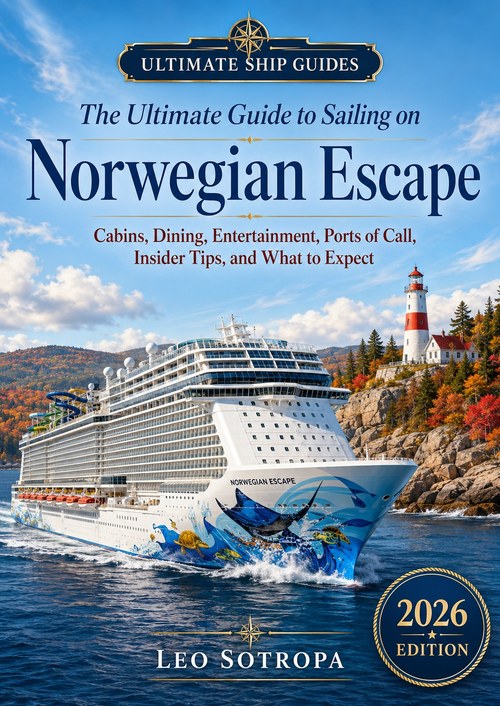
Everything in this article and far more, deck by deck, in The Ultimate Guide to Sailing on Norwegian Escape.
Get the book →What Norwegian Escape actually is
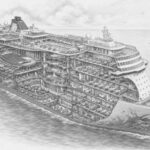
Norwegian Escape was the first of NCL’s Breakaway Plus ships, the original of a design that later produced Joy, Bliss, and Encore. She measures around 165,000 gross tons across roughly 20 decks and carries about 4,218 guests at double occupancy, more when every berth is filled. That puts her among the largest ships Norwegian operates, which matters in a practical way: more restaurants, more bars, more entertainment, and more room to spread out, but also more people to move around a port on a busy day.
Because she was the first of her class, Escape does not carry a couple of features that showed up on her younger sisters. There is no go-kart Speedway racetrack on the top deck, and no two-deck Observation Lounge wrapped in glass at the bow. If those specific features are on your must-have list, know that they arrived on later Breakaway Plus ships, not this one. What Escape does have are three signatures worth planning around: the Free Fall slides, the three-story ropes course, and the Waterfront. More on each of those below.
If you want a room-by-room walkthrough of the public spaces before you sail, the companion piece on what to expect on Norwegian Escape goes deck by deck.
Freestyle Cruising in brief
Freestyle Cruising is the core of the Norwegian experience, and it is the single biggest thing to understand before you board. There are no fixed dining times, no assigned tables, and no formal dress codes. You eat when you are hungry, where you feel like eating, and with whoever you want to sit with, across a wide range of restaurants. If you land back on the ship late and tired after a full day in Bar Harbor, you are not tied to a 6:00 seating you will miss. You simply go to dinner when you are ready.
The complimentary side of the ship includes the two main dining rooms, Savor and Taste, plus the Garden Café buffet. Beyond that sits a set of specialty restaurants that carry an extra charge or run through a dining package. Freestyle gives you freedom, but freedom works best with a little structure: at peak times, and especially on a port-heavy itinerary where everyone returns to the ship around the same hour, reservations for the specialty spots genuinely help. First-timers who want the mechanics spelled out should read the primer on first-time Norwegian Escape Freestyle.
The signature features
The Aqua Park and the Free Fall slides
The top-deck Aqua Park stacks several waterslides together. The headliner is the Free Fall, marketed as the fastest slides at sea, with a near-vertical drop that launches you down in a matter of seconds. Alongside it runs the Aqua Racer, a tube-racing slide where you can go head to head, plus a family slide, the pools, and a separate kids’ aqua park. It is a genuine draw for families and for anyone who likes a jolt of adrenaline between ports.
The three-story ropes course
Escape’s ropes course is one of the largest at sea, rising three stories with sky rails and two planks that jut straight out over the side of the ship, high above the water. Walking to the end of a plank and looking down at the sea passing below is the kind of thing you either love or firmly decline, and both are fine. It is a highlight of the top deck and worth a look even if you only watch.
The Waterfront
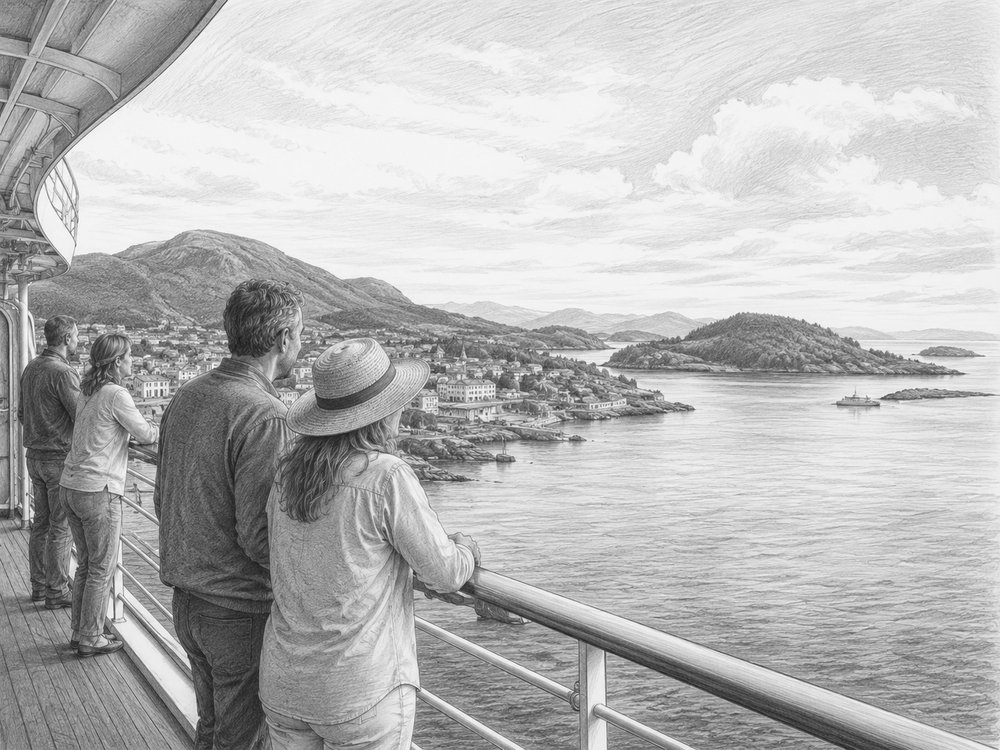
The Waterfront is a quarter-mile open-air promenade that runs along the outer edge of the ship, lined with restaurants and bars that open directly onto the sea. On a Canada and New England sailing it comes into its own: you can order a drink, step outside, and watch a Maine lighthouse or the Nova Scotia coast slide past without being sealed behind glass. It changes how the ship feels, turning the deck into a place to linger rather than just pass through.
The Haven, Spice H2O, and the shows
The Haven by Norwegian is an exclusive, keycard-only suite complex, a ship-within-a-ship with its own private courtyard, pool, sun deck, restaurant, lounge, and butler service. It was enlarged on Escape compared with earlier NCL ships, and it functions as a quiet retreat from the busier public decks. At the other end of the ship, Spice H2O is an adults-only sundeck and lounge at the stern, a calmer space for grown-ups. For entertainment, Escape runs Broadway-style musical productions, comedy including an Improv-style comedy club, a Beatles tribute act, and live music around the ship. Lineups change, so confirm the current schedule in the NCL app once you are aboard.
Where Norwegian Escape sails
The season this guide focuses on is Canada and New England, sailing round-trip from New York City. These are typically seven-night voyages through the cooler, more colorful months, including peak fall-foliage season. Escape also repositions to the Caribbean from Florida in another season, so always confirm which itinerary your specific voyage follows before you book flights or plan ports.
Ports across the various itineraries typically include Newport in Rhode Island, Boston, Portland in Maine, Bar Harbor for Acadia National Park, Saint John in New Brunswick for the Bay of Fundy, Halifax in Nova Scotia, and Sydney on Cape Breton. Exact calls vary by sailing, so treat any list as indicative and confirm your own itinerary in the app. Here is what each port is known for:
| Port | Known for |
|---|---|
| New York City (embark) | The skyline, Times Square, Central Park, the Statue of Liberty |
| Newport, RI | Gilded Age mansions of the Cliff Walk, the harbor, colonial town |
| Boston, MA | The Freedom Trail, Faneuil Hall, the harbor, nearby Cambridge |
| Portland, ME | The Old Port, lighthouses, lobster, the rocky coast |
| Bar Harbor, ME | Gateway to Acadia, Cadillac Mountain, the carriage roads |
| Saint John, NB | The Bay of Fundy’s highest tides, the Reversing Falls |
| Halifax, NS | The Citadel, the waterfront, Peggy’s Cove, Titanic history |
| Sydney / Cape Breton, NS | The Cabot Trail, Fortress of Louisbourg, the Highlands |
This is a port-intensive route with a new town or city almost every day, so pace yourself. Mix the marquee excursions, Acadia, the Bay of Fundy tides, whale-watching off New England and Nova Scotia, with relaxed town wanders where you just walk and eat. And you will eat well: this is one of the great seafood regions, with lobster rolls and clam chowder through New England and fresh seafood across the Maritimes. For a full breakdown of the route, see the deeper guide to the Norwegian Escape Canada and New England season, and if the tides and national park are your priority, the Bay of Fundy and Acadia ports guide goes deeper on those two.
A few ports reward a bit of planning. Bar Harbor is the gateway to Acadia National Park, where Cadillac Mountain and the carriage roads are the draws, and note that it is a tender port on some calls, which affects your timing ashore. Saint John puts you at the Bay of Fundy, home to the world’s highest tides, along with the Reversing Falls. Halifax stacks the Citadel, the harbor and waterfront, the famous Peggy’s Cove lighthouse, and its Titanic history into one manageable day. Sydney opens up Cape Breton, the Cabot Trail, and the Fortress of Louisbourg. Newport leans Gilded Age, with the mansions of the Cliff Walk, while Boston is walkable history along the Freedom Trail and around Faneuil Hall, and Portland is lighthouses, the Old Port, the rocky coast, and lobster. Because the ship carries thousands of guests, the best local tours book up fast, so reserve the excursions you care about well before you sail.
The fall-foliage advantage
An autumn Canada and New England voyage combines maritime history and coastal beauty with the spectacular fall colors of the Northeast, one of the great seasonal sights in North America. Foliage timing shifts from year to year and moves north to south, so nothing is guaranteed, but sailing in the season and hitting the more northerly, inland-leaning stops gives you the best chance of catching the color. The season runs cool and changeable, with mild days and cooler evenings, so pack layers and a waterproof shell. If leaf-peeping is the whole point of your trip, the guide to fall foliage in New England covers timing and tactics.
Dining across the Freestyle range
Dining is where Freestyle Cruising earns its keep, and Escape gives you a lot to work with. The complimentary options anchor the ship: Savor and Taste, the two main dining rooms, and the Garden Café buffet for casual meals and quick breakfasts. You can build an entire week around those without spending a cent beyond your fare.
The specialty restaurants carry an extra charge or run through a dining package, and they cover a lot of ground:
- Cagney’s Steakhouse for steaks and chops
- Le Bistro for classic French
- La Cucina for Italian
- Teppanyaki for Japanese hibachi cooked at your table
- Food Republic for a mix of Asian and international small plates
- Ocean Blue for seafood
On the bar side, the District Brew House pours craft beer, the Sugarcane Mojito Bar leans rum and cocktails, the Cavern Club ties into the Beatles theme with live music, and the Skyline Bar gives you a spot to settle in. A practical tip for this itinerary: because so many guests come back aboard within the same window after a full port day, the specialty restaurants and the main dining rooms fill up fast in the early evening. Booking ahead in the app, or eating slightly earlier or later than the crowd, makes the whole experience smoother.
Cabins, including the solo studios
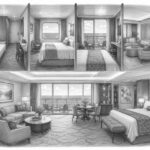
Escape offers the full spread of cabin categories: the value Inside, the solo Studios with their own Studio Lounge, Oceanview, Balcony, Club Balcony Suite, Mini-Suites, Spa cabins, and The Haven suites at the top. The one that sets Escape apart is the studio complex. These are cabins designed for one person and priced without the traditional single supplement, so solo travelers are not paying double to sail alone. They come with keycard access to a private Studio Lounge, a social hub where solo guests can meet others, grab a coffee, and plan the day. Escape carries one of the larger studio complexes in the fleet, which makes her one of the better big ships for people traveling on their own. The dedicated guide to the Norwegian Escape solo studio cabins covers how they work and whether one suits you.
For choosing among the rest, a few rules of thumb hold up. Best value is a solo Studio if you are on your own, or an Inside if you are not. Best all-round is a midship Balcony on the mid-decks, which gives you the coastal scenery this itinerary is built for plus the steadiest ride. Top of the range is The Haven. Whatever you pick, check the deck plan before you commit and try to avoid a few spots: cabins directly under the pool deck, the Garden Café, or the ropes course can be noisy, as can rooms near nightlife venues; forward high-deck rooms move the most in rough water, which matters if anyone in your party is prone to motion; and some lower-deck balconies have obstructed views.
Who Norwegian Escape suits
Escape suits families who want slides, a ropes course, and enough dining variety to keep everyone happy without a fixed-seating fight. She suits solo travelers exceptionally well, thanks to the studio complex and the Studio Lounge. She suits couples who like the idea of the Waterfront and a relaxed, no-fixed-times rhythm, and she suits anyone drawn to a scenic, port-rich itinerary rather than a sun-and-sea beach week. If your dream cruise is lying by a pool in the Caribbean for seven days, note that the Canada and New England season is a different animal: cooler, busier with ports, and built around towns and scenery rather than beaches.
She is a large ship, so she carries a lot of people, and on the busiest port days you will feel it at the gangway and in the popular restaurants. The trade-off is choice: there is almost always somewhere to eat, drink, or sit that fits your mood.
How to start planning
Start by confirming your exact voyage, since Escape sails both the Canada and New England season from New York and a Caribbean season from Florida. Once you know the itinerary, arrive in New York a day early to take the pressure off embarkation and to see a little of the city. Pack for cool, changeable weather: layers, a waterproof shell, and comfortable walking shoes, with a warmer layer for autumn sailings. This is not a beach-cruise packing list. Bring a camera, and binoculars for the whales off New England and Nova Scotia.
On board, your key card is your cashless account and your room key. Service charges and gratuities apply, Wi-Fi is a paid plan, and the NCL app runs your day, from dining reservations to the current show schedule to any changes in your ports. Excursions for the marquee experiences, Acadia, the Bay of Fundy, and whale-watching, sell out early, so book the ones you care about ahead of time rather than hoping at the pier. For currency, you will use US dollars in New York and the New England ports and Canadian dollars in Saint John, Halifax, and Cape Breton, though cards are widely accepted everywhere. Because this cruise leaves a US port and calls in Canada, US citizens can often sail with a passport or, in some cases, other approved documents, but a passport is strongly recommended and required for some travelers, so check current CBP rules. Non-US citizens should verify their own document requirements.
Plan your ports of call
Make the most of every day ashore with our in-depth port guides for the stops on this ship’s itineraries:
Get the complete Norwegian Escape playbook
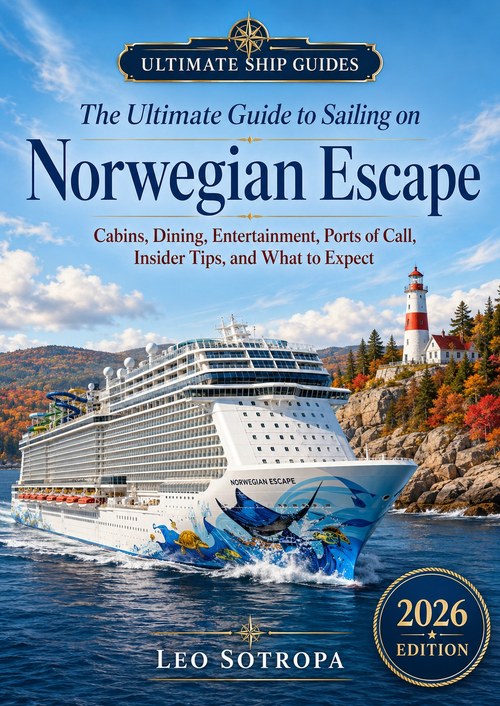
If you want every one of these decisions worked out in advance, “The Ultimate Guide to Sailing on Norwegian Escape” walks you through the ship deck by deck, port by port, and cabin by cabin. It is part of the Ultimate Ship Guides series by Leo Sotropa, with clear action steps in every chapter so you board knowing exactly what to do.
Frequently asked questions
Does Norwegian Escape have go-karts and the glass Observation Lounge?
No. As the first Breakaway Plus ship, Escape does not carry the go-kart Speedway or the two-deck Observation Lounge that appeared on later ships in the class. Her signature attractions are the Free Fall slides, the three-story ropes course, and the Waterfront promenade.
What is Freestyle Cruising?
Freestyle Cruising is Norwegian’s approach to dining and dress: no fixed dining times, no assigned tables, and no formal dress codes. You eat when, where, and with whom you like across a large range of restaurants. Complimentary options include the Savor and Taste main dining rooms and the Garden Café buffet, while many specialty restaurants carry an extra charge or run through a dining package.
Where does Norwegian Escape sail?
This guide focuses on her Canada and New England season, seven-night voyages round-trip from New York City through the cooler, colorful months. Ports often include Newport, Boston, Portland, Bar Harbor, Saint John, Halifax, and Sydney. She also repositions to the Caribbean from Florida in another season, so confirm your specific voyage in the NCL app.
Is Norwegian Escape good for solo travelers?
Yes, unusually so. Escape carries one of the larger studio complexes in the fleet, with solo cabins priced without the traditional single supplement and keycard access to a private Studio Lounge where solo guests can meet and socialize. That combination makes her one of the better large ships for traveling alone.
When is the best time to sail for fall foliage?
Autumn sailings coincide with the Northeast’s fall colors. Foliage timing varies year to year and moves north to south, so there are no guarantees, but sailing in the autumn season and calling at the more northerly, inland-leaning stops gives you the best chance of catching the peak color.
What should I pack for a Canada and New England cruise?
Pack for cool, changeable weather, often the 50s to 70s Fahrenheit by day and cooler at night, with a chance of rain and wind. Bring layers, a waterproof shell, and comfortable walking shoes, plus a warmer layer for autumn sailings. Add a camera and binoculars for whale-watching. This is not a beach-cruise packing list.
Do I need a passport for this cruise?
This cruise leaves a US port and calls in Canada, so US citizens can often sail with a passport or, in some cases, other approved documents. A passport is strongly recommended and required for some travelers, so check current CBP rules before you go. Non-US citizens should verify their own document requirements.
Ready for the whole ship in one place? It is all in The Ultimate Guide to Sailing on Norwegian Escape.
Get the book →
Meet Leo: The Heartbeat Behind ‘A Country A Month’
Journeying through the pages of A Country A Month, you might often feel the rhythm of a storyteller’s heartbeat, pulsating through each line, each image, and each adventure shared. That heartbeat belongs to none other than our remarkable website editor, Leo.
With a lens in one hand and a pen in the other, Leo seamlessly marries his passions for photography and writing. His eye captures moments that words can barely describe, yet his eloquence brings those images to life, transcending borders and connecting us all through shared stories. An avid traveler, every country he’s visited has added another chapter to his expansive tale, and through our platform, he generously shares these chapters with us.